Business Framework Recall Mastery
Value Quantification Framework
Putting a Number on Value
How do you prove a product is worth its price? You can talk about features and potential, but what decision-makers really want to see are numbers. This is where the Value Quantification Framework (VQF) comes in. It's a straightforward, four-step method to measure and communicate the tangible value your product or service delivers.
Instead of making vague promises, the VQF helps you build a clear, data-backed case that shows customers exactly what they stand to gain. It translates benefits into a language everyone understands: money.
The Four Steps
The framework breaks the process down into four manageable parts. Let's walk through them using a practical example: a company selling new inventory management software to a mid-sized retail business.
1. Identify Value Drivers
First, pinpoint the specific ways your product helps the customer. These are your value drivers. They typically fall into categories like increasing revenue, decreasing costs, or reducing risk. Don't just list features; think about the outcomes those features create for the customer's business.
For our retail software, the key value drivers might be:
• Reduced staff time spent on manual inventory counts. • Fewer stockouts, meaning more potential sales are captured. • Less capital tied up in excess inventory.
2. Quantify the Benefits
This is the most critical step: assigning a dollar value to each driver. Use concrete data from the customer, case studies, or industry benchmarks to make your calculations as accurate as possible. This turns an abstract benefit into a tangible financial gain.
Quantify the Benefits: Assign a dollar value to each benefit where possible.
| Value Driver | Calculation | Annual Benefit |
|---|---|---|
| Reduced Labor | 2 employees x 10 hrs/wk x $20/hr x 52 wks | $20,800 |
| Increased Sales | 5% reduction in stockouts on $1M annual revenue | $50,000 |
| Lower Carrying Costs | 10% reduction in $200k average inventory | $20,000 |
By adding these up, the total quantified benefit of the software is $90,800 per year.
3. Calculate the Costs
Next, be transparent about the customer's investment. This isn't just the sticker price. It includes all direct and indirect costs associated with adopting your solution, such as one-time setup fees, annual subscription costs, and the cost of employee time for training.
For our example, let's say the total first-year cost is: • Software subscription: $15,000 • Implementation & training: $5,000
The total cost for the first year is $20,000.
4. Determine Net Value
Finally, subtract the total costs from the total benefits to arrive at the net value. This simple calculation gives you a powerful number that summarizes the financial impact of your solution for the customer.
Using our example:
Net Value = $90,800 (Benefits) - $20,000 (Costs) = $70,800
You can now confidently tell the customer that your software will deliver a net value of $70,800 in the first year alone. This is far more compelling than simply listing features.
Why It Matters
The Value Quantification Framework is essential in sales, product marketing, and customer success. It helps you justify pricing, create powerful marketing messages, and prove ROI to existing customers. By focusing on measurable value, you shift the conversation from cost to investment.
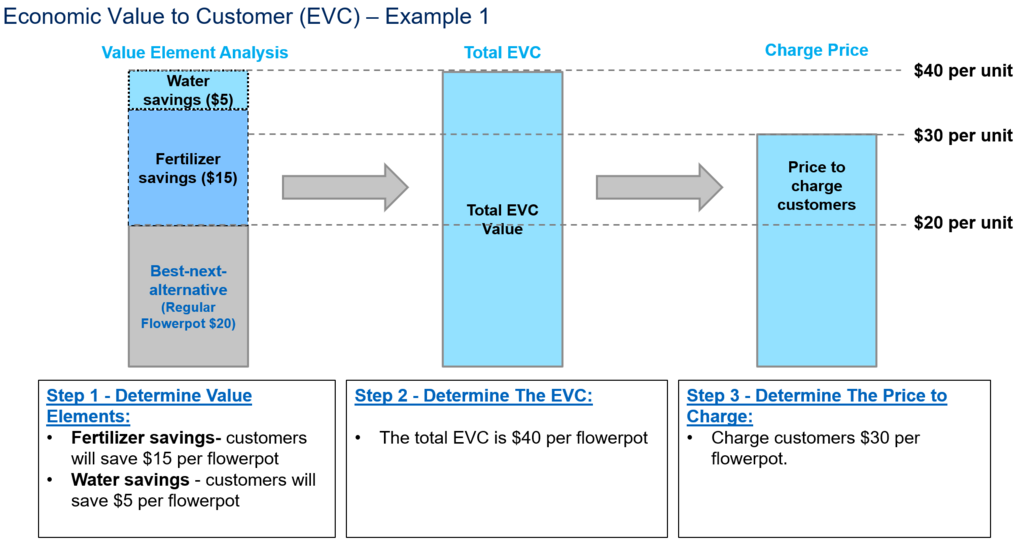
This structured approach removes guesswork and builds trust. When you can clearly demonstrate how your product improves a customer's bottom line, you provide a compelling reason for them to choose you.
What is the primary purpose of the Value Quantification Framework (VQF)?
In the VQF, which of the following is the best example of a 'value driver' for a new CRM software?
Using a framework like the VQF helps you move beyond just selling a product and instead sell a quantifiable outcome.