Business Essentials Fundamentals
Introduction to Business Operations
What Are Business Operations?
Think of a business as a complex machine. It has many moving parts, all working together to create something of value. Business operations are the systems and processes that make the machine run. They are the day-to-day activities that a company engages in to turn raw materials, labor, and information into goods and services for customers.
Without effective operations, even the best business idea will fail. A brilliant new smartphone is useless if the factory can't build it correctly. A revolutionary software application won't succeed if the servers constantly crash. Operations are the engine that powers the business, ensuring that products are made, services are delivered, and customers are satisfied.
Operations
noun
The set of business activities that create value by transforming inputs into outputs, such as finished goods or services.
In short, operations are how a business delivers on its promises.
The Engine of Success
The primary role of operations is to manage the process of creation. This involves overseeing everything from the supply chain that brings in raw materials to the manufacturing floor that assembles the product, and finally to the logistics that deliver it to the customer. The goal is to do all of this efficiently and effectively.
Efficiency means doing things with the least amount of waste—minimizing costs, time, and effort. Effectiveness means doing the right things to create value for the customer—ensuring quality, reliability, and satisfaction.
A business that excels at operations can produce higher quality products at a lower cost than its competitors. This provides a significant competitive advantage. It's the difference between a smoothly running engine and one that sputters and stalls.
How the Pieces Fit Together
Business operations don't exist in a silo. They are deeply interconnected with every other part of the company. This network of activities is often visualized using a model called the Value Chain, which separates a company's activities into primary and support functions.
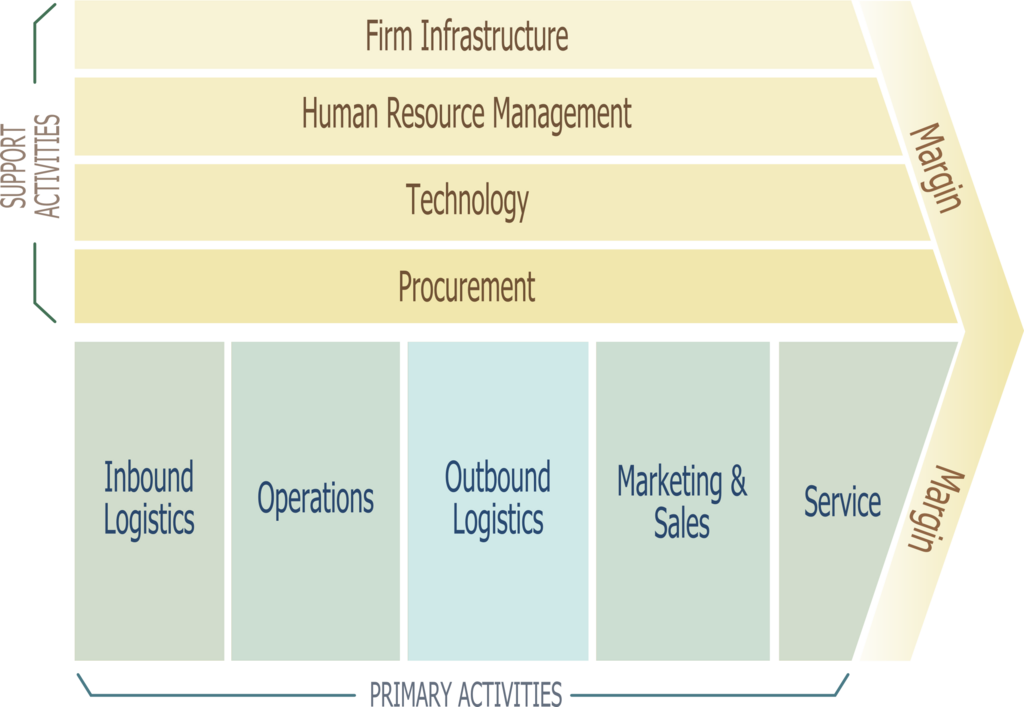
Let's see how these connections work in practice:
-
Marketing & Sales: Marketing creates demand for a product, and sales makes promises to customers. Operations must be able to fulfill that demand and meet those promises. If marketing launches a huge promotion, operations needs to be ready to ramp up production.
-
Finance: The finance department allocates a budget for resources like machinery and raw materials. Operations must work within this budget to produce goods and services. In turn, efficient operations help increase the company's profitability, which is finance's primary concern.
-
Human Resources: HR is responsible for hiring, training, and managing the people who perform the operational tasks. A well-run operations team depends on having skilled and motivated employees.
-
Technology Development: This department designs the products and improves the processes. They work closely with operations to ensure new product designs are manufacturable and to implement new technologies that can make production more efficient.
When all these functions are aligned and communicating well, the business runs smoothly. When they are not, problems quickly arise. Imagine the sales team promising a feature that the operations team can't actually build. The result is wasted resources and unhappy customers.
Understanding these fundamental relationships is the first step to seeing a business not as a collection of separate departments, but as a single, integrated system designed to create value.