Business Computer Networking Essentials
Network Types
Networks Big and Small
Not all computer networks are the same. They come in different sizes and serve different purposes, much like roads. Some are small local streets, while others are massive highways spanning the globe. The size of a network is often defined by the geographical area it covers.
Close Connections: LANs
The most common type of network you'll encounter is a Local Area Network, or LAN. A LAN connects devices within a limited area, like a single office building, a school campus, or your home. Think of it as a private, local web of computers, printers, and other devices that can all talk to each other directly.
Because the distances are short, communication on a LAN is very fast and reliable. This makes it perfect for sharing resources. Instead of buying a printer for every employee, a business can connect one printer to the LAN for everyone to use. The same goes for sharing files stored on a central server.
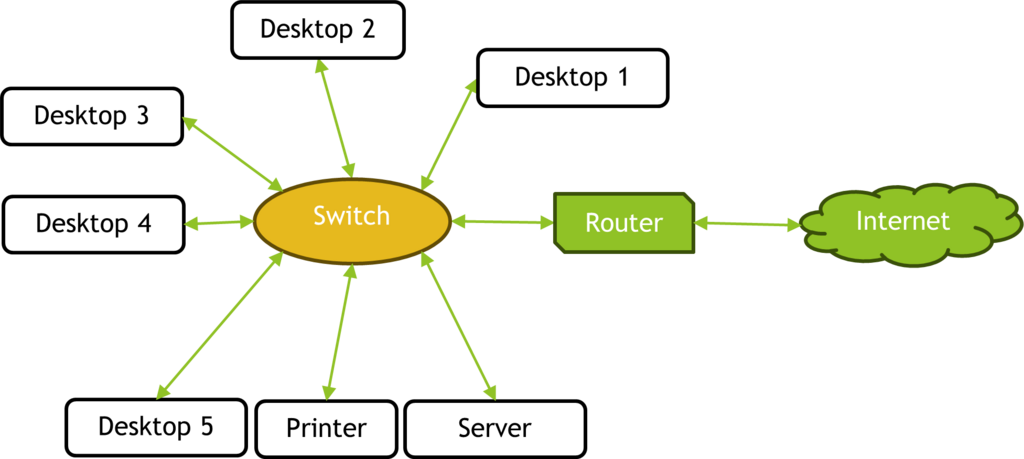
In a LAN, devices are close enough to be connected by physical cables (like Ethernet) or short-range wireless signals. This creates a self-contained and high-speed environment.
A close cousin to the LAN is the WLAN, or Wireless Local Area Network. It's functionally the same as a LAN, but it uses radio waves instead of cables to connect devices. The technology that makes this possible is commonly known as Wi-Fi.
WLANs offer incredible flexibility. You can connect your laptop, phone, or tablet to the network without being tied to a desk. This mobility is why you find WLANs everywhere, from coffee shops and airports to modern offices and homes.
The Shape of a Network
The way devices are physically or logically arranged in a LAN is called its topology. It's like the layout of a neighborhood. Different layouts have different strengths. For instance, in a star topology, all devices connect to a central hub. It's easy to add new devices, but if the hub fails, the whole network goes down.
In a bus topology, all devices share a single communication line. It's simple and cheap to set up, but a break in the main cable can disrupt everyone. A ring topology connects devices in a circle, with data passing from one to the next.
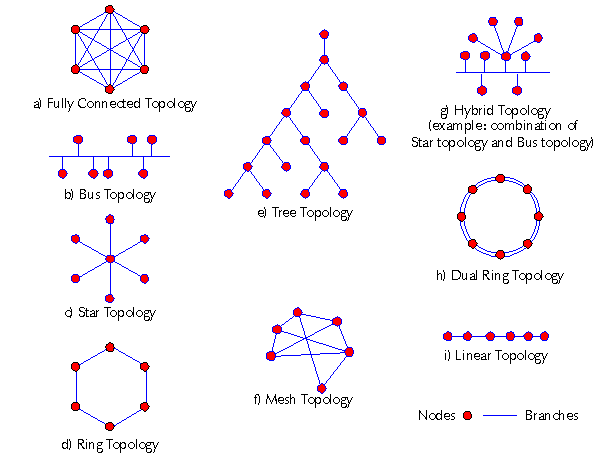
Most modern LANs use a star or hybrid topology because it's reliable and easy to manage. The choice of topology affects a network's cost, performance, and how difficult it is to troubleshoot problems.
Going Global: WANs
When you need to connect networks over a large geographical area, you use a Wide Area Network, or WAN. A WAN isn't a single network but a collection of interconnected LANs. It can link an office in New York with another in London, or connect thousands of LANs all over the world.
Because WANs span long distances, they typically rely on infrastructure provided by telecommunications companies, like fiber optic cables, satellite links, or phone lines. This makes them slower and more expensive to operate than LANs.
The most famous example of a WAN is the internet itself. It's a massive, global network of networks.
A business might use a private WAN to securely connect its various branches. This allows employees in different cities to access the same company-wide resources, applications, and data as if they were all in the same building.
| Network Type | Area Covered | Speed | Example Use Case |
|---|---|---|---|
| LAN | Small (office, home) | Very Fast | Sharing a printer in an office. |
| WLAN | Small (office, home) | Fast | Connecting laptops to Wi-Fi at a café. |
| WAN | Large (cities, countries) | Slower | Connecting a company's branch offices. |
Time to check your understanding of these network types.
Which of the following best describes a Local Area Network (LAN)?
A company wants to connect its office in New York with its office in London, allowing them to share internal resources. Which type of network would be most appropriate for this task?