Business Analytics for Capstone Projects
Introduction to Business Analytics
What is Business Analytics?
Business analytics is the process of using data to make smarter decisions. Instead of relying on gut feelings, companies use analytics to understand past performance, predict future outcomes, and figure out the best course of action. It transforms raw data into valuable insights that can guide strategy and improve results.
Think of it as a conversation with your data. You ask questions, and the data provides answers. This process is generally broken down into three main types, each answering a different kind of question.
The Three Types of Analytics
Analytics isn't a single activity but a spectrum of approaches. These approaches build on one another, moving from understanding the past to shaping the future.
| Type | Question Answered | Example |
|---|---|---|
| Descriptive | What happened? | A sales report showing total revenue by region for the last quarter. |
| Predictive | What will happen? | A forecast predicting which customers are most likely to stop using a service. |
| Prescriptive | What should we do? | A system that recommends the optimal price for a product to maximize profit. |
Descriptive analytics is the most common form. It summarizes historical data to give you a clear picture of what has already occurred. It's like looking in the rearview mirror to understand the road you've just traveled. This includes things like dashboards and reports that track key business metrics.
Predictive analytics goes a step further. It uses historical data, statistical algorithms, and machine learning techniques to identify the likelihood of future outcomes. It’s about looking ahead to anticipate trends and behaviors.
Prescriptive analytics is the most advanced stage. It doesn't just predict what will happen; it recommends actions you can take to affect those outcomes. Think of it as a GPS for your business. It analyzes the data and suggests the best route to your destination, optimizing for factors like time, cost, or customer satisfaction.
Business analytics is fundamentally a three-step process: descriptive (what happened), predictive (what will happen), and prescriptive (what should be done)
How Analytics Works
To perform these types of analysis, businesses rely on a few core technologies and methods to manage and interpret data effectively.
Data Mining
noun
The practice of examining large pre-existing databases in order to generate new information.
Data mining is about discovering hidden patterns and valuable information from large datasets. It’s like being a detective, sifting through clues to find connections that aren't obvious at first glance.
But where does all this data live? That's where a data warehouse comes in. It's a central repository where a company consolidates data from various sources. Information from sales, marketing, finance, and operations all gets organized in one place, creating a single source of truth for analysis.
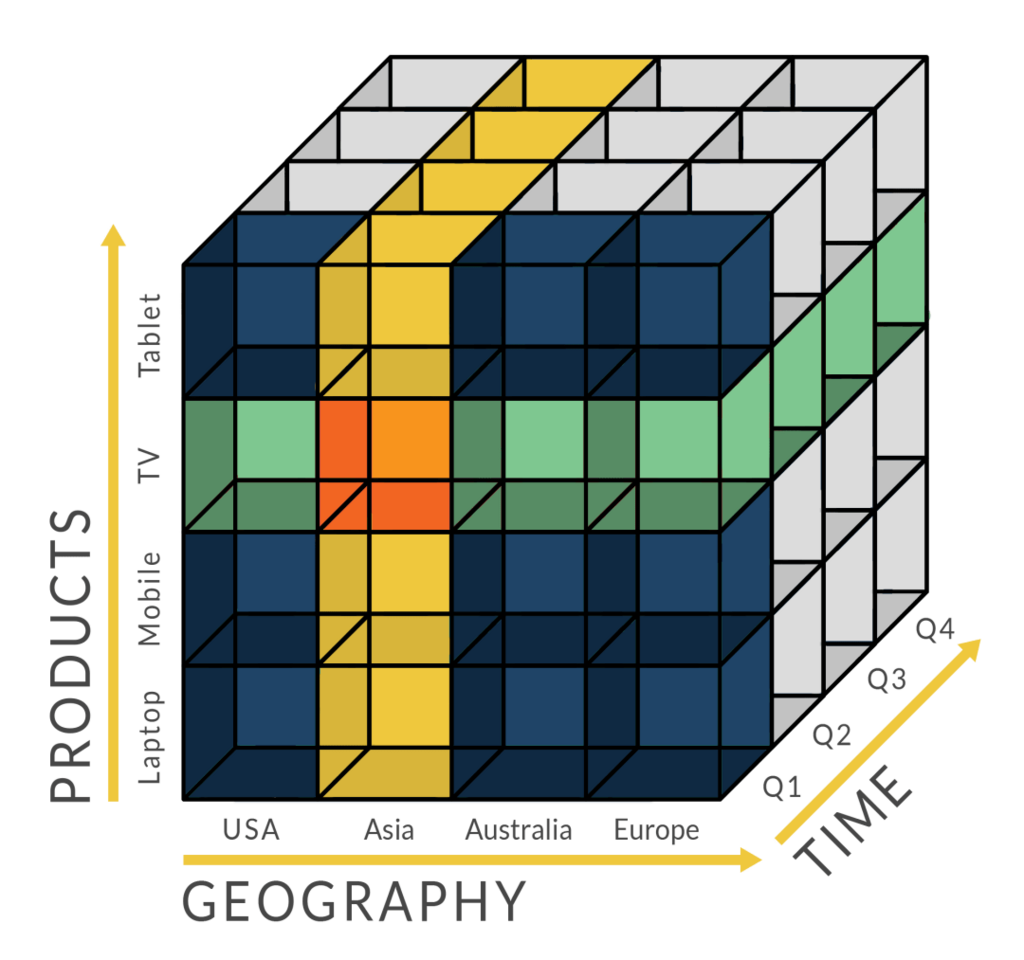
Once data is in the warehouse, analysts need a way to explore it. Online Analytical Processing (OLAP) is a technology that allows for the rapid, interactive analysis of data from multiple perspectives, or dimensions. Think of an OLAP cube as a data Rubik's Cube. You can slice, dice, and pivot the data to view it by product, region, and time period, all at once.
Measuring What Matters
Analytics is only useful if it helps you achieve your goals. To track progress, businesses use Key Performance Indicators (KPIs). A KPI is a measurable value that demonstrates how effectively a company is achieving its key business objectives. They focus on what's most important.
A KPI is not just any metric. It's a key metric tied directly to a strategic business goal. For example, 'website visitors' is a metric, but 'conversion rate' (the percentage of visitors who make a purchase) is a KPI if your goal is to increase online sales.
Choosing the right KPIs is critical. A marketing team might track 'cost per lead' to measure the efficiency of their campaigns. An e-commerce store would monitor 'average order value' to understand customer purchasing habits. Good KPIs are specific, measurable, and directly relevant to the success of the business.
Now that you understand the key concepts, let's test your knowledge.
What is the primary goal of business analytics?
A shipping company uses historical data on traffic, weather, and delivery times to suggest the most efficient routes for its drivers in real-time. Which type of analytics is being used?
Understanding these foundational elements of business analytics is the first step toward using data to drive real-world results.