Bulgarian Statehood and National Unification
Emergence of the Bulgarian National Question
A People Awakens
For centuries, the Ottoman Empire organized its non-Muslim subjects into communities called millets. These were based on religion, not ethnicity. As Orthodox Christians, Bulgarians belonged to the Rum Millet, governed by the Greek-speaking Ecumenical Patriarchate in Constantinople. This system effectively submerged a distinct Bulgarian identity under a broader Hellenic, or Greek, cultural and religious umbrella.
But starting in the 18th century, and gaining momentum in the 19th, a profound change began. This period, known as the Bulgarian National Revival, was a cultural and intellectual reawakening. It began not with armies, but with books, schools, and a renewed sense of history.
A pivotal moment came in 1762 when a monk named Paisii Hilendarski wrote Istoriya Slavyanobolgarskaya (Slavo-Bulgarian History). It wasn't just a history book; it was a passionate call for Bulgarians to remember their glorious past of powerful tsars and distinct culture. Paisii's work, copied by hand and circulated in secret, reminded a people of who they were and why they should be proud.
Language, Schools, and the Church
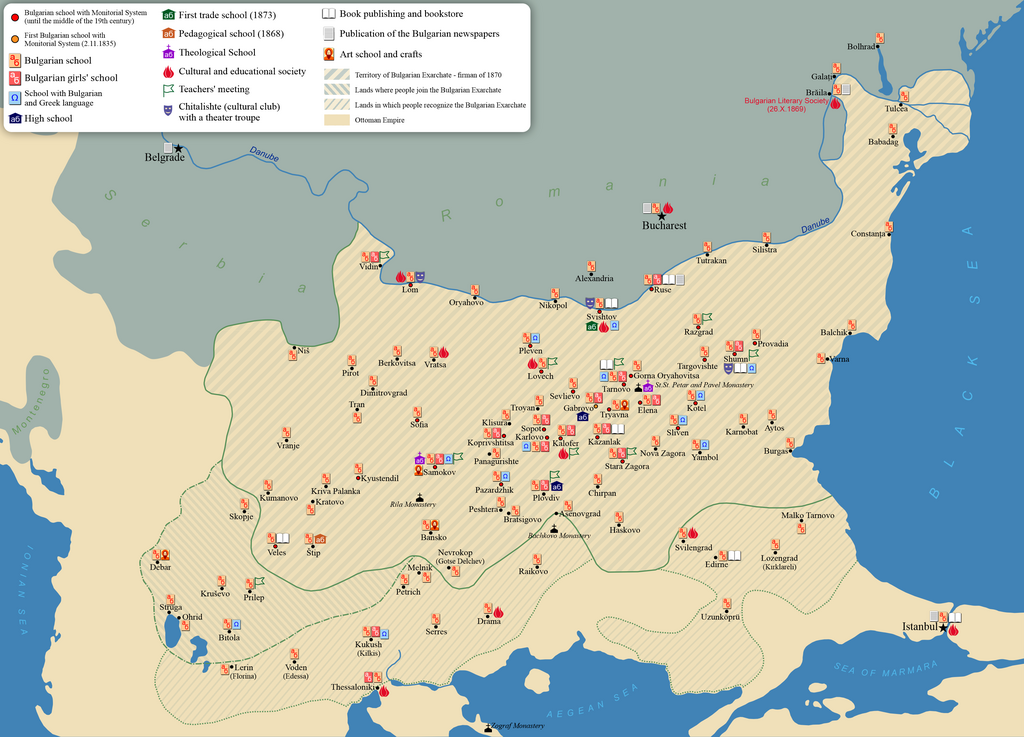
The revival blossomed through education. The first Bulgarian secular school opened in Gabrovo in 1835, funded by the merchant Vasil Aprilov. It marked a crucial shift. Instead of only religious instruction in Greek, this new school taught various subjects in the Bulgarian language. Soon, a network of similar schools, along with community reading rooms called chitalishta, sprang up across Bulgarian lands. These became the incubators of national consciousness.
Chitalishte
noun
A public cultural institution in Bulgaria that functions as a library, theater, and community center. They were crucial to the National Revival.
The struggle for cultural autonomy soon turned into a fight for religious independence. Bulgarians demanded their own church, separate from the Greek Patriarchate, which they felt promoted Hellenic interests over their own. The campaign was long and peaceful, waged with petitions and diplomacy rather than weapons. It was a national movement for recognition.
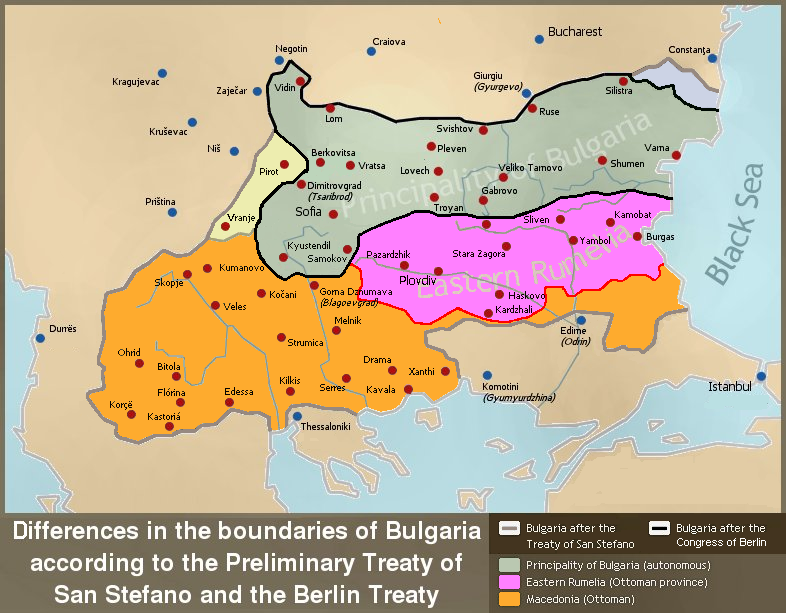
Success came in 1870, when the Ottoman Sultan issued a firman, or decree, establishing the Bulgarian Exarchate. This autonomous national church was a monumental victory. For the first time in centuries, Bulgarians had an official institution that represented them as a distinct people within the Ottoman Empire. The Exarchate's territory, defined by the will of the local population, effectively drew the first modern map of the Bulgarian nation.
Echoes of Revolution
Ideas sweeping across Europe did not stop at the Ottoman borders. The ideals of liberty, equality, and fraternity from the French Revolution, along with the successful independence struggles of nearby Serbs and Greeks, inspired Bulgarian thinkers and revolutionaries. They began to imagine not just cultural autonomy, but political freedom.
Figures like Georgi Rakovski were among the first to organize revolutionary groups. But it was Vasil Levski, known as the "Apostle of Freedom," who envisioned a new path. He traveled tirelessly through Bulgarian lands, creating a network of secret committees. His goal was a "pure and sacred republic" where all citizens, regardless of ethnicity or religion, would be equal before the law.
Levski's vision was radical: a democratic republic, not just an independent state. He argued that freedom had to be won by the Bulgarians themselves, not granted by foreign powers.
Levski’s capture and execution by Ottoman authorities in 1873 was a devastating blow, but his ideas lived on. Other revolutionaries, like the poet-rebel Hristo Botev, continued the struggle. Botev believed that national liberation required total sacrifice, a sentiment he expressed powerfully in his poetry and his actions. These early resistance movements, though often ending in failure, laid the ideological groundwork for future uprisings and eventual independence.
The Bulgarian National Question had been born. It was a complex blend of cultural pride, religious identity, and a modern desire for political self-determination. The journey from a forgotten community within a vast empire to a nation demanding its place on the map was now fully underway.
Ready to test your knowledge?
Under the Ottoman millet system, how were non-Muslim communities like the Bulgarians primarily organized?
What was the primary significance of Paisii Hilendarski's 1762 book, Istoriya Slavyanobolgarskaya?