Building the B-2 Spirit
Introduction to Aircraft Design
The Four Forces of Flight
For an object to fly, it must overcome its own weight. This is the fundamental challenge of aviation. Flight is a constant balancing act between four competing forces: lift, weight, thrust, and drag. Think of it as a tug-of-war in two different directions at once. To fly straight and level, lift must equal weight, and thrust must equal drag.
Here’s a quick breakdown:
- Lift is the upward force created by the wings. Wings have a special curved shape called an airfoil. As air flows over the wing, it travels faster over the curved top surface than the flatter bottom one. This creates lower pressure on top and higher pressure below, pushing the wing—and the entire plane—up.
- Weight is the force of gravity pulling the aircraft down. Lift must be greater than or equal to weight for the plane to stay in the air.
- Thrust is the forward force produced by the engines (propellers or jets). It pushes the aircraft through the air.
- Drag is the resistance of the air pushing back against the aircraft as it moves. It’s a form of friction that slows the plane down. Thrust must overcome drag to move forward.
Anatomy of an Airplane
Most aircraft you see share a similar basic structure. Each part has a specific job to do in managing the four forces and controlling the plane's movement.
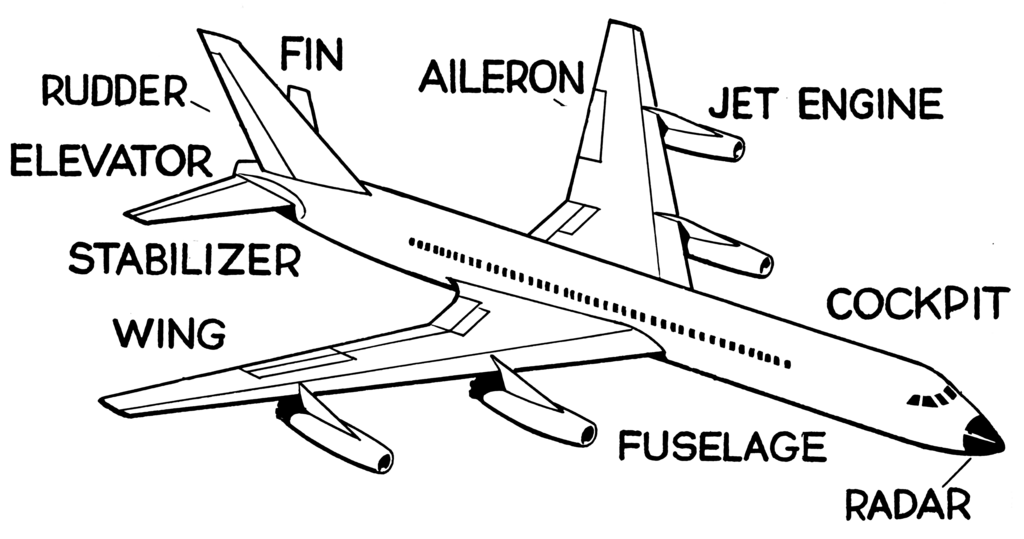
The main body is the fuselage, where passengers, cargo, and the cockpit are located. Attached to the fuselage are the wings, which are the primary source of lift.
At the back is the tail assembly, or empennage. It provides stability, keeping the plane from tumbling through the air. The vertical part is the fin, and the horizontal parts are the stabilizers. These surfaces prevent the plane's nose from swinging side-to-side (yaw) or pitching up and down (pitch) uncontrollably.
To actually steer the aircraft, pilots use movable sections on the wings and tail called control surfaces. Ailerons on the wings roll the plane left or right. The elevator on the horizontal stabilizer pitches the nose up or down. The rudder on the fin yaws the nose left or right.
Rethinking the Design
But does a plane need a distinct fuselage and tail? Not necessarily. Every component that sticks out into the airflow creates drag. For decades, designers dreamed of an aircraft that was almost all wing.
This concept is known as a flying wing.
A flying wing is an aircraft that integrates the fuselage, engines, and sometimes even the tail into a single, sleek wing structure. By eliminating the tail and the conventional tube-like body, a flying wing dramatically reduces drag. Less drag means the engines don't have to work as hard, which can lead to greater fuel efficiency and longer range.
However, this design presents a huge challenge: stability. Without a tail, a flying wing is naturally unstable. The very features that give a conventional plane its steady flight path are gone. Controlling a pure flying wing requires complex calculations and constant, tiny adjustments to its control surfaces, a task often handled by advanced computer systems.
The concept isn't new. Aviation pioneers tinkered with flying wing designs in the early 20th century. While the idea is simple on paper, making it a practical reality took decades of advances in materials, aerodynamics, and flight control technology. These aircraft represent a fascinating trade-off, sacrificing natural stability for a huge gain in aerodynamic efficiency.
For an aircraft to maintain a constant altitude and speed (straight and level flight), which of the following conditions must be met?
Which part of the aircraft is primarily responsible for providing stability and preventing the nose from swinging side-to-side (yaw)?
This look at the basics of flight and aircraft structure sets the stage for understanding more advanced and unconventional designs.