Building Retrieval-Augmented Generation Systems
Introduction to RAG
Beyond the Training Data
Large language models, or LLMs, can feel like magic. You ask a question, and they generate a remarkably human-like answer. This ability comes from being trained on vast amounts of text and data from the internet. But this training has a fundamental limitation: it’s a snapshot in time. An LLM's knowledge is frozen on the day its training was completed.
This means an LLM doesn't know about events that happened yesterday. It can't access private company documents or the latest medical research. This leads to a few problems. Sometimes, the model gives answers that are confidently wrong, a phenomenon often called “hallucination.” Other times, its information is simply out of date.
So how can we give these powerful models access to current, specific, or private information without constantly retraining them? The answer is a technique called Retrieval-Augmented Generation, or RAG.
RAG connects an LLM to external knowledge sources, allowing it to pull in real-time information to answer questions accurately.
Instead of relying only on its stored, static knowledge, a RAG system first retrieves relevant information from a designated source, like a company's internal wiki, a database of news articles, or a collection of legal documents. Then, it uses this freshly retrieved context to generate its answer. It’s like an open-book exam for the AI.
How RAG Works
The process is straightforward. It turns a simple user query into a two-step process that combines the best of search technology with the best of generative AI.
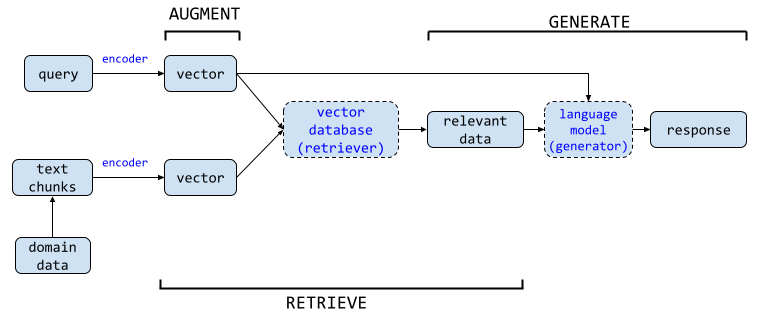
Here’s a breakdown of the basic architecture:
-
The User Query: It all starts with a user asking a question, like "What were our company's sales figures for the last quarter?"
-
The Retriever: Instead of going straight to the LLM, the system first searches a specific knowledge base. This could be a collection of internal company reports. The retriever's job is to find the most relevant snippets of text that could answer the user's question.
-
Augmented Prompt: The original query and the retrieved information are combined into a new, richer prompt. It might look something like this: "Based on the following text: [insert relevant text from last quarter's sales report], what were our company's sales figures for the last quarter?"
-
The Generator (LLM): This augmented prompt is then fed to the LLM. With the exact information it needs right in front of it, the model can now generate a precise and factual answer. It's no longer guessing based on old data; it's summarizing the provided facts.
Retrieval-Augmented Generation (RAG) is an AI framework that connects a language model to an external knowledge repository, allowing the model to fetch and include relevant information when generating an answer.
The Benefits of RAG
This approach brings several powerful advantages. The most obvious is accuracy. By grounding the LLM's response in specific, verifiable documents, RAG drastically reduces hallucinations and ensures the information is up-to-date. If a document in the knowledge base is updated, the RAG system will immediately use the new information.
It also provides transparency. Most RAG systems can cite their sources, showing the user exactly which document the answer came from. This builds trust and allows for fact-checking.
Finally, it's efficient. Constantly retraining an LLM on new data is computationally expensive and slow. RAG allows developers to update the model's knowledge simply by adding new documents to the knowledge base, a much faster and cheaper process.
Ready to check your understanding of these core concepts?
What is the primary problem with large language models (LLMs) that Retrieval-Augmented Generation (RAG) is designed to solve?
In the RAG process, what happens immediately after the system retrieves relevant information from a knowledge base?
By bridging the gap between an LLM's static training and the dynamic, ever-changing world of information, RAG makes AI more reliable, trustworthy, and useful for real-world applications.