Building Artificial Intelligence
Introduction to Artificial Intelligence
What Is Artificial Intelligence?
At its core, artificial intelligence is the science of making machines that can think like humans. It's a broad field in computer science focused on creating systems that can perform tasks that typically require human intelligence. This includes things like learning from experience, solving problems, understanding language, and recognizing objects.
Artificial Intelligence
noun
The theory and development of computer systems able to perform tasks that normally require human intelligence, such as visual perception, speech recognition, decision-making, and translation between languages.
The idea isn't new. Philosophers have long imagined creating artificial beings. But the modern field of AI truly began in the summer of 1956 at a workshop at Dartmouth College. A small group of scientists gathered to discuss the possibility of creating machines that could reason and be creative. They coined the term "artificial intelligence" and laid the groundwork for the decades of research that followed.
The Three Types of AI
AI is often discussed as a single concept, but it's helpful to break it down into three stages or types. These categories describe the AI's capabilities, from highly specialized to vastly superhuman.
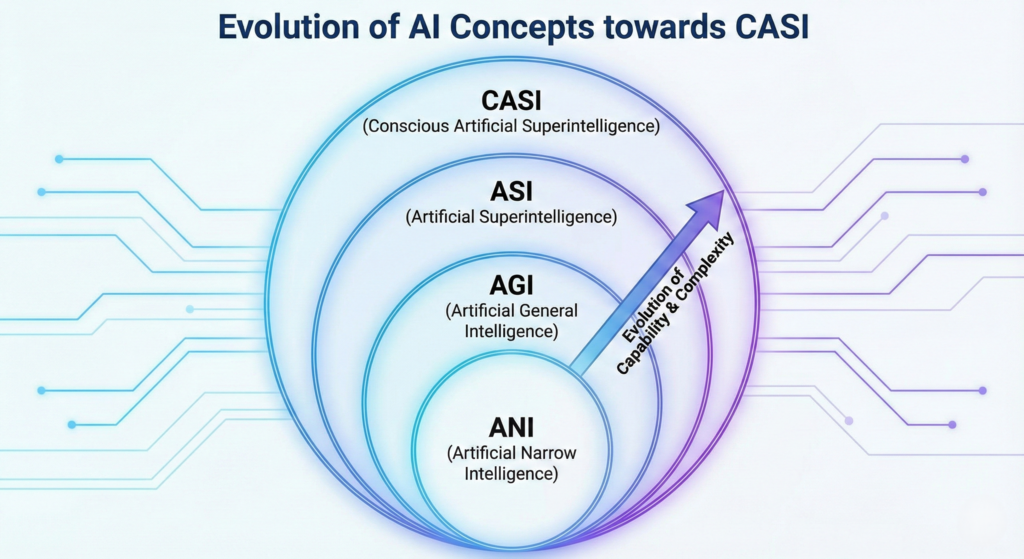
Artificial Narrow Intelligence (ANI) is the only type of AI we have successfully created so far. It's designed to perform a single, specific task. Your spam filter, a chess-playing computer, and the voice assistant on your phone are all examples of ANI. They can be incredibly good at what they do, but they can't operate outside their pre-defined functions.
Artificial General Intelligence (AGI) is the next step. This is a hypothetical AI with the ability to understand, learn, and apply its intelligence to solve any problem, much like a human being. An AGI could switch between writing a poem, navigating an unfamiliar city, and conducting scientific research without being specifically trained for each task.
Artificial Superintelligence (ASI) is the final, most speculative stage. An ASI would be an intellect that is much smarter than the best human brains in practically every field, including scientific creativity, general wisdom, and social skills. The concept of ASI raises profound questions about humanity's future.
| Type | Capability | Example |
|---|---|---|
| Narrow (ANI) | Performs a specific task | Spam filters, voice assistants |
| General (AGI) | Human-like problem-solving | (Still hypothetical) |
| Super (ASI) | Surpasses human intelligence | (Still hypothetical) |
AI in the Real World
While AGI and ASI remain in the realm of science fiction, narrow AI is already all around us. It powers many of the technologies we use every day and drives innovation across various industries.
In entertainment, AI curates your experience. Streaming services like Netflix and Spotify use AI algorithms to analyze your viewing and listening habits, then recommend new content you might enjoy.
In finance, AI is a silent guardian. Banks use it to detect fraudulent transactions in real time, flagging suspicious activity that deviates from your normal spending patterns. It also helps in algorithmic trading and assessing loan risks.
Healthcare is being transformed by AI. Machine learning models can analyze medical images like X-rays and MRIs to spot signs of disease, sometimes with greater accuracy than human radiologists. It's also used to predict patient outcomes and personalize treatment plans.
Even your daily commute is likely influenced by AI. Navigation apps like Google Maps use AI to analyze real-time traffic data, predict congestion, and suggest the fastest routes.
The applications are expanding constantly, from optimizing supply chains in retail to improving crop yields in agriculture. AI is a versatile tool that is fundamentally changing how we solve problems and interact with technology.
Busting Common Myths
With any transformative technology, misunderstandings are common. Let's clear up a few myths about AI.
Myth 1: AI is about conscious, thinking robots. Many people imagine AI as sentient beings like those in movies. The reality is that current AI systems are not conscious or self-aware. They are complex mathematical models that process data and make predictions based on patterns. They don't have feelings, desires, or intentions.
Myth 2: AI is always objective and unbiased. AI systems learn from the data they are given. If that data reflects existing human biases, the AI will learn and even amplify those biases. For example, if a hiring algorithm is trained on historical data where men were predominantly hired for a certain role, it may unfairly favor male candidates. Creating fair and ethical AI is one of the biggest challenges in the field.
Myth 3: AI will take all our jobs. AI will certainly change the job market, automating some tasks and creating new roles that we can't yet imagine. Historically, technological revolutions have shifted the types of jobs available rather than causing mass, permanent unemployment. The focus is likely to shift towards skills that complement AI, such as creativity, critical thinking, and emotional intelligence.
Understanding AI means seeing it for what it is: a powerful tool created by humans. It's not magic, and it's not a sentient being. It's a technology with incredible potential and real limitations.
What is the primary characteristic of Artificial Narrow Intelligence (ANI), the only type of AI currently in existence?
The term "artificial intelligence" was first coined at a scientific workshop in 1956. Where did this event take place?