Building AI Products
AI Product Lifecycle
The AI Product Journey
Creating an AI product isn't a simple, straight-line process. It’s a cycle. You don't just build it, launch it, and walk away. Instead, you create, release, learn, and improve, over and over again. This structured path ensures that an AI product not only works but also continues to deliver value long after its initial release.
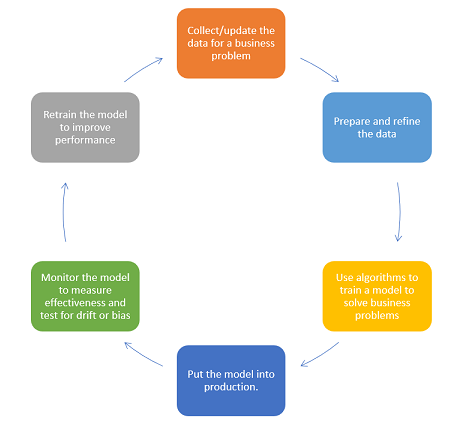
Each stage in this cycle has a distinct purpose, building on the one before it. Skipping a step or rushing through it can lead to a product that fails to solve the intended problem or, worse, creates new ones. Let's walk through the key phases of this journey.
From Idea to Data
Everything starts with an idea. The ideation phase is all about identifying a meaningful problem that AI can help solve. It’s not about technology for technology's sake. The goal is to define a clear, specific objective. What business problem are we trying to solve? How will an AI-powered solution make things better for the user?
Once a solid goal is established, the focus shifts to the most critical ingredient for any AI system: data. During the data collection phase, teams gather the raw information the model will learn from. This could be anything from customer reviews and sales figures to medical images or sensor readings. The quality and relevance of this data are paramount. An AI model is only as good as the data it's trained on.
Raw data is often messy, inconsistent, or incomplete. That's why data preparation is crucial. This step involves cleaning the data, correcting errors, and formatting it in a way the model can understand. It’s like preparing ingredients before you start cooking—it’s a lot of work, but essential for a good result.
Building and Refining the Model
With clean data ready, it's time for model development. This is where the core AI
AI in product management refers to the use of machine learning, natural language processing, and data analytics to automate, optimize, and enhance various aspects of the product lifecycle.
brain" is built and trained. Data scientists select an appropriate algorithm and feed it the prepared data, allowing the model to learn patterns, relationships, and rules. This training process is like teaching a student a new subject by showing them thousands of examples.
After the initial training, the model enters the testing phase. It’s not enough for the model to perform well on the data it has already seen. It must also prove it can make accurate predictions on new, unseen data. This stage is like a final exam. Teams evaluate the model's performance, checking for accuracy, fairness, and reliability to ensure it behaves as expected.
Into the Wild
Once a model has passed its tests, it's ready for deployment. This means integrating the AI into a real-world application or business process where it can start delivering value. This could be a recommendation engine on a shopping website, a fraud detection system at a bank, or a predictive maintenance tool in a factory.
But the work doesn't stop at deployment. The world is constantly changing, and so is the data. The final stage, continuous monitoring, is an ongoing process of observing the AI's performance in its live environment. Is it still accurate? Is it developing any biases? Is it meeting the original business goals?
This monitoring provides feedback that fuels the iterative nature of AI development. If performance degrades or new data becomes available, the cycle begins again. The model might be retrained with fresh data or even replaced entirely with a better one. This ensures the AI product remains effective, relevant, and trustworthy over time.
What is the primary goal of the ideation phase in the AI product lifecycle?
The principle "an AI model is only as good as the data it's trained on" highlights the critical importance of which two connected phases?