Building Academic Foundations
Algebra I
The Language of Algebra
Algebra extends the rules of arithmetic by using symbols, usually letters, to represent unknown numbers. This lets us build general rules and solve problems where we don't have all the information up front.
The basic building blocks are variables and expressions. A variable is a placeholder for a value that can change, while an expression is a combination of numbers, variables, and operations.
variable
noun
A symbol, typically a letter, that represents an unknown numerical value.
For example, if you buy some apples for $1.50 each and a bag for $2, the expression $1.50a + 2$ represents your total cost. Here, 'a' is the variable for the number of apples. The expression itself doesn't equal anything yet; it just describes a calculation.
Solving for the Unknown
When we set an expression equal to a specific value, we create an equation. The goal then becomes finding the value of the variable that makes the statement true. The simplest type is a linear equation.
To solve this, we isolate the variable. We use inverse operations to undo what's been done to . First, add 7 to both sides to cancel out the subtraction. Then, divide both sides by 3 to undo the multiplication.
which simplifies to .
which gives us .
Sometimes, instead of a precise answer, we're interested in a range of possible values. This is where inequalities come in.
We solve inequalities much like equations. Subtract 5 from both sides to get , then divide by 2 to get . This means any number that is 4 or greater will make the original statement true.
The one special rule for inequalities is that if you multiply or divide both sides by a negative number, you must flip the direction of the inequality sign. For example, becomes .
Working with Polynomials
Expressions can get more complex. A polynomial is an expression made of variables and coefficients, involving only addition, subtraction, multiplication, and non-negative integer exponents of variables.
Simple polynomials have special names. A polynomial with two terms is a binomial (e.g., ), and one with three terms is a trinomial (e.g., ).
Just as you can multiply numbers to get a product, you can multiply polynomials. For example, to multiply , you use the distributive property. You multiply each term in the first binomial by each term in the second one:
Factoring is the reverse process. It means breaking a polynomial down into the simpler expressions that multiply together to produce it. Factoring would give you back .
Factoring is a key skill for solving more complex equations, especially quadratic equations.
Quadratic Equations
A quadratic equation is any equation that can be written in the standard form , where , , and are numbers and is not zero. The term is what makes it quadratic.
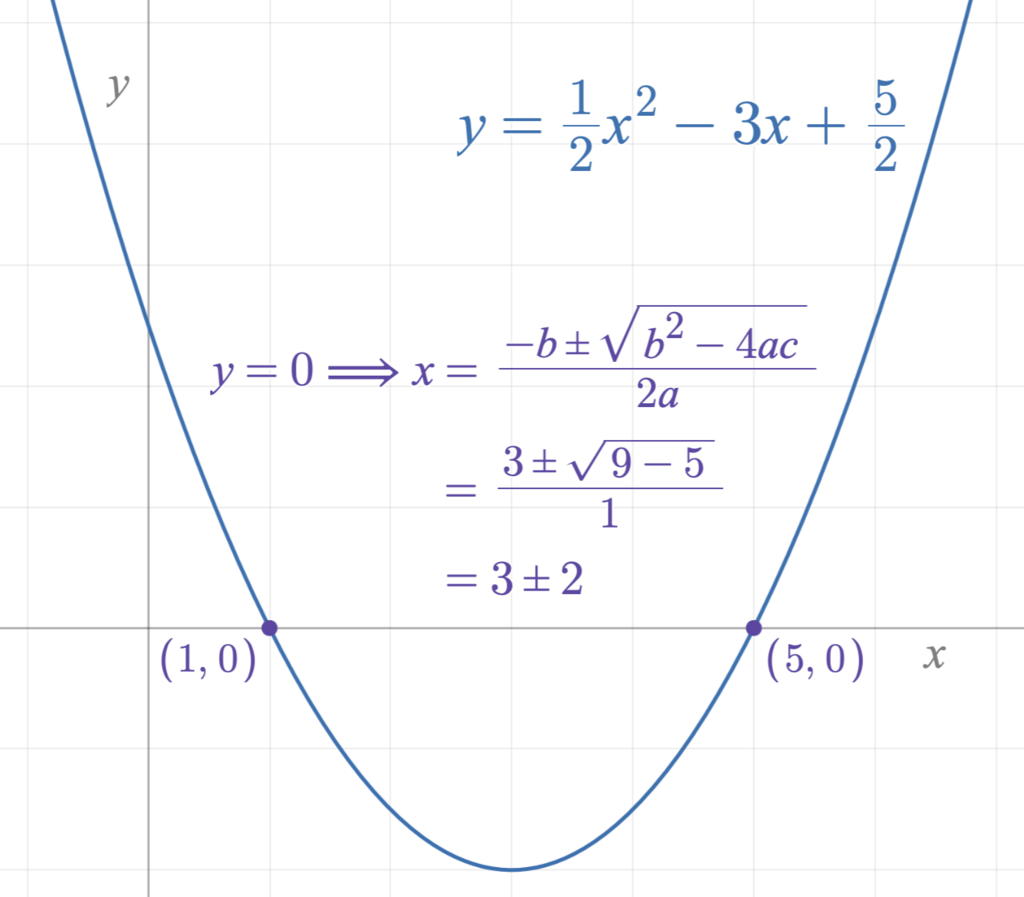
The solutions to a quadratic equation are the values of where the parabola crosses the x-axis. There are a few ways to find these solutions. One way is by factoring. If we have the equation , we look for two numbers that multiply to 6 and add to -5. Those numbers are -2 and -3. So we can factor the equation as:
For this product to be zero, one of the factors must be zero. So, either or . This gives us two solutions: and .
When factoring is difficult or impossible, we can use the quadratic formula. It works for any quadratic equation.
The part inside the square root, , is called the discriminant. It tells you how many real solutions the equation has.
- If , there are two distinct real solutions.
- If , there is exactly one real solution.
- If , there are no real solutions (the solutions involve imaginary numbers).
Understanding Functions
A function is a rule that assigns a single output for every given input. Think of it like a machine: you put something in (the input), and it gives you one specific thing back (the output). We often write functions as , read as "f of x", where is the input.
function
noun
A relation between a set of inputs and a set of permissible outputs with the property that each input is related to exactly one output.
For the linear function , if you input , the output is . For any given , you will only get one output.
We can visualize functions by graphing them on a coordinate plane. Each input-output pair, , becomes a point on the graph. For , the points , , and are all on its graph. Connecting these points reveals a straight line, which is why it's called a linear function.
Quadratic functions, like , produce a U-shaped curve called a parabola. The graph provides a powerful visual way to understand the behavior of a function, showing where it increases, decreases, and crosses the axes.
These core concepts form the foundation of algebra, enabling you to model relationships and solve a huge variety of problems.