Build Your Startup No Code
Startup Fundamentals
What Makes a Startup Tick
A startup isn't just a new business. While a new local bakery and a new software company are both new, they operate on fundamentally different principles. The bakery has a proven business model. The startup does not.
Startup
noun
A temporary organization designed to search for a repeatable and scalable business model.
The key words are search and scalable. Unlike a traditional small business that executes a known plan, a startup is on a quest to find a plan that works. It operates under conditions of extreme uncertainty.
The goal is rapid growth. A local restaurant might hope to serve a few hundred people a day. A food delivery startup, on the other hand, aims to serve millions of customers across the globe. This ambition to scale quickly is what truly defines a startup.
It All Starts with a Problem
Successful startups don't begin with a brilliant solution. They begin with a deep understanding of a problem. Think about it: before Airbnb, finding affordable short-term lodging was a hassle. Before Uber, hailing a cab could be unpredictable. These companies became successful because they solved real, tangible problems for a lot of people.
Innovation is the engine that drives the solution. It’s not just about inventing something new, but about applying a fresh approach to an existing issue. This could mean using new technology, creating a more efficient process, or designing a better user experience. The most durable companies are built on a simple foundation: finding a better way to solve a customer's pain point.
The Lean Startup Method
So how does a startup navigate the uncertainty of its search? One of the most popular frameworks is the lean startup methodology. Instead of spending months or years perfecting a product in isolation, the goal is to get feedback from real users as quickly as possible.
This approach revolves around a simple loop: Build-Measure-Learn.
- Build: Create a basic version of the product with just enough features to be usable. This is called a Minimum Viable Product, or MVP.
- Measure: Release the MVP to a small group of early users and collect data on how they use it.
- Learn: Analyze the data and user feedback to learn what’s working and what isn’t. Then, use those insights to decide whether to continue on the current path or make a significant change—a “pivot.”
Minimum Viable Product
noun
A version of a new product which allows a team to collect the maximum amount of validated learning about customers with the least effort.
This cycle of testing assumptions and iterating based on feedback helps startups avoid building something nobody wants. It's a scientific approach to creating a business.
Developing a minimum viable product, seeking customer feedback, and iterating and tweaking is the proven path to entrepreneurial success
The Startup Journey
The path from an idea to a thriving business can be broken down into a few key stages. While every journey is unique, most follow a similar pattern.
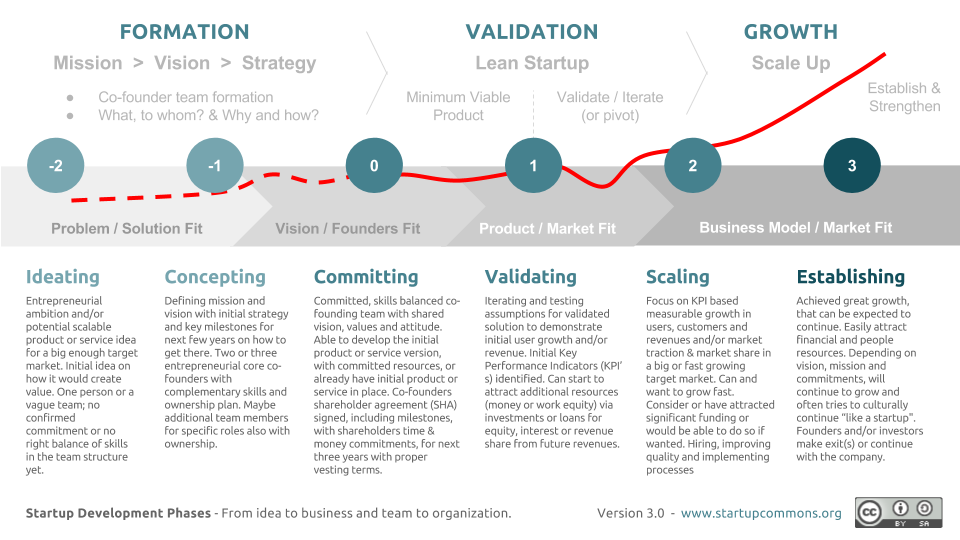
Ideation: This is the very beginning—the spark. It's where you identify a problem and brainstorm potential solutions. The goal here isn't to have a perfect plan, but to generate a promising concept worth exploring.
Validation: In this stage, you test your idea. You talk to potential customers, build an MVP, and gather feedback. The main question you're trying to answer is: "Am I solving a real problem for a specific group of people?" This is where the Build-Measure-Learn loop is in constant motion. The goal is to achieve “Problem/Solution Fit.”
Growth: Once you've validated that you have a solution people want (and are willing to pay for), the focus shifts to scaling. This means acquiring more customers, refining the product, and building a sustainable business model. The goal of this stage is to find “Product/Market Fit” and then step on the gas.
Ready to test what you've learned about the fundamentals of entrepreneurship?
What are the two key characteristics that most accurately define a startup?
According to the lean startup methodology, what is the correct sequence of the feedback loop?
Understanding these core concepts provides a strong foundation for navigating the challenging but rewarding world of startups.