Build Your Personal AI Development Stack
Understanding AI Basics
What Is Artificial Intelligence?
Artificial intelligence is about making machines smart. The goal is to create systems that can think, learn, and solve problems in ways that are similar to human intelligence. It's not about creating conscious robots from science fiction, but about building tools that can perform tasks that typically require human intellect.
Artificial Intelligence
noun
The theory and development of computer systems able to perform tasks that normally require human intelligence, such as visual perception, speech recognition, decision-making, and translation between languages.
You probably interact with AI every day. When a streaming service suggests a movie you might like, that's AI. When you ask a voice assistant for the weather, that's AI. These systems analyze vast amounts of data to recognize patterns and make predictions or decisions.
The Building Blocks of AI
AI isn't a single technology; it's a broad field with many subfields. Two of the most important concepts are machine learning and deep learning. Think of them as nested dolls: AI is the largest doll, machine learning is a smaller one inside it, and deep learning is the smallest one inside machine learning.
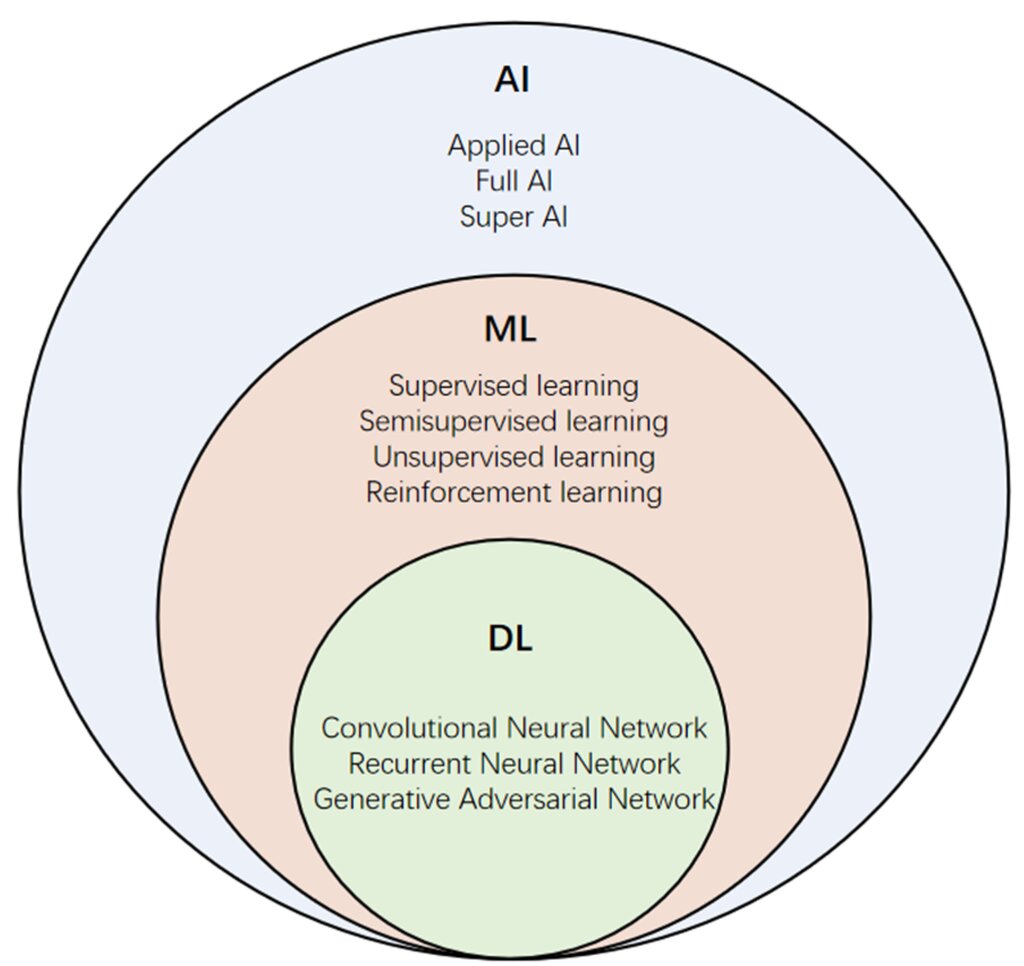
Machine Learning (ML) is a core part of most modern AI. Instead of giving a computer a detailed list of instructions for every possible situation, we give it a large dataset and let it learn the rules for itself. For example, to teach a machine to identify spam emails, you don't write rules like "if the email contains 'free money', it's spam." Instead, you feed it thousands of emails that have already been labeled as 'spam' or 'not spam.' The machine learning algorithm analyzes them and learns the patterns associated with spam on its own.
Deep Learning (DL) is a more advanced type of machine learning. It uses structures called artificial neural networks, which are loosely inspired by the human brain. These networks have many layers that process information, allowing them to learn very complex patterns from huge amounts of data. Deep learning is the technology behind self-driving cars recognizing pedestrians and AI systems that can generate realistic images from text descriptions.
In short: Machine learning uses data to find patterns. Deep learning is a type of machine learning that uses complex, multi-layered neural networks to find those patterns.
A Question of Ethics
As AI becomes more powerful, it's crucial to think about the ethical implications. These aren't just abstract philosophical questions; they have real-world consequences.
| Ethical Issue | Description |
|---|---|
| Bias | AI systems learn from data. If the data reflects human biases (like gender or racial prejudice), the AI will learn and amplify those biases. This can lead to unfair outcomes in areas like hiring or loan applications. |
| Privacy | AI systems often require massive amounts of personal data to function. This raises questions about how that data is collected, stored, and used, and how to protect individuals' privacy. |
| Accountability | When an AI system makes a mistake—like a self-driving car causing an accident—who is responsible? The user, the programmer, the manufacturer? Establishing clear lines of accountability is a major challenge. |
| Transparency | Many complex AI models, especially in deep learning, are considered "black boxes." We can see the input and the output, but it's difficult to understand the exact reasoning process in between. This lack of transparency can make it hard to trust AI decisions or identify errors. |
Developing AI responsibly means actively working to address these issues. This involves creating fairer datasets, designing systems that protect user privacy, and building models that are more transparent and explainable.

Now that you understand the core concepts, you're ready to test your knowledge.
What is the primary goal of Artificial Intelligence?
Which statement best describes the relationship between AI, Machine Learning (ML), and Deep Learning (DL)?
Understanding these fundamentals is the first step toward using AI effectively and responsibly.