Build Your Own LLM Repair Tool with RAG
Introduction to RAG
Giving AI an Open Book Test
Large Language Models, or LLMs, are powerful tools. They can write emails, summarize articles, and even generate computer code. Their ability to understand and produce human-like text comes from being trained on vast amounts of information from the internet. But this training method has a couple of significant drawbacks.
First, an LLM's knowledge is frozen in time. Once its training is complete, it doesn't learn anything new. If a model was trained on data up to 2023, it won't know who won the World Series in 2024 or about any major events that happened after its training cutoff. It's like talking to a brilliant historian who fell asleep three years ago.
Second, LLMs can "hallucinate." This means they sometimes make up facts or details with complete confidence. Because they are designed to predict the next most likely word in a sentence, they can sometimes predict a sequence of words that sounds plausible but is entirely incorrect. This is a huge problem when you need reliable, factual answers.
How RAG Changes the Game
This is where Retrieval-Augmented Generation, or RAG, comes in. It’s a clever way to give an LLM access to fresh, relevant information without having to retrain the entire model from scratch. Think of it as giving the LLM an open book and a search engine to use during its exam. Instead of just relying on its memorized (and possibly outdated) knowledge, it can look up the latest information before giving an answer.
Retrieval-Augmented Generation (RAG) is an AI framework that connects a language model to an external knowledge repository, allowing the model to fetch and include relevant information when generating an answer.
RAG enhances an LLM by adding two simple steps to the process: retrieval and generation.
The Two Phases of RAG
1. Retrieval: When you ask a question, the RAG system doesn't immediately send it to the LLM. First, it uses your query to search an external knowledge base. This could be a specific set of company documents, a legal database, or even the current internet. The system finds the most relevant snippets of information related to your question. This is the "retrieval" part.
2. Generation: Next, the system takes the relevant information it just found and bundles it with your original question. It then hands this entire package to the LLM. With this new, up-to-date context, the LLM can now generate a much more accurate and relevant response. It's no longer just relying on its internal memory; it's using the provided documents to inform its answer.
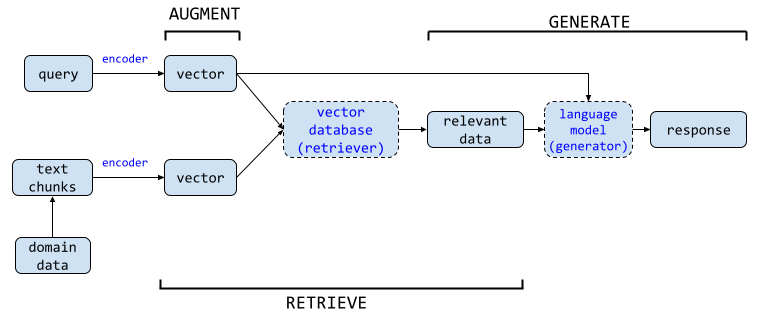
For example, imagine asking a customer support bot, "What is the warranty policy for the new X-100 drone?" An LLM trained last year wouldn't know about the new drone. But a RAG system would first search the company's latest product manuals, find the warranty section for the X-100, and then feed that specific text to the LLM to generate a precise answer.
By grounding the LLM in external, verifiable facts, RAG makes its responses more trustworthy, accurate, and up-to-date.
Now that you understand the core concepts of RAG, let's test your knowledge.
What is a primary limitation of a standard Large Language Model (LLM) that Retrieval-Augmented Generation (RAG) is designed to address?
RAG improves an LLM's knowledge by completely retraining the model from scratch with new information.
This ability to connect LLMs to external knowledge is a fundamental step in building more capable and reliable AI tools.