Build Your Own LLM
Introduction to Transformers
The Transformer Revolution
At the heart of most modern large language models (LLMs) is a powerful architecture called the Transformer. Introduced in a 2017 paper titled "Attention Is All You Need," it completely changed how machines process language. Before Transformers, models like Recurrent Neural Networks (RNNs) read text one word at a time, like a person reading a book. This sequential process was slow and often struggled to remember context from far back in a long text.
The Transformer architecture has revolutionized the Natural Language Processing field and is the backbone of Large Language Models (LLMs).
Transformers work differently. They look at all the words in a sentence at once, allowing for parallel processing. This not only makes them much faster but also gives them a more holistic understanding of the text. The key ingredient that makes this possible is a mechanism called self-attention.
Understanding Context with Self-Attention
Self-attention is what allows a model to weigh the importance of different words in a sentence when processing a specific word. It helps the model understand relationships and context. For example, consider the sentence: "The robot picked up the ball because it was heavy."
What does "it" refer to? A human reader instantly knows "it" refers to the ball, not the robot. Self-attention gives the model this same ability. When processing the word "it," the model pays more attention to "ball" and less to "robot."
How does this work? For each word, the model creates three vectors: a Query, a Key, and a Value.
- Query: This represents the current word you're focusing on. It's like a question: "What other words are relevant to me?"
- Key: This is like a label for all the other words in the sentence. The Query vector is compared against all the Key vectors to find matches.
- Value: This contains the actual meaning or substance of a word. Once the Query finds the most relevant Keys, it takes their corresponding Values.
Think of it like searching on a video platform. Your search term is the Query. The video titles are the Keys. The video content itself is the Value. The platform matches your query to the best keys and returns the most relevant values (the videos).
By calculating these scores for every word in relation to every other word, the model builds a rich map of contextual relationships.
Building a Deeper Understanding
While self-attention is the main event, a few other components are crucial for making the Transformer architecture work.
Positional Encoding
Self-attention is great at understanding relationships, but it doesn't naturally know the order of words. To a simple self-attention mechanism, "The dog chased the cat" and "The cat chased the dog" look the same. To fix this, Transformers add a piece of information called a "positional encoding" to each word's embedding. This is like adding a unique timestamp or a page number to each word, giving the model a sense of its position in the sequence.
Multi-Head Attention
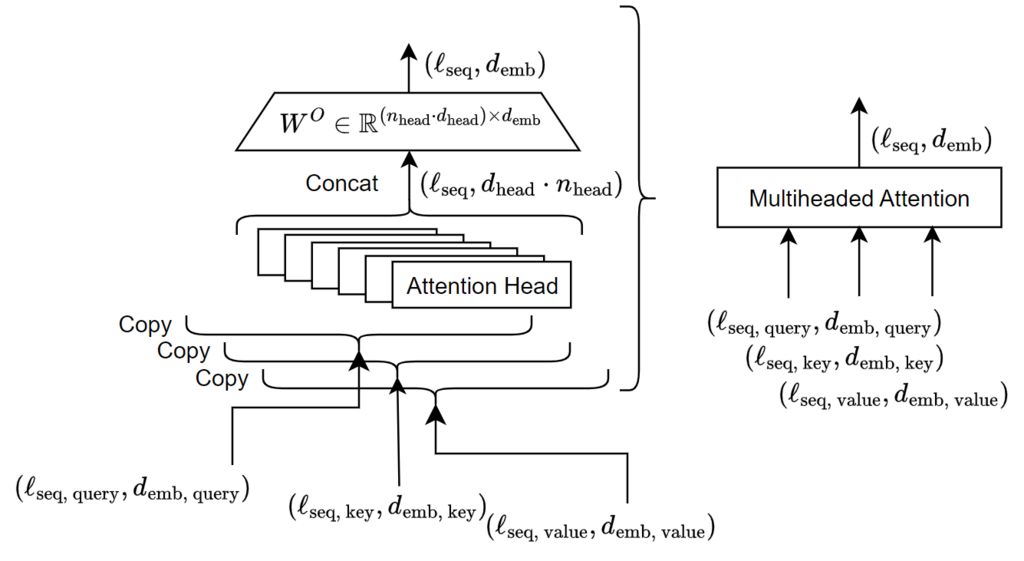
To make the model even more powerful, Transformers don't just use one set of Query, Key, and Value vectors. They use multiple sets in parallel. This is called multi-head attention. Each "head" can learn to focus on different types of relationships. One head might focus on grammatical structure, while another tracks who is doing what to whom. It's like having a team of experts analyze the sentence simultaneously, each from a different perspective.
Feed-Forward Networks & Layer Normalization
After the attention heads have calculated their outputs, the information is passed through a simple feed-forward neural network. This network processes the output from each word's attention calculation independently. Its job is to perform further transformations on the data, adding more computational depth.
Finally, a process called layer normalization is applied after each major step (like multi-head attention and the feed-forward network). You can think of this as a clean-up step that keeps the data flowing smoothly through the network. It standardizes the inputs to each layer, which helps stabilize and speed up the training process.
These core components—self-attention, positional encoding, multi-head attention, and feed-forward networks—are stacked on top of each other multiple times to create the full Transformer architecture. Together, they allow models to process language with a level of nuance and context that was previously out of reach.