Build Your Own L1 Blockchain
Blockchain Basics
What Is a Blockchain?
At its core, a blockchain is a digital ledger, much like a notebook used for keeping records. But this isn't just any notebook. It's a special kind that is copied and spread across a vast network of computers. This is what makes it a distributed ledger.
Its main purpose is to record transactions or any digital information in a way that's secure, transparent, and permanent. The clever part is that it does this without needing a central authority, like a bank or government, to verify everything. The network itself handles the trust.
The Building Blocks
The name "blockchain" is quite literal. It's a chain of blocks, where each block stores information. A block is made up of three key components:
- Data: The actual information being recorded, such as the details of a transaction.
- Hash: A unique, fixed-length string of characters that acts as a digital fingerprint for the block. It's generated from the data inside the block.
- Previous Block's Hash: The hash of the block that came before it in the chain.
This third element, the hash of the previous block, is what links the blocks together, creating the chain. If any data in a block is changed, its hash changes completely. This would break the link to the next block, making the tampering immediately obvious to the entire network.
This simple but powerful structure is fundamental to a blockchain's security.
A Decentralized Network
The blockchain ledger doesn't live in one place. It's maintained by a network of computers called nodes. Each node holds a full copy of the entire blockchain. When a new block is created, it's sent to every node in the network. The nodes then check the block to make sure it's valid before adding it to their copy of the ledger.
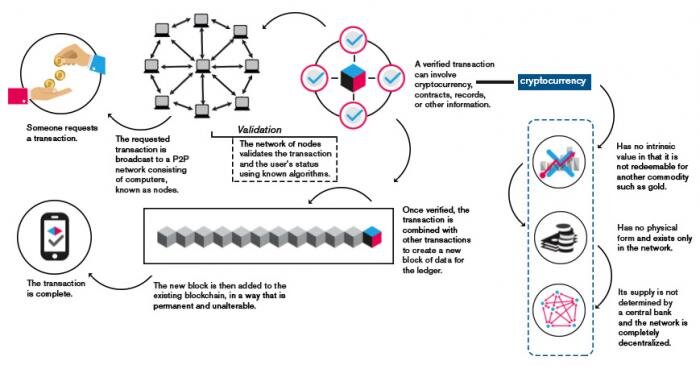
This structure creates two crucial properties: decentralization and immutability.
Decentralization means there is no single point of control or failure. Since every node has a copy of the ledger, the network can continue to function even if some nodes go offline. No single person or group can dictate the rules or alter the history.
Immutability means that once data is written to the blockchain, it cannot be altered. To change a block, a bad actor would need to alter the block's data, which would change its hash. This would invalidate all subsequent blocks in the chain. They would then have to get more than 50% of the network's nodes to agree that their altered version of the chain is the correct one. This is incredibly difficult and expensive to do on a large, public network.
How the Network Agrees
If there's no central boss, how do all the nodes agree on which new blocks are valid? They use a consensus mechanism, which is a set of rules for achieving agreement in a distributed system.
There are many types of consensus mechanisms, but two of the most common are Proof of Work and Proof of Stake.
Proof of Work (PoW): This is the original mechanism used by Bitcoin. Nodes, often called "miners," compete to solve a complex mathematical puzzle. The first one to solve it gets to add the next block to the chain and is rewarded. This process requires significant computational power, which helps secure the network by making it expensive to attack.
Proof of Stake (PoS): In this system, individuals can lock up their own cryptocurrency as a "stake." The protocol then chooses a validator to create the next block, often based on the size of their stake. If a validator approves a fraudulent transaction, they can lose their stake. This incentivizes honest behavior without the high energy consumption of PoW.
The consensus mechanism is the engine that allows the decentralized network to function, ensuring that everyone agrees on the current state of the ledger.
It's time for a quick check on what we've covered.
What is the primary function of the 'hash of the previous block' within a blockchain's structure?
The fact that a blockchain is maintained by a network of computers, each holding a full copy of the ledger, leads to which key property?
Understanding these core ideas—blocks chained together, a decentralized network of nodes, and a consensus mechanism for agreement—is the key to grasping how blockchain technology works.