Build Your Own CNC Laser Cutter
Laser Fundamentals
How Lasers Work
At the heart of every laser is a process called stimulated emission. It all starts with atoms. Normally, the electrons in an atom sit in a low-energy state. If you pump energy into them, say with electricity or another light source, the electrons jump to a higher, excited state. But they can't stay there forever.
When an excited electron falls back to its low-energy state, it releases its extra energy as a particle of light, a photon. In a laser, we don't wait for this to happen randomly. Instead, we send another photon with just the right amount of energy whizzing by the excited atom. This passing photon stimulates the electron to drop down and release its own photon. The new photon is a perfect clone of the first one, they have the same wavelength, phase, and travel in the same direction.
Photon
noun
The fundamental particle of light, carrying a specific amount of energy.
Now, imagine a tube filled with atoms, called a gain medium. We pump energy into this medium to get most of its atoms into an excited state. Then, we place mirrors at both ends of the tube.
A few photons will inevitably be released. One of these photons will travel down the tube, stimulating other excited atoms to release more identical photons. This growing cascade of light hits a mirror at the end and reflects, traveling back through the medium and amplifying the light even more. One of the mirrors is partially transparent, allowing a fraction of this highly concentrated, perfectly aligned light to escape. That's your laser beam.
Lasers for Cutting
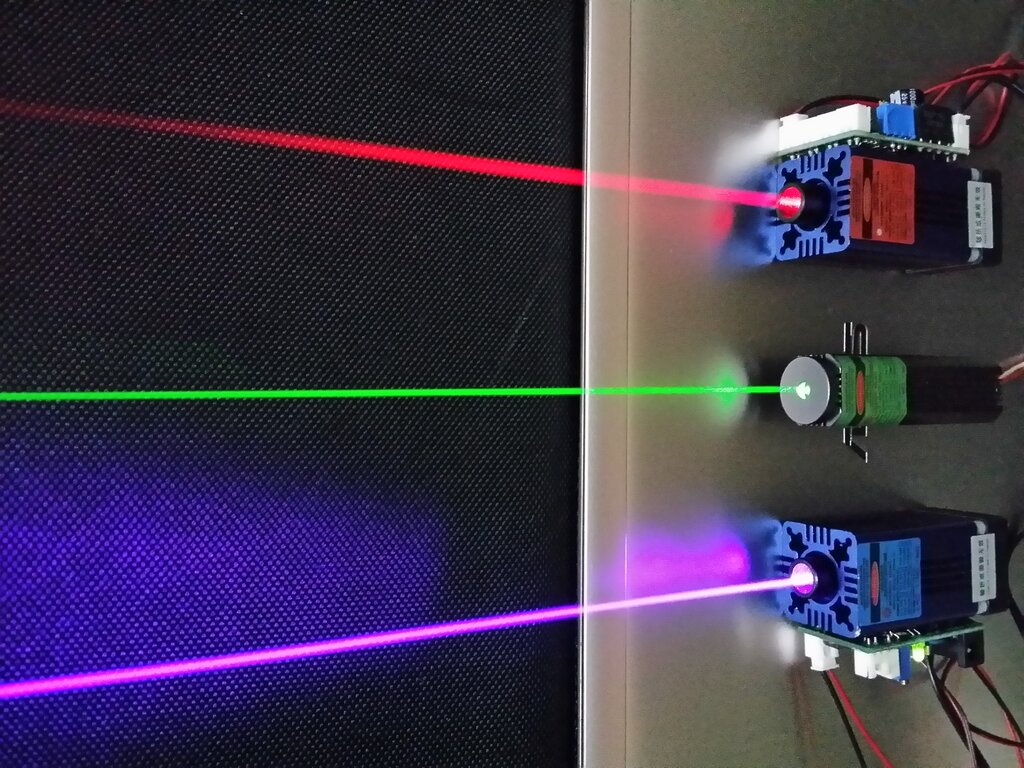
Not all lasers are created equal. For CNC cutting, three main types dominate, each with its own strengths based on the gain medium used.
| Laser Type | Gain Medium | Best For | Key Feature |
|---|---|---|---|
| CO₂ | Carbon Dioxide Gas | Non-metals (wood, acrylic, leather) | Long wavelength, versatile for engraving |
| Fiber | Optical Fiber | Metals (steel, aluminum, brass) | High power efficiency, low maintenance |
| Diode | Semiconductor | Hobbyist uses, engraving, thin materials | Compact size, lower power |
CO₂ lasers are the workhorses for organic materials. Their long infrared wavelength is readily absorbed by wood, plastics, and fabrics, making them excellent for cutting and engraving.
Fiber lasers are the go-to for cutting metals. Their shorter wavelength is absorbed much more efficiently by reflective surfaces like steel and aluminum. They are also incredibly efficient and require little maintenance, making them ideal for industrial production. Diode lasers, often found in smaller desktop machines, are great for engraving and cutting thin, soft materials but lack the power for serious metalwork.
Laser Meets Material
When a high-power laser beam strikes a material, it's not just a gentle touch, it's an intense, focused delivery of energy. This interaction happens in a few ways, depending on the laser's power and the material's properties.
The most common process in cutting is vaporization. The laser heats the material so quickly that it instantly turns from a solid into a gas, which is then blown away, creating a clean cut or kerf. For some materials, the laser might first melt the material, and a jet of gas (like nitrogen or oxygen) is used to blow the molten material out of the cut. This is called melt shearing.
This intense heat doesn't just stay in one spot. It spreads into the surrounding material, creating what's known as a Heat-Affected Zone (HAZ). Minimizing the HAZ is often crucial, as it can change the properties of the material right next to the cut.
The effectiveness of a cut depends on a balance of factors. The laser's wavelength determines how well a material absorbs the light. Metals, for instance, are highly reflective to the long wavelengths of CO₂ lasers but absorb the shorter wavelengths of fiber lasers much better. Power density—how much energy is focused into a tiny spot—dictates how quickly the material can be vaporized. A higher power density generally leads to a faster, cleaner cut with a smaller HAZ.
Let's check your understanding of these core concepts.
What is the fundamental process that creates a cascade of identical photons in a laser?
In a laser tube, what is the primary function of the mirrors at each end?
Understanding these principles of light generation, laser types, and material interaction is the first step to mastering CNC laser cutting.