Build Your Own Algo Trading App with Free LLMs
Introduction to Algorithmic Trading
What Is Algorithmic Trading?
Algorithmic trading, often called algo trading, is the process of using computer programs to place trades. These programs follow a predefined set of instructions, or an algorithm, to make decisions based on timing, price, quantity, or any other model-based factor. Instead of a human trader watching screens and making split-second choices, the computer does the work automatically.
Algorithmic trading refers to the use of computer programs that follow defined sets of instructions (algorithms) to execute trades at speeds and frequencies impossible for human traders.
This isn't a new idea. Traders have used quantitative models for decades. But with the rise of powerful computers and high-speed internet, algo trading moved from a niche practice to a dominant force in financial markets. It began with simple commands, like executing a large order in smaller pieces to avoid spooking the market. Today, algorithms handle complex strategies across global markets in fractions of a second.
Advantages and Challenges
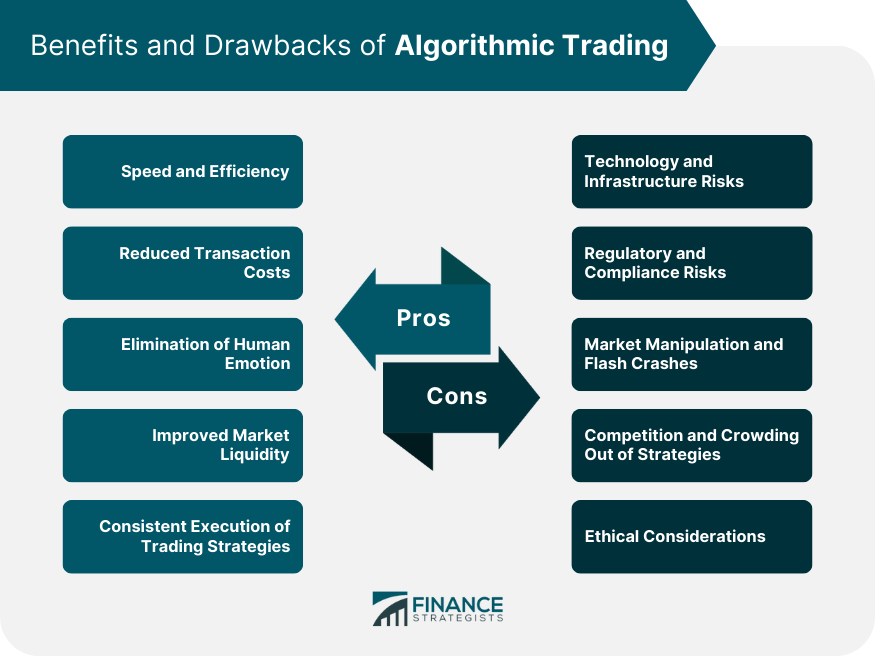
The primary advantage of algorithmic trading is its speed. An algorithm can analyze market data and execute a trade in microseconds, far faster than any human. This speed allows traders to capitalize on fleeting opportunities. Another key benefit is the removal of human emotion. Algorithms stick to their instructions and aren't swayed by fear or greed, which often lead to poor trading decisions.
By automating the process, trades are executed more efficiently, reducing the chance of manual errors and often lowering transaction costs.
However, algo trading comes with its own set of challenges. A poorly designed algorithm can lead to significant losses in a very short time. There's also the risk of technical failures—a lost internet connection or a server crash can be disastrous. The complexity of creating, testing, and maintaining these systems requires specialized knowledge in finance, computer science, and mathematics.
Common Strategies
An algorithm is only as good as its strategy. While there are countless complex strategies, most are built on a few fundamental concepts.
Trend Following
other
This is one of the most straightforward strategies. The algorithm identifies the direction of the market trend and places trades that follow it. If a stock's price is consistently rising, the algorithm buys. If it's falling, it sells. It operates on the principle that a trend in motion is likely to continue.
Mean Reversion
other
This strategy is based on the idea that asset prices tend to revert to their historical average or mean. If a stock price moves significantly away from its average, the algorithm bets that it will return. It buys assets that have fallen well below their average and sells those that have risen far above it.
Arbitrage
noun
Arbitrage seeks to profit from price discrepancies of the same asset in different markets. For example, a stock might be trading for $10.00 on the New York Stock Exchange and $10.01 on another exchange. An arbitrage algorithm would simultaneously buy the stock on the cheaper exchange and sell it on the more expensive one, capturing the $0.01 difference.
| Strategy | Core Idea | Example Action |
|---|---|---|
| Trend Following | An asset's price will continue its current trend. | Buy a stock that is consistently rising. |
| Mean Reversion | An asset's price will return to its average over time. | Sell a stock that is trading far above its 20-day average. |
| Arbitrage | Profit from price differences of the same asset on different markets. | Buy a stock on Exchange A and sell it on Exchange B for a higher price. |
Anatomy of a Trading System
Every algorithmic trading system, whether simple or complex, is built from the same core components. Think of it as a production line for making trades.
The process starts with Data. The system needs a constant stream of market information, like prices and trading volumes. The Strategy Engine is the brain of the operation; it takes in the data, applies the rules of the algorithm, and decides when to trade.
Once a decision is made, the Execution Mechanism sends the order to the market. Finally, Risk Management protocols act as a safety net. This component monitors the system's performance and can automatically intervene to prevent large losses, for example, by closing a position if it drops by a certain percentage.
Time to review what we've covered.
Now, let's test your understanding with a few questions.
What is the primary function of algorithmic trading?
According to the text, which of the following is a major advantage of using algorithms for trading?
Understanding these foundational concepts is the first step into the world of algorithmic trading. It's a field that combines finance, technology, and strategy to navigate the complexities of modern markets.