Build Your Own AI Teaching Assistant
Understanding AI Agents
What is an AI Agent?
An AI agent is a program that can act on your behalf to get things done. Think of it as a smart assistant with a specific job. To do its job, an agent needs to do three things:
- Perceive: It senses its environment. This could be anything from a user's question in a chat window to data from the internet.
- Reason: It processes that information and decides what to do next to achieve its goal.
- Act: It takes action in its environment. This might mean answering a question, booking a flight, or adjusting a setting.
A self-driving car is a classic example of an agent. Its goal is to get from point A to point B safely. It perceives the road with cameras and sensors, reasons about traffic rules and obstacles, and acts by steering, accelerating, or braking.
agent
noun
An autonomous entity that perceives its environment through sensors and acts upon that environment through actuators to achieve goals.
In the digital world, an agent is just software. Instead of physical sensors, it uses data inputs. Instead of mechanical actuators, it produces digital outputs, like text, images, or commands to other programs. The core idea is the same: perceive, reason, act.
AI Agents in the Classroom
This concept of an autonomous helper is incredibly powerful in education. AI agents can take on different roles to support both students and teachers, creating more personalized and efficient learning experiences.
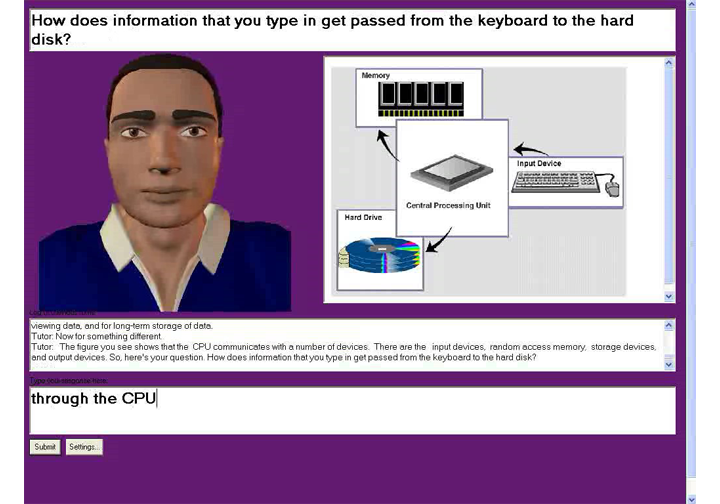
One of the most common applications is the virtual tutor. Imagine a student is stuck on a coding problem late at night. A human teacher isn't available, but an AI agent is. The agent can analyze the student's code, identify the error, and offer a targeted hint—not just the answer. Its goal isn't just to solve the problem, but to guide the student toward understanding.
Another key example is an automated grading system. For an 'Introduction to Programming' class, a teacher might have to grade dozens of similar assignments. An AI agent can run the code, check it against the requirements, and provide instant, consistent feedback on what works and what doesn't. This frees up the teacher to focus on higher-level concepts and give one-on-one help where it's needed most.
Benefits and Challenges
Bringing AI agents into education has clear advantages. Students get immediate, personalized support whenever they need it. Learning can adapt to each student's pace, with agents providing extra practice on tough topics or offering advanced challenges to those who are ready. For teachers, agents are powerful assistants that handle repetitive tasks, giving them more time for meaningful interaction with students.
Agentic AI in education represents a fundamental transformation in how learning occurs, providing intelligent, adaptive, and personalized educational experiences that enhance rather than replace human instruction while ensuring that all learners have access to high-quality, engaging, and effective educational opportunities.
However, there are challenges to consider. An AI can't replicate the empathy and personal connection of a human teacher. There are also important concerns about data privacy and ensuring that the algorithms behind these agents are fair and unbiased. Finally, building and implementing these tools can be complex and costly.
The key is to view AI agents not as replacements for teachers, but as powerful tools that can make education more effective and accessible for everyone involved.
Let's check your understanding of these core concepts.
What are the three fundamental actions that define an AI agent's operation cycle?
An AI system reviews a student's submitted code, checks it for errors against a set of requirements, and provides immediate feedback. What educational role is this agent performing?