Build Your Own AI Agent
Introduction to AI Agents
What Is an AI Agent?
You've probably interacted with an AI agent today. If you asked a smart speaker for the weather, used a GPS app to find the best route, or got a movie recommendation on a streaming service, you were guided by an AI agent.
At its core, an AI agent is a system that can perceive its environment, make decisions, and take actions to achieve a specific goal. Think of it as an autonomous entity that can operate on its own without constant human supervision.
An AI agent is a software program designed to understand its environment, process information, and take actions to achieve specific goals.
For a system to be considered an agent, it generally needs a few key characteristics:
- Perception: It can sense its surroundings. For a self-driving car, this means using cameras and sensors to detect other cars, pedestrians, and road signs. For a customer service chatbot, it means reading and understanding your typed questions.
- Autonomy: It can act independently. You don't tell your GPS how to find the fastest route; you just give it a destination, and it figures out the rest.
- Goal-Oriented: It has a clear objective. The goal of a spam filter is to keep unwanted emails out of your inbox. The goal of a robotic vacuum is to clean your floor.
A Brief History
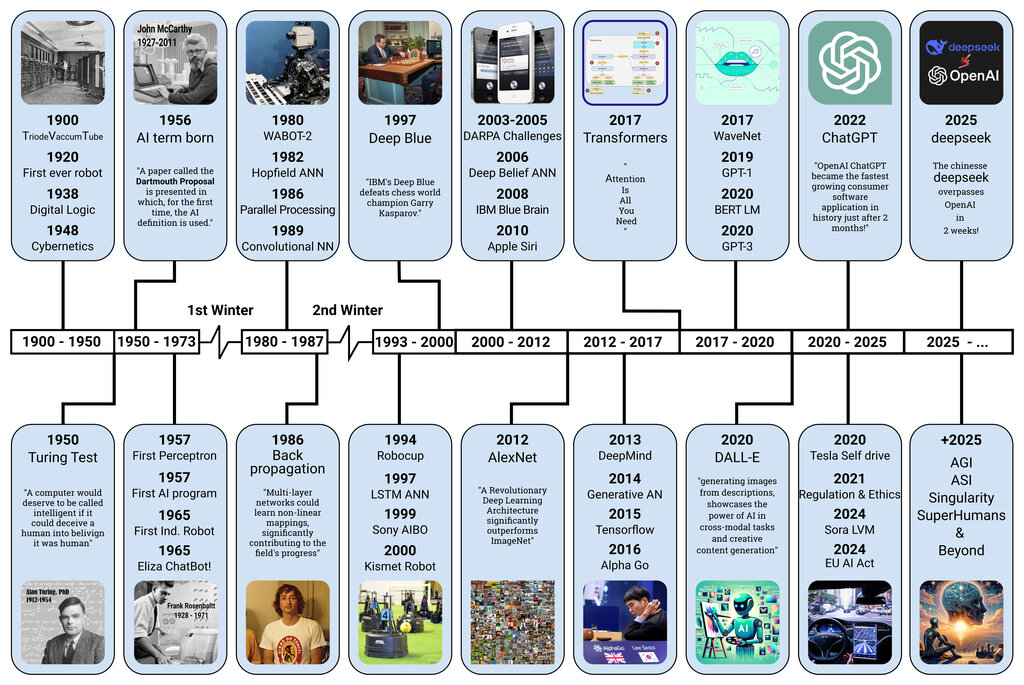
The idea of autonomous agents isn't new. It dates back to the early days of artificial intelligence in the 1950s. Early systems, often called "automatons," were simple, rule-based programs. For instance, the first chatbots like ELIZA in the 1960s could simulate conversation but didn't truly understand it. They followed scripts.
Over the decades, as computing power grew and AI research advanced, agents became more sophisticated. They moved from simple logic to complex reasoning, planning, and learning. The rise of machine learning in the 2000s and deep learning in the 2010s was a major turning point, allowing agents to learn from vast amounts of data and improve their performance over time.
Types of Agents
Not all agents are created equal. They can be categorized based on how they make decisions. Let's look at three main types.
Reactive Agent
noun
An agent that responds directly to what it perceives in the present moment, without considering past events or future consequences.
Reactive agents are the simplest type. They operate on a simple "if-then" logic. If the sensor detects an obstacle, then stop. If the room is dark, then turn on the light. They don't have memory or a sense of history. Your robotic vacuum bumping into a chair and changing direction is a perfect example of a reactive agent at work.
Reactive agents are all about the here and now.
Deliberative Agent
noun
An agent that uses an internal model of the world to plan its actions, considering past states and the potential outcomes of its choices.
Deliberative agents are more complex. They maintain an internal representation of the world and use it to think ahead. A GPS navigation app is a deliberative agent. It doesn't just react to the next turn. It has a map of the entire area, knows about traffic conditions (its environment), and calculates the optimal path to your destination (its goal). It plans ahead.
Finally, there are hybrid agents. As the name suggests, they combine the best of both worlds. They use reactive behaviors for immediate needs while engaging in deliberative planning for long-term goals. A Mars rover is a great example. It can react instantly to avoid an unexpected rock (reactive) while following a carefully planned route from scientists on Earth to explore a specific region (deliberative).
| Agent Type | Key Feature | Example |
|---|---|---|
| Reactive | Acts on current input | Thermostat |
| Deliberative | Plans using a world model | GPS navigation |
| Hybrid | Combines reacting and planning | Mars Rover |
Agents in the Wild
AI agents are already integrated into many aspects of our lives. Virtual assistants like Siri and Alexa are agents that understand your voice commands to play music, set timers, or answer questions. E-commerce sites use recommendation agents to analyze your browsing history and suggest products you might like.
In finance, agents execute trades automatically based on market conditions. In healthcare, they help analyze medical images to spot diseases earlier. And in entertainment, non-player characters (NPCs) in video games are agents designed to create a more immersive and challenging experience for the player.
As AI technology continues to advance, agents will become even more capable and autonomous, working alongside us to solve complex problems and handle everyday tasks.
At its most fundamental level, what is an AI agent?
A robotic vacuum that changes direction immediately upon hitting a wall is a classic example of which type of agent?
Now that you've learned the basics of AI agents, you can start to see them everywhere. They are the engines that make many of the smart technologies we rely on work.