Build Your First AI Agent No-Code
Introduction to AI
What Is Artificial Intelligence?
Artificial intelligence, or AI, is about creating systems that can think, learn, and solve problems like humans. At its core, AI gives computers the ability to interpret data, learn from it, and use that knowledge to achieve specific goals through flexible adaptation. It’s not about creating a conscious robot from a sci-fi movie; it's about building tools that can perceive their environment, reason, and make decisions to achieve a goal.
Think of it this way: traditional software follows explicit instructions written by a programmer. AI systems, on the other hand, can learn from experience and adjust their behavior without being reprogrammed for every new situation.
intelligence
noun
The ability to acquire and apply knowledge and skills.
AI encompasses a broad range of techniques, from simple rule-based systems to complex neural networks that mimic the human brain. This allows AI to perform tasks that typically require human intelligence, like understanding language, recognizing faces, or driving a car.
A Brief History
The idea of artificial minds has been around for centuries, but the formal field of AI research began in the 1950s. Early pioneers believed they could simulate all aspects of human intelligence, leading to a period of great optimism. They developed programs that could solve algebra problems, prove logical theorems, and speak simple English.
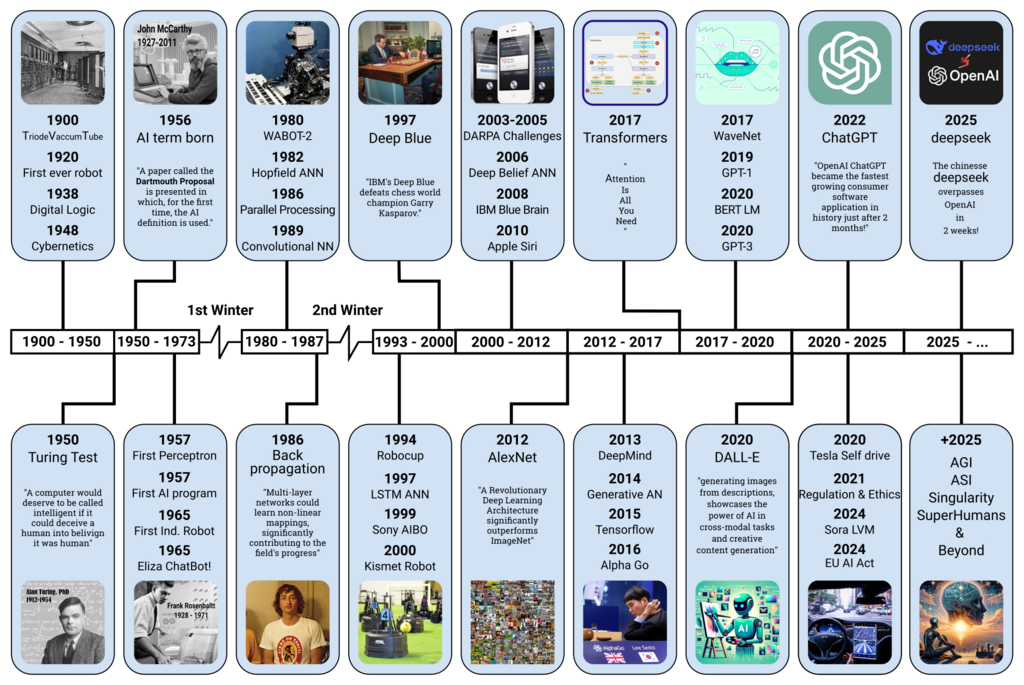
Progress was slower than expected. The limited computing power of the time and the immense complexity of human thought led to funding cuts and a loss of interest. These periods were known as "AI winters."
However, breakthroughs in the 1990s and 2000s, driven by faster computers and the availability of massive amounts of data, sparked a revival. Machine learning, a subfield of AI, began to flourish. Instead of programming rules by hand, developers could now train computers by showing them thousands of examples.
One major milestone was in 1997, when IBM's Deep Blue chess computer defeated the world champion, Garry Kasparov. This demonstrated that a machine could master a complex, strategic game once thought to be the exclusive domain of human intellect.
Two Kinds of AI
Today's AI can be broadly divided into two categories: Narrow AI and General AI. Understanding the difference is key to cutting through the hype.
| Type | Description | Example |
|---|---|---|
| Artificial Narrow Intelligence (ANI) | Designed to perform a specific, narrow task. | A language translation app, a self-driving car, or a spam filter in your email. |
| Artificial General Intelligence (AGI) | A hypothetical AI with the ability to understand or learn any intellectual task that a human can. | A single system that could write a novel, compose a symphony, and make a scientific discovery. |
All the AI we use today is Narrow AI. These systems can be incredibly powerful and outperform humans at their specific tasks, but they operate within a limited, pre-defined range. A chess program can't recommend a movie, and a spam filter can't diagnose a disease.
Artificial General Intelligence, often called "strong AI," remains theoretical. It's the kind of AI you see in movies—a machine with consciousness, self-awareness, and the ability to reason about a wide variety of topics. While researchers are working toward it, AGI is still a long way off.
AI in the Real World
Even though we only have Narrow AI, its impact is enormous. It's already woven into the fabric of our daily lives and is transforming industries around the globe.
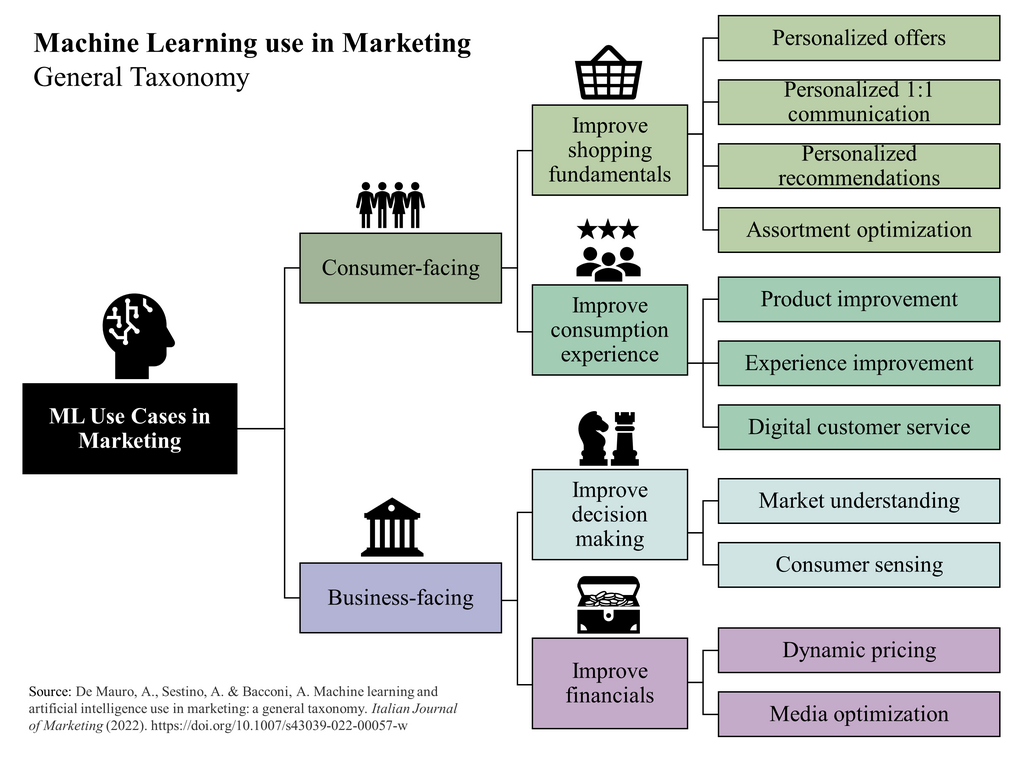
In healthcare, AI helps doctors diagnose diseases earlier and more accurately by analyzing medical images like X-rays and MRIs. It also powers personalized treatment plans based on a patient's genetic makeup and lifestyle.
In finance, AI algorithms detect fraudulent transactions in real time, assess credit risk, and automate trading strategies. They can analyze market data far faster than any human, identifying patterns and opportunities.
Retail uses AI to power recommendation engines, suggesting products you might like based on your past purchases. It also helps manage inventory, predict demand, and optimize supply chains to ensure products are on the shelf when you want them.
In transportation, AI is the brain behind self-driving cars, which use sensors and computer vision to navigate roads. It also optimizes traffic flow in cities and powers navigation apps that find the fastest route.
Ready to check your understanding?
What is the fundamental goal of Artificial Intelligence as described in the text?
The periods in AI history characterized by reduced funding and a loss of public interest due to slower-than-expected progress are known as:
From its early theoretical roots to its practical applications today, AI is a field that continues to evolve at a breathtaking pace. Understanding these foundational concepts is the first step in appreciating its power and potential.