Build Tiny LLM Text Segmenter for Mobile
Introduction to Machine Learning
Learning from Experience
Machine learning is a way of teaching computers to find patterns. Instead of writing explicit, step-by-step instructions for every task, we give the computer data and let it figure out the rules on its own. It's the difference between giving someone a detailed recipe and letting them taste a finished dish to reverse-engineer how it was made.
Machine learning
noun
A field of artificial intelligence that uses statistical techniques to give computer systems the ability to "learn" from data, without being explicitly programmed.
The core idea is to train a model. A model is just a mathematical representation of the patterns found in the data. Once trained, this model can make predictions or decisions about new, unseen data. The better and more relevant the data you provide, the smarter your model becomes.
Two Main Flavors
Machine learning comes in two main styles: supervised and unsupervised. The difference boils down to whether the computer has an "answer key" during its training.
Supervised learning is like studying for a test with a practice exam that includes the answers. The data is labeled, meaning each piece of information already has the correct outcome attached. The model learns the relationship between the inputs and their corresponding correct outputs.
For example, to predict house prices, you would train a model with a dataset of houses where you already know the features (square footage, number of bedrooms) and the final sale price (the label). The model learns how features relate to the price. Predicting spam is another classic example; the model learns from thousands of emails already labeled as "spam" or "not spam."
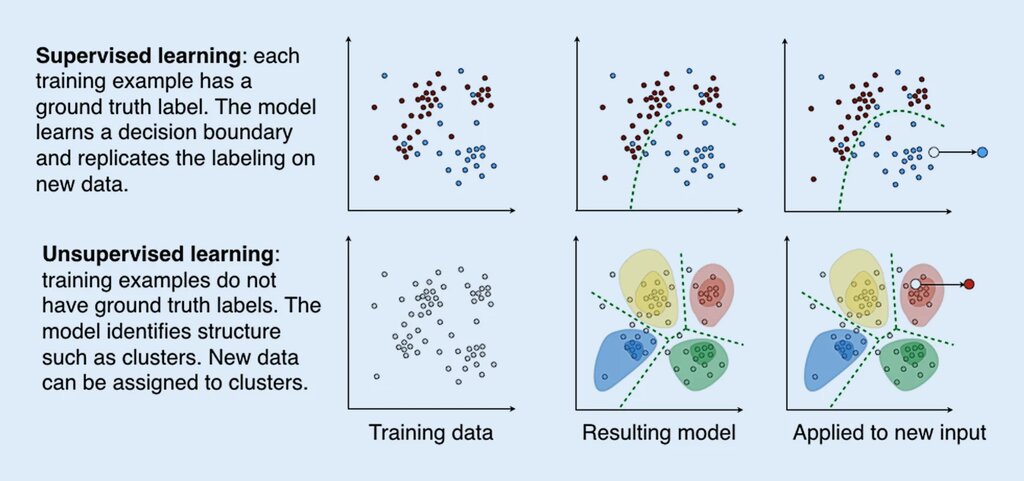
Unsupervised learning is the opposite. It's like being handed a box of mixed Lego bricks and asked to sort them into piles that make sense. The data is unlabeled, so there's no answer key. The goal is to find hidden structures or groupings within the data itself.
A common use is customer segmentation. An online store might use unsupervised learning to group customers with similar purchasing habits. This helps them understand their audience and tailor marketing efforts without knowing the customer categories beforehand.
A Few Common Tools
Different problems require different algorithms. Let's look at three foundational ones.
Linear Regression (Supervised) This is one of the simplest algorithms. It's used to predict a continuous numerical value, like a temperature, a stock price, or a person's height. It works by finding the straight line that best fits the data points.
In this classic formula, is the value we want to predict, is our input variable, is the slope of the line, and is the intercept. The machine learning model's job is to find the best values for and that minimize the overall distance between the line and the actual data points.
Decision Trees (Supervised) Decision trees are used for classification problems—answering questions with a category, like "Is this email spam?" or "Will this customer renew their subscription?". The model looks like an upside-down tree or a flowchart. It asks a series of simple yes/no questions about the data to arrive at a decision.
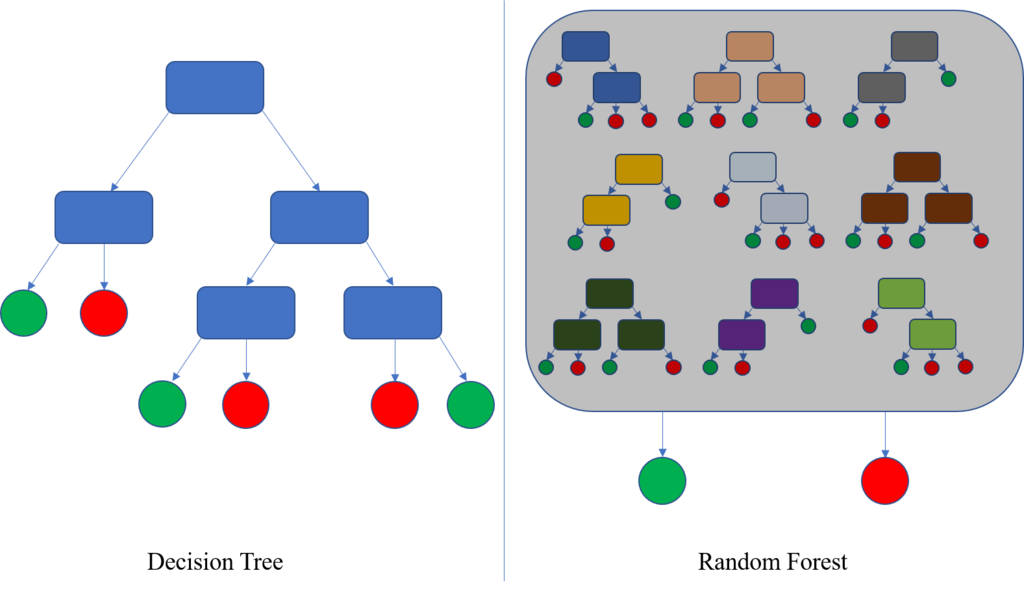
Each node in the tree represents a question, each branch represents an answer, and each leaf node at the bottom represents the final classification. The algorithm learns which questions to ask, and in what order, to best split the data into pure categories.
K-Means Clustering (Unsupervised) This algorithm is for grouping unlabeled data into a pre-specified number of clusters, known as 'k'. It works by plotting all the data points and then finding the center, or centroid, for each of the 'k' clusters.
The process is iterative:
- Randomly place k centroids in the data.
- Assign each data point to its nearest centroid.
- Move each centroid to the average position of all the points assigned to it.
- Repeat steps 2 and 3 until the centroids stop moving much.
The result is 'k' distinct groups of similar data points.
The Goldilocks Problem
A common challenge in machine learning is finding the right balance in how much a model learns from its training data. It's possible for a model to learn too well.
Overfitting
noun
A modeling error that occurs when a function is too closely fit to a limited set of data points. An overfit model learns the training data's noise and details to the point that it negatively impacts the model's performance on new, unseen data.
Imagine a student who memorizes every single question and answer from a practice test but doesn't understand the underlying concepts. They'll ace the practice test, but they'll fail the real exam because the questions are slightly different. An overfit model is like this student. It performs great on the data it was trained on but can't generalize to new situations.
The opposite problem is underfitting. This happens when a model is too simple to capture the underlying patterns in the data. It's like a student who only learns the chapter titles but not the content. They won't do well on the practice test or the real exam. An underfit model performs poorly on both training and new data.
The goal is to create a model that is just right—complex enough to find the real patterns but simple enough that it doesn't mistake random noise for a meaningful signal. This ensures the model can generalize well and make accurate predictions on data it has never seen before.
What is the primary purpose of a machine learning model?
An e-commerce company wants to group its customers into different segments based on their browsing and purchasing habits, but it doesn't have any predefined categories for these groups. Which type of machine learning should it use?
These core ideas form the foundation of machine learning. By understanding the different types of learning and the basic algorithms, you can start to see how computers can learn to perform complex tasks all on their own.