Build and Launch Your AI App
Understanding AI Fundamentals
What Is AI, Really?
Artificial intelligence is about making computers smart. The goal is to create machines that can think, learn, and solve problems in ways that seem human. It's not about creating conscious robots from science fiction, but about building tools that can perform tasks requiring intelligence, like recognizing patterns, understanding language, or making decisions.
Think of it this way: We're teaching a computer how to learn, not just what to do. Instead of writing step-by-step instructions for every single possibility, we give it a model for learning and let it figure things out from data.
The idea isn't new. The term "artificial intelligence" was coined way back in 1956 at a workshop at Dartmouth College. For decades, it was mostly a theoretical field. But with the rise of powerful computers and massive amounts of data, AI has moved from academic labs into our daily lives. Now, it’s the engine behind everything from your phone's camera to the way you get movie recommendations.
The AI Family Tree
AI isn't a single technology; it's a broad field with many branches. The most important ones to know are Machine Learning, Deep Learning, and Natural Language Processing. You can think of them like nested dolls: AI is the biggest doll, Machine Learning is a smaller doll inside it, and Deep Learning is an even smaller one inside Machine Learning.
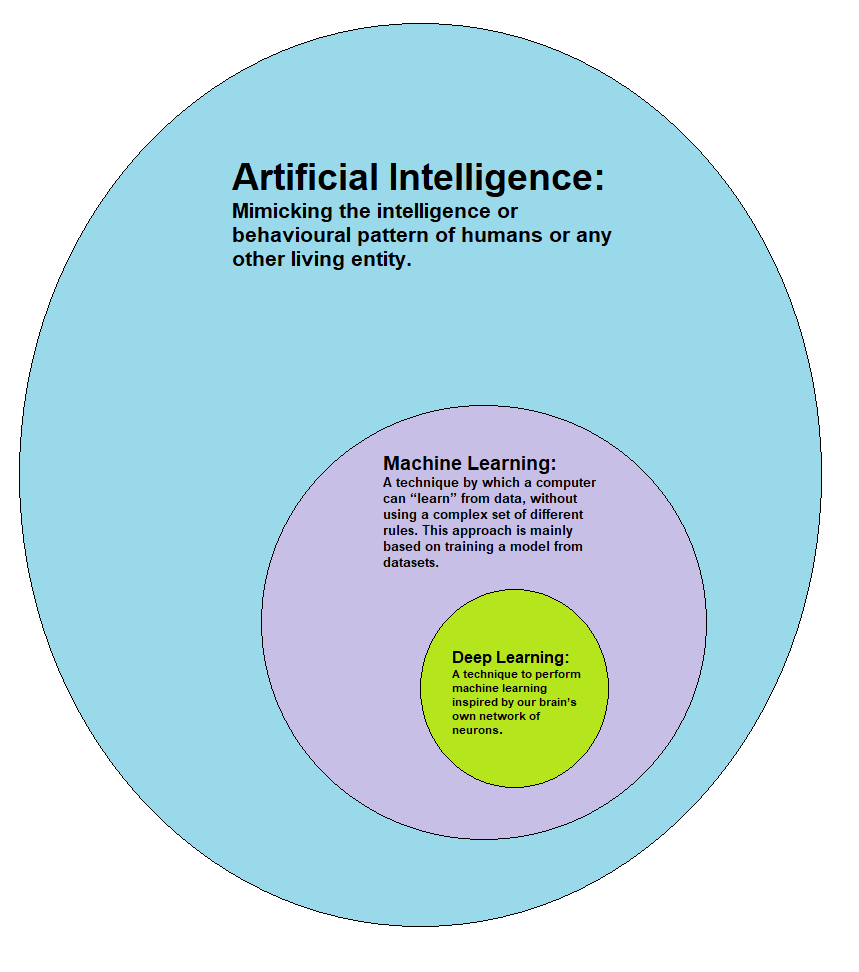
Machine Learning (ML) is the most common type of AI today. It’s the process of training a system on data so it can make predictions or decisions without being explicitly programmed. For example, an email service learns to identify spam by analyzing millions of emails you and others have marked as junk. It learns the patterns of spammy words, senders, and links on its own.
Deep Learning (DL) is a more advanced type of machine learning. It uses structures called neural networks, which are loosely inspired by the human brain. These networks have many layers that allow them to learn complex patterns from huge amounts of data. Deep learning is the magic behind facial recognition on your phone or a car's ability to identify a pedestrian.
Neural Network
noun
A computational model inspired by the structure and function of biological neural networks in the brain. It's used in deep learning to recognize complex patterns in data.
Natural Language Processing (NLP) is another branch of AI focused on helping computers understand, interpret, and generate human language. Whenever you talk to a voice assistant like Siri or Alexa, or use an app that translates text from one language to another, you're using NLP.
AI in the Wild
So where do you actually see AI in action? It's more common than you might think. Different industries use AI to solve specific problems, often in ways that are nearly invisible to us.
| Industry | Application of AI |
|---|---|
| Entertainment | Recommendation engines on platforms like Netflix and Spotify learn your taste to suggest new movies and music. |
| Healthcare | AI helps doctors analyze medical images like X-rays and MRIs to spot diseases like cancer earlier and more accurately. |
| Finance | Banks use machine learning to detect fraudulent transactions in real time by identifying unusual spending patterns. |
| Transportation | Navigation apps like Google Maps use AI to predict traffic and find the fastest route based on live data. |
| Retail | E-commerce sites use AI to power chatbots for customer service and to personalize shopping experiences. |
Each of these applications relies on the core concepts of learning from data to perform a task that would normally require human intelligence. They analyze vast datasets to find patterns we might miss, making processes more efficient and effective.
Ready to check your understanding? Let's see what you've learned.
What is the primary goal of artificial intelligence?
Which statement best describes the relationship between Artificial Intelligence (AI), Machine Learning (ML), and Deep Learning (DL)?
Understanding these fundamentals—what AI is, its key branches, and how it's used—is the first step toward figuring out how you can build with it.