Build AI Apps with Google AI Studio
Introduction to AI
What Is AI Anyway?
Artificial Intelligence, or AI, is about making machines smart. The goal is to create computer systems that can perform tasks that typically require human intelligence. This includes things like learning from experience, understanding language, recognizing objects, and solving problems.
Think of it like teaching a robot to be a chef. You wouldn't just give it a list of every possible instruction for every recipe. Instead, you'd teach it the basic principles of cooking: how to chop vegetables, how different ingredients taste together, and how to adjust heat. Over time, it could learn to create its own new dishes. AI works in a similar way, enabling machines to learn and adapt instead of just following rigid commands.
AI fundamentals encompass the basic principles, concepts, and technologies that power artificial intelligence systems.
A Quick Trip Through Time
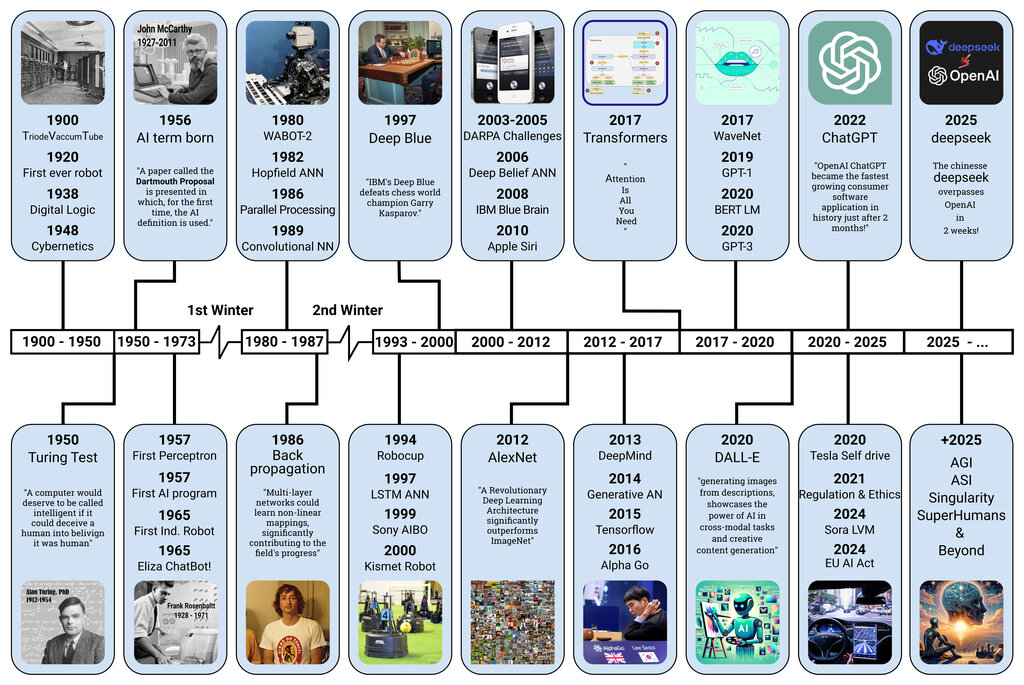
The idea of intelligent machines has been around for centuries, but the modern field of AI officially began in the 1950s. A group of scientists organized a workshop at Dartmouth College in 1956, coining the term "Artificial Intelligence" and kicking off decades of research.
Progress wasn't always a straight line. There were periods of huge excitement and funding, known as "AI summers," followed by periods of disappointment and cutbacks, called "AI winters." But with the rise of powerful computers and massive amounts of data in the 21st century, AI has experienced a major resurgence.
Not All AI Is the Same
When people talk about AI, they're usually referring to one of two broad categories. It's important to know the difference, because one is all around us and the other is still the stuff of science fiction.
| Type | Description | Examples |
|---|---|---|
| Narrow AI (ANI) | Designed to perform a specific, single task. It's very good at what it does, but it can't operate outside its programming. | Voice assistants, spam filters, recommendation engines, facial recognition. |
| General AI (AGI) | A theoretical form of AI that has human-like intelligence. It could understand, learn, and apply its knowledge across a wide range of tasks. | This does not exist yet. Think of characters like Data from Star Trek. |
Today, every AI application you interact with is a form of Narrow AI. While incredibly powerful, these systems are specialists. The AI that recommends movies on your streaming service can't drive a car, and the AI that filters your email has no idea how to play chess.
The Brains of the Operation
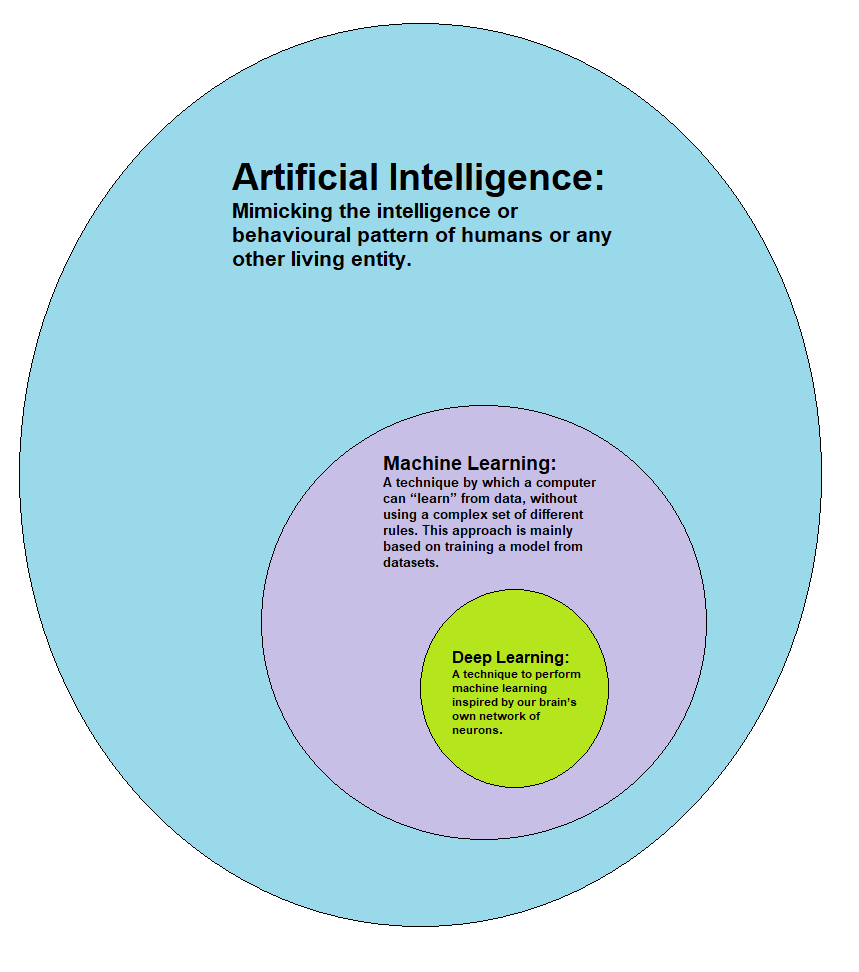
So how do machines learn to perform these tasks? The two most important concepts to understand are machine learning and deep learning. They're the engines that power most modern AI.
Machine Learning
noun
A subset of AI where algorithms are trained on large amounts of data to find patterns and make predictions without being explicitly programmed for that task.
Instead of writing rules, developers feed a machine learning model examples. To build a cat detector, you'd show it thousands of pictures labeled "cat" and thousands labeled "not cat." The model learns the patterns on its own and can then identify cats in new, unseen images.
Deep Learning
noun
A subfield of machine learning that uses multi-layered artificial neural networks, inspired by the structure of the human brain, to learn from vast amounts of data.
Deep learning is what allows AI to tackle more complex problems, like understanding natural language or generating realistic images. Its layered structure helps it recognize intricate patterns that would be difficult for simpler models to find.
AI is already woven into the fabric of our daily lives, powering everything from fraud detection in banking and personalized shopping recommendations to medical diagnoses and navigation apps.
What is the primary goal of Artificial Intelligence (AI)?
The text compares teaching an AI to teaching a robot chef. What does this analogy illustrate?
Understanding these core ideas—what AI is, its different types, and the basics of how it learns—is the first step. It provides the foundation for exploring how these powerful tools are built and used.