Build a Transformer Neural Network
Introduction to Transformers
A New Way to Handle Sequences
Many tasks in AI, like translating languages or summarizing articles, involve dealing with sequences of data. For a long time, the go-to tool for this was the Recurrent Neural Network, or RNN. RNNs process information one piece at a time, in order, just like you might read a sentence. This sequential nature seems logical, but it creates a bottleneck. To understand the last word of a long paragraph, an RNN has to process every single word that came before it.
This step-by-step process is slow and makes it difficult for the model to connect words that are far apart. Imagine trying to remember the first word of a chapter by the time you reach the end. It's tough. This is the long-range dependency problem, and it was a major hurdle for older models.
In 2017, a new architecture called the Transformer changed everything. It found a way to process entire sequences at once, breaking free from the slow, sequential nature of RNNs.
The Transformer Architecture
At its core, the Transformer has two main parts: an encoder and a decoder. Think of it like a human translator. The encoder reads and understands the original sentence in its entirety. It creates a rich numerical representation of the sentence's meaning, capturing all the nuances and relationships between words.
The decoder then takes this understanding and begins generating the translated sentence, one word at a time. The key is that the encoder has already processed the entire input, giving the decoder a complete contextual picture to work from.
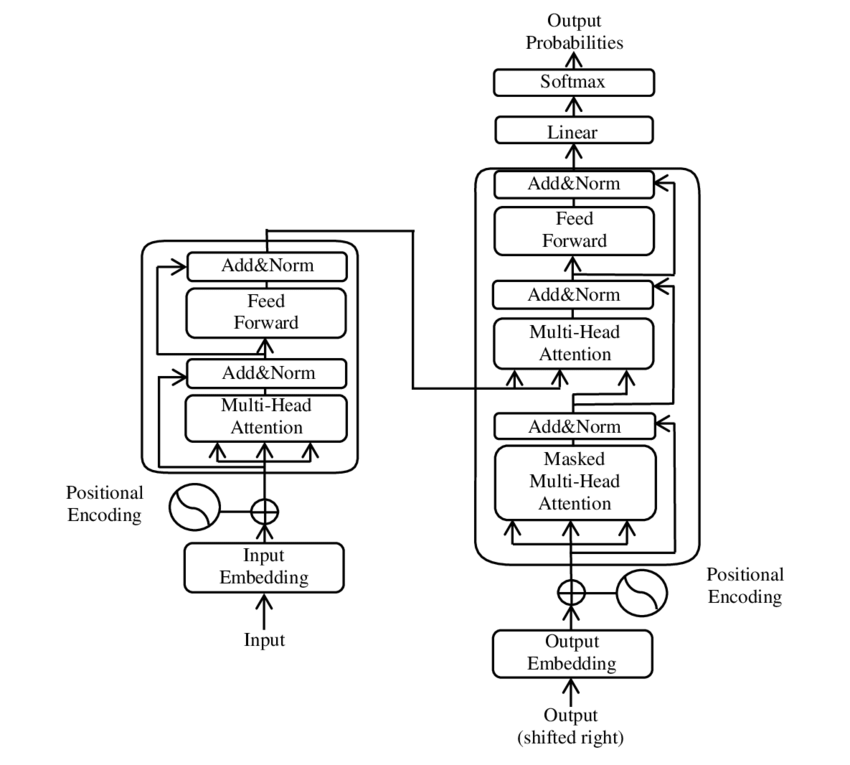
Both the encoder and decoder are built from stacks of identical layers. This design allows the model to refine its understanding of the input and the structure of the output through multiple steps of processing.
The Magic of Self-Attention
So how does a Transformer process all the words at once? The secret ingredient is a mechanism called self-attention. Instead of looking at words one by one, self-attention allows the model to look at all the words in a sentence simultaneously and weigh their importance relative to each other.
Consider the sentence: "The robot picked up the wrench because it was heavy." When the model processes the word "it," self-attention helps it determine whether "it" refers to the "robot" or the "wrench." It calculates scores that link "it" more strongly to "wrench," capturing the correct meaning. This ability to create connections between any two words in the sequence, no matter how far apart, is what makes Transformers so powerful at understanding context.
The core principle of transformers is the use of Self-Attention, which allows consideration of the context and importance of various elements in the input sequence.
This parallel approach not only allows the model to grasp long-range dependencies but also makes it much faster to train. By removing the need for sequential processing, Transformers can take full advantage of modern hardware like GPUs, dramatically speeding up the training process for massive datasets.