Build a RAG System
Introduction to RAG
Giving LLMs an Open Book
Large Language Models (LLMs) are incredibly powerful. They can write essays, generate code, and carry on conversations. But they have a fundamental limitation: they only know what they were taught during their training. Their knowledge is frozen in time and limited to the data they've seen. Ask a standard LLM about today's news or your company's internal policies, and it will likely come up empty or, worse, make something up.
This is where Retrieval-Augmented Generation, or RAG, comes in. It's a technique that gives an LLM an open book to the world's information. Instead of relying solely on its internal memory, a RAG system first retrieves relevant, up-to-date information from an external knowledge source and then uses that information to generate a better, more accurate response.
Retrieval-Augmented Generation (RAG) is an AI framework that connects a language model to an external knowledge repository, allowing the model to fetch and include relevant information when generating an answer.
The Two-Step Process
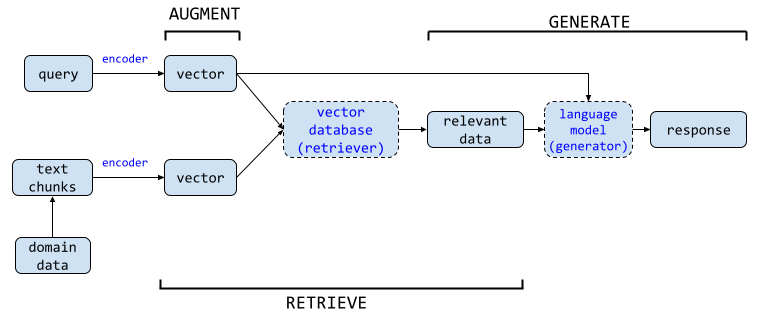
At its core, RAG works in two main phases: Retrieval and Generation. Think of it like calling an expert research assistant.
1. Retrieval (The Search): When you ask a question, the system doesn't immediately go to the LLM. First, it searches a designated knowledge base—a collection of documents, web pages, or a database—for information relevant to your query. This step is like a librarian finding the right books and articles on your topic.
2. Generation (The Answer): The relevant information found by the retriever is then packaged up with your original prompt and sent to the LLM. The model uses this new, specific context to craft its response. It's no longer answering from memory alone; it's using the provided sources to build its answer.
Why Bother with RAG?
Connecting LLMs to external knowledge solves several key problems. Standalone models can suffer from:
| Limitation | Description |
|---|---|
| Knowledge Cutoff | An LLM's knowledge is static and ends when its training data does. It can't know about events that happened yesterday. |
| Hallucination | When an LLM doesn't know an answer, it might invent a plausible-sounding but incorrect one. |
| Lack of Specificity | A general-purpose model won't know the details of your internal company wiki or a specialized engineering manual. |
RAG addresses these issues directly. By grounding the LLM's response in real, retrieved data, it improves factual accuracy and reduces the chance of hallucination. It allows the model to access the most current information and provides a way to give it specialized, private knowledge without the massive cost of retraining the entire model.
This makes AI applications more reliable, transparent, and useful for specific, real-world tasks. Now, let's check your understanding of these core concepts.
What is a fundamental limitation of a standard Large Language Model (LLM) that Retrieval-Augmented Generation (RAG) is designed to solve?
A RAG system works in two main phases. First, it ______ relevant information from an external source, and then it uses that information to ______ a response.
By adding a retrieval step, we can build smarter and more trustworthy AI systems.