Build a RAG System for Newspaper Archives
Introduction to RAG
Giving AI an Open Book Test
Large language models (LLMs) like ChatGPT are powerful, but they have a fundamental limitation: they only know what they learned during their training. Their knowledge is frozen in time. If you ask about an event that happened yesterday, or for details from a private company document, they'll come up empty. It's like taking a closed-book exam where you can only use what you've memorized.
Retrieval-Augmented Generation, or RAG, changes this. It gives the AI an open book. Instead of relying solely on its memory, RAG allows an LLM to look up relevant, up-to-date information from an external source before it answers your question. This makes the answers more accurate, timely, and trustworthy.
Retrieval-Augmented Generation (RAG) is an AI framework that connects a language model to an external knowledge repository, allowing the model to fetch and include relevant information when generating an answer.
Think of it as the difference between asking an expert to recall a fact from memory versus letting them quickly consult their library. The second approach is almost always better. RAG provides that library.
The RAG Process
The RAG process can be broken down into a few key stages. It starts with preparing a knowledge base and ends with the LLM generating a response. While it seems complex, the core idea is a simple, logical flow of information.
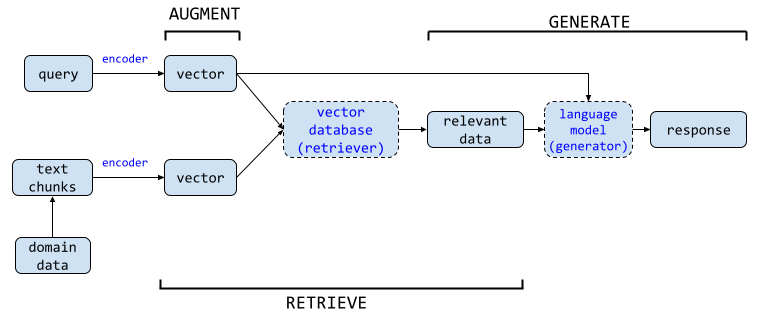
Let's walk through the four main steps: indexing, retrieval, augmentation, and generation.
1. Indexing This is the setup phase. Before you can ask any questions, you need to give the system a library of information to draw from. This could be a collection of PDFs, a company's internal wiki, or a set of technical manuals. The system processes this data, breaking it down into smaller chunks and creating a searchable index. It’s like creating a detailed map of your library so you can find any piece of information quickly.
2. Retrieval This stage kicks off when you ask a question. Instead of going straight to the LLM, the system first uses your query to search the indexed library. It finds the most relevant chunks of information related to your question. If you ask, "What were our sales figures for the last quarter?" the retrieval system finds the exact documents or passages containing that sales data.
3. Augmentation Here, the system takes the relevant information it just retrieved and combines it with your original question. This creates a new, much more detailed prompt for the LLM. The prompt now effectively says: "Using the following information [insert retrieved sales data here], answer the question: What were our sales figures for the last quarter?"
4. Generation Finally, this enhanced prompt is sent to the LLM. The model now has all the context it needs. It uses the provided data to generate a precise, factual answer. It's no longer guessing or relying on old training data; it's synthesizing an answer from the specific, up-to-date information it was just handed.
Why Does RAG Matter?
Integrating a retrieval system with a generator offers clear benefits. The most significant is a reduction in "hallucinations," where an AI confidently makes up incorrect information. Because the model's answer is grounded in specific, retrieved documents, its responses are more reliable.
It also keeps the AI's knowledge current. You can constantly update the knowledge library without having to retrain the entire model, which is a costly and time-consuming process. This makes RAG incredibly useful for a wide range of applications.
| Domain | Application of RAG |
|---|---|
| Customer Support | Answering customer questions using the latest product manuals and help articles. |
| Healthcare | Helping doctors find relevant information from medical research papers and patient histories. |
| Finance | Analyzing real-time market data and financial reports to answer investor questions. |
| Legal | Quickly searching through thousands of legal documents and case files to find precedents. |
By connecting powerful language models to curated sources of truth, RAG makes AI a more practical and trustworthy tool for everyday tasks.
Ready to check your understanding of Retrieval-Augmented Generation?
What is the primary problem that Retrieval-Augmented Generation (RAG) is designed to solve?
In the RAG process, what happens during the 'Augmentation' stage?
RAG is a clever way to enhance what LLMs can do. By giving them a library to check, we make their answers more accurate, relevant, and useful.