Buddhism for Beginners
Introduction to Buddhism
The Prince Who Woke Up
Buddhism began with one man's profound quest for answers. Around 2,500 years ago in what is now Nepal, a prince named Siddhartha Gautama was born into a life of incredible luxury. His father, a king, shielded him from all the world’s unpleasantness. He lived in beautiful palaces, surrounded by comfort, and knew nothing of aging, sickness, or death.
But a life behind palace walls couldn't last forever. As a young man, Siddhartha ventured out and encountered what are known as the Four Sights: an old man, a sick person, a corpse, and a holy man who had renounced worldly life. These encounters shook him to his core. He realized that suffering was a part of every life, and his own luxury was just a temporary illusion.
This realization sparked a powerful question: Is there a way to end suffering?
Determined to find an answer, Siddhartha left his palace, his wife, and his newborn son. He renounced his title and wealth to become a wandering ascetic. For six years, he studied with different teachers and practiced extreme self-denial, hoping to find the key to liberation. He nearly starved himself to death, but found that this path didn't lead to true understanding.
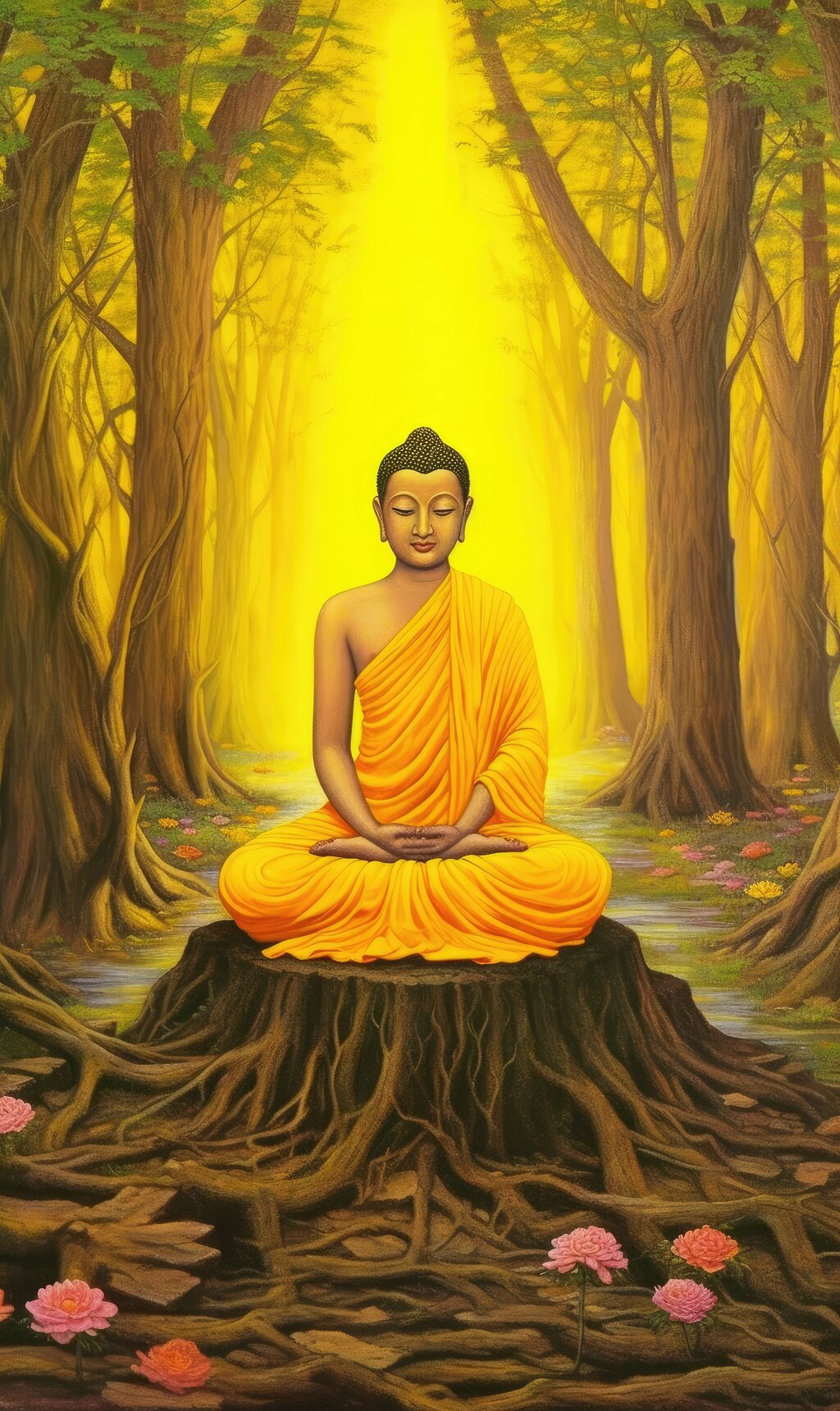
Finally, he decided to forge his own path, a "middle way" between indulgence and extreme asceticism. He sat down to meditate under a large fig tree, later known as the Bodhi tree, and vowed not to rise until he had found the truth. After a profound meditative experience, he awoke to the true nature of reality. He had achieved enlightenment. From that moment on, he was known as the Buddha, which means "the awakened one."
From India to the World
After his enlightenment, the Buddha spent the rest of his life teaching others what he had discovered. His teachings, called the Dharma, offered a practical path to end suffering. He gave his first sermon in a deer park in Sarnath, India, to a small group of ascetics who became his first disciples. This event is often called "turning the wheel of the Dharma."
These disciples formed the first Sangha, or community of monks, which helped preserve and spread the Buddha's teachings. They traveled from village to village, sharing the path to awakening with anyone who would listen, regardless of their social status or background.
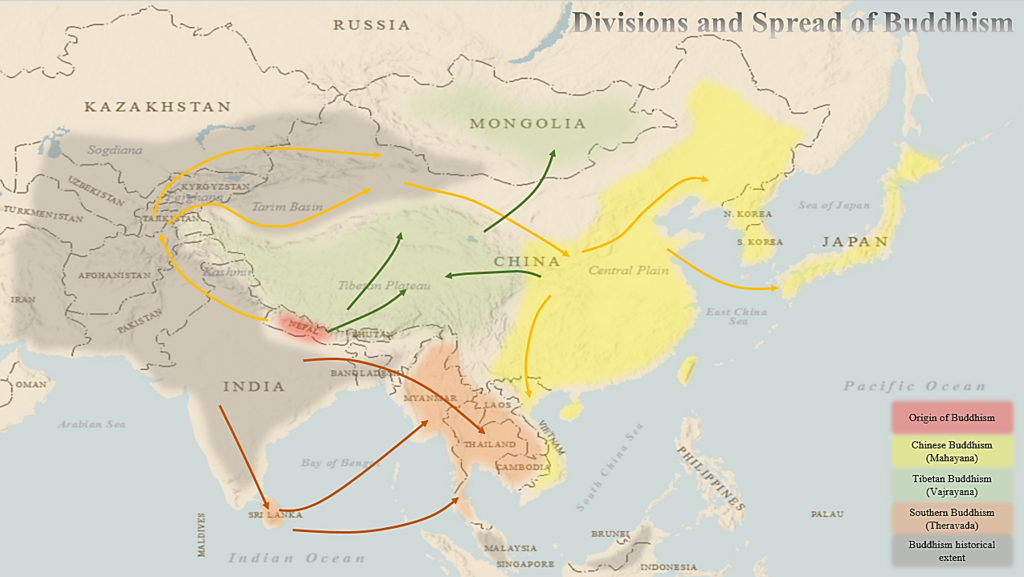
Buddhism didn't remain confined to India. Over centuries, it spread throughout Asia, carried by monks and merchants along trade routes like the Silk Road. As it moved into new lands, it adapted to local cultures, giving rise to different schools of thought. Theravada Buddhism took hold in Southeast Asia, Mahayana Buddhism spread to East Asia (China, Japan, Korea), and Vajrayana Buddhism developed in Tibet.
Core Ideas
At its heart, Buddhism is a path to understanding the nature of existence. The ultimate goal is to end dukkha, a term often translated as suffering, dissatisfaction, or stress, and achieve a state of lasting peace and liberation known as Nirvana.
This is accomplished not through faith in a creator god, but through direct insight and personal experience. Buddhism encourages people to look inward and understand their own minds.
The main goal is to see things as they really are, freeing ourselves from the cycle of suffering.
A few fundamental principles underpin this journey. One is the law of karma, the idea that our actions of body, speech, and mind have consequences that shape our future. Another is the concept of rebirth (or reincarnation), the cycle of life, death, and new life driven by karma. The Buddha taught that we can break free from this cycle.
His specific, detailed instructions for doing so, such as the Four Noble Truths and the Eightfold Path, form the core of Buddhist practice. These provide the framework for living an ethical life and training the mind.
Now, let's test your understanding of these foundational concepts.