BSc PMCs Integrated Sciences
Computational Mathematical Logic
From Logic to Language
Logic isn't just about winning arguments. In the world of computing, it's the bedrock language that allows machines to reason. We've seen how propositional logic uses statements that are either true or false. But to build complex systems, we need a more expressive tool. That's where predicate logic comes in.
Predicate logic introduces variables and quantifiers. It lets us move from a simple statement like "The server is online" to a general rule like "For all servers , if is in the main cluster, then the status of is online." This is a massive leap in expressive power. We can now make claims about entire collections of objects, not just single instances.
This ability to generalise is what allows us to write algorithms that work on any valid input, or database queries that search through millions of records. We're not just stating facts; we're defining the rules and properties of a system. This formalisation is the first step in bridging the gap between a human idea and a computational task.
Building with Sets and Relations
The variables in predicate logic don't exist in a vacuum. They range over specific collections of objects, which we formally define using sets. Set theory provides the vocabulary for grouping things together. The universal quantifier in our server example, , implicitly operates on the set of all servers.
Beyond simple collections, we need to describe how elements within sets interact. We do this with relations. A relation is just a set of ordered pairs that defines a connection. For instance, in a social network, the "is friends with" relation can be described as a set of pairs like {(Alice, Bob), (Bob, Charlie)}. This rigorous structure is exactly what databases use to store and query relational data.
These formalisms, rooted in systems like , are essential for preventing ambiguity. They provide a solid foundation for defining data structures and operations, ensuring that a command means exactly one thing.
Logic in Silicon
How do these abstract ideas of logic and sets become physical computations? The answer lies in , a system where variables can only have two values: true (1) and false (0). The core operations are simple: AND, OR, and NOT.
This two-state system is perfect for representing the on/off states of electrical signals in a transistor. By combining millions of transistors into structures called logic gates, we can physically implement Boolean operations. An AND gate only outputs a '1' if both of its inputs are '1'. An OR gate outputs a '1' if at least one input is '1'.
These simple gates are the fundamental building blocks of all digital hardware. From them, we can construct more complex circuits that perform arithmetic, store data, and execute instructions. Every complex algorithm running on a processor ultimately boils down to an intricate sequence of these basic logical operations.
The Limits of Computation
Now that we can express logic formally and build machines that execute it, a crucial question arises: What problems can computers actually solve? This is the domain of automata theory and formal languages.
A is a set of strings defined by a precise set of rules. For example, the language of all binary strings with an even number of 1s. An automaton is an abstract mathematical model of a computer that acts as a recogniser for a formal language. It takes an input string and determines whether it belongs to the language by entering an 'accept' state.
The simplest automaton is the , which has a limited memory. It can recognise simple patterns, like those found by a text search, but can't handle more complex structures like ensuring brackets are correctly matched in code. For that, you need a more powerful model like a Pushdown Automaton, which has a stack for memory.
The most powerful model is the Turing Machine, which has an infinite tape for memory. The Church-Turing thesis posits that any problem that can be solved by an algorithm can be solved by a Turing Machine. Problems that a Turing Machine cannot solve are considered undecidable. This sets a fundamental limit on the power of computation.
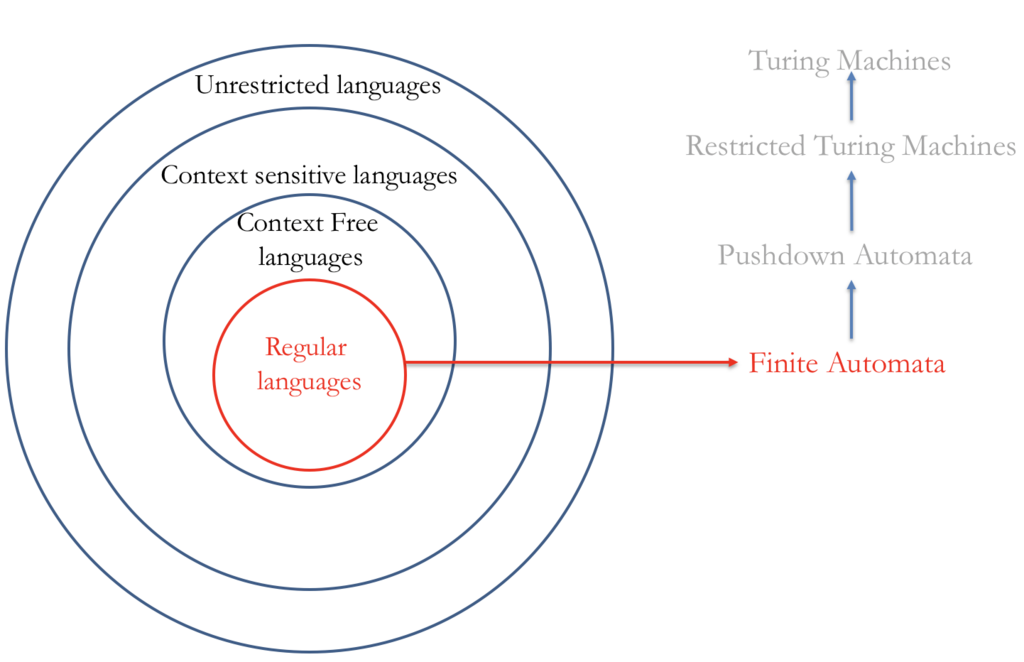
This theoretical framework isn't just an academic exercise. It directly influences programming language design, compiler construction, and our understanding of what is and isn't possible to compute, forming a core part of theoretical computer science and even physics models that treat the universe as a computational system.
Understanding these layers, from abstract predicate logic to the physical constraints of automata, gives us a complete picture of computational logic. It's the toolkit we use to build, reason about, and ultimately understand the limits of the digital world.