Brazilian Jiu-Jitsu Fundamentals
Introduction to Brazilian Jiu-Jitsu
The Gentle Art
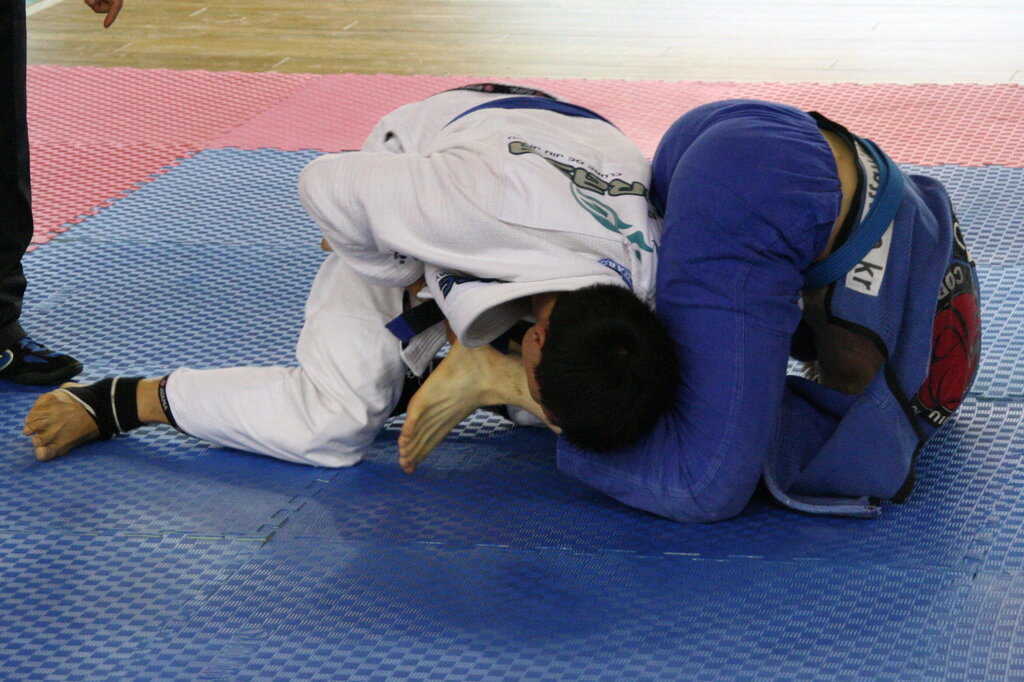
Brazilian Jiu-Jitsu, or BJJ, is a martial art and combat sport based on grappling and ground fighting. It's often called “the gentle art” because it doesn’t rely on striking. Instead, the goal is to control and submit an opponent using leverage, angles, and pressure. This core principle makes it possible for a smaller, weaker person to defend themselves against a larger, stronger attacker.
Brazilian Jiu-Jitsu is often called “the gentle art” because it relies on leverage, timing, and strategy rather than brute force.
Think of it like using a lever to lift a heavy object. With the right tool and technique, you don't need immense strength. BJJ teaches you how to use your body as a system of levers and frames to control an opponent's body. It’s a thinking person's game, often compared to physical chess, where strategy trumps raw power.
From Japan to Brazil
The story of BJJ begins in the early 20th century. A Japanese master of Judo named Mitsuyo Maeda traveled to Brazil. There, he taught his art to a young man named Carlos Gracie.
Carlos shared the techniques with his brothers, including the smallest and frailest, Hélio Gracie. Because of his size, Hélio couldn't rely on the strength and athleticism that many Judo throws required. So he began to experiment. He refined the techniques, adapting them to focus almost entirely on ground fighting and leverage. He created a system that empowered him to defeat much larger opponents. This modified art became Brazilian Jiu-Jitsu.
The Positional Game
In BJJ, fighting isn't a chaotic scramble. It's a strategic battle for position. The core idea is to move through a hierarchy of positions, each one offering more control and more opportunities to attack. Your goal is to constantly improve your position while preventing your opponent from improving theirs.
Imagine you're on the bottom with someone on top of you. That's a bad spot. Your first job isn't to immediately try for a submission. It's to get to a safer, more neutral position, like the guard, where you can use your legs to control the distance. From there, you might try to sweep them and get on top yourself. Once on top, you can advance through other dominant positions.
This concept is often summarized as: Position before submission.
This hierarchy provides a roadmap for a BJJ match. Instead of feeling lost, you always have a clear goal: improve your position. Control comes from achieving a dominant position, and from that control, you can safely and effectively apply a submission.
Time to see what you've learned about the fundamentals of Brazilian Jiu-Jitsu.
What is the primary principle that allows a smaller, weaker person to be effective in Brazilian Jiu-Jitsu?
Hélio Gracie adapted the techniques he learned because his smaller size made it difficult to use the strength-based throws common in which martial art?
BJJ is a deep and rewarding martial art. By focusing on these core ideas of leverage, position, and control, practitioners build a solid foundation for everything that follows.