Brainwaves and Oxygenation
Brainwave Activity
The Brain's Electrical Symphony
Your brain is constantly buzzing with activity, even when you're asleep. This activity is powered by billions of neurons firing in coordinated patterns, sending electrical messages to one another. When large groups of neurons synchronize their firing, they produce a rhythmic electrical pulse. We call these pulses brainwaves.
Think of it like a crowd at a stadium. The roar of the crowd is the combined sound of thousands of individual voices. Similarly, a brainwave is the combined electrical signal of thousands of firing neurons.
These waves aren't just random noise. They are the rhythms of your mind, and their patterns change depending on what you're doing or thinking. By measuring these waves, we can get a glimpse into the brain's inner workings. The speed of these rhythms is measured in cycles per second, or Hertz (Hz).
The Five Rhythms of the Mind
Brainwaves are categorized into five main types based on their frequency. Each type is associated with different mental states, from deep sleep to intense focus.
| Brainwave | Frequency (Hz) | Associated State |
|---|---|---|
| Delta (δ) | 0.5–4 Hz | Deep, dreamless sleep, healing |
| Theta (θ) | 4–8 Hz | Light sleep, deep relaxation, meditation |
| Alpha (α) | 8–12 Hz | Calm wakefulness, passive attention |
| Beta (β) | 12–30 Hz | Active thinking, focus, problem-solving |
| Gamma (γ) | 30–100+ Hz | Peak concentration, high-level processing |
When you're deeply asleep and your body is repairing itself, slow Delta waves dominate. As you drift into a light sleep or a meditative state, your brain shifts to slightly faster Theta waves.
Close your eyes and let your mind wander. That calm, reflective state is linked to Alpha waves. Right now, as you read and process this information, your brain is likely producing faster Beta waves. This is the rhythm of active engagement and concentration.
Finally, Gamma waves are the fastest of all. They are associated with moments of intense focus, insight, and binding different pieces of information together to form a coherent whole.
How We Measure Brainwaves
So how do we listen in on this electrical symphony? The most common method is electroencephalography, or EEG. It’s a non-invasive technique that uses a special cap fitted with small metal discs called electrodes.
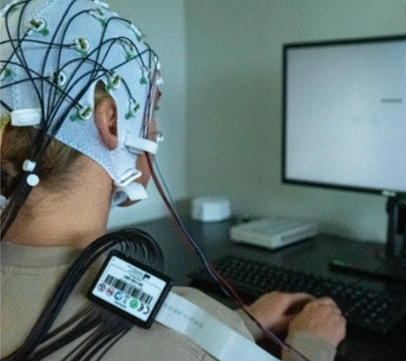
These electrodes are placed on the scalp to detect the tiny electrical signals generated by your neurons. The signals are then amplified and recorded, showing up as wavy lines on a computer screen. Each line represents the activity from a different part of the brain.
Electroencephalography
noun
A non-invasive method for recording the electrical activity of the brain along the scalp.
EEG is invaluable in both clinical and research settings. In hospitals, it's a key tool for diagnosing conditions like epilepsy, which is characterized by abnormal bursts of electrical activity. It's also used to study sleep disorders by tracking how brainwaves change throughout the night. Researchers use EEG to understand cognitive processes, such as how the brain responds to new information or makes decisions.
If a person is in a state of deep, dreamless sleep, which type of brainwave would be most dominant?
What is the primary unit of measurement for the speed, or frequency, of brainwaves?
Understanding brainwaves gives us a powerful window into the mind's activity, linking our internal states to measurable electrical patterns.