Brain Vision and AI
Visual Neuroscience Foundations
The Journey of Light
Your ability to see the world begins with light entering your eyes. This light first passes through the cornea and lens, which focus it onto a light-sensitive layer of tissue at the back of the eye called the retina. The retina isn't just a simple screen; it's a complex piece of neural tissue that starts processing visual information immediately.
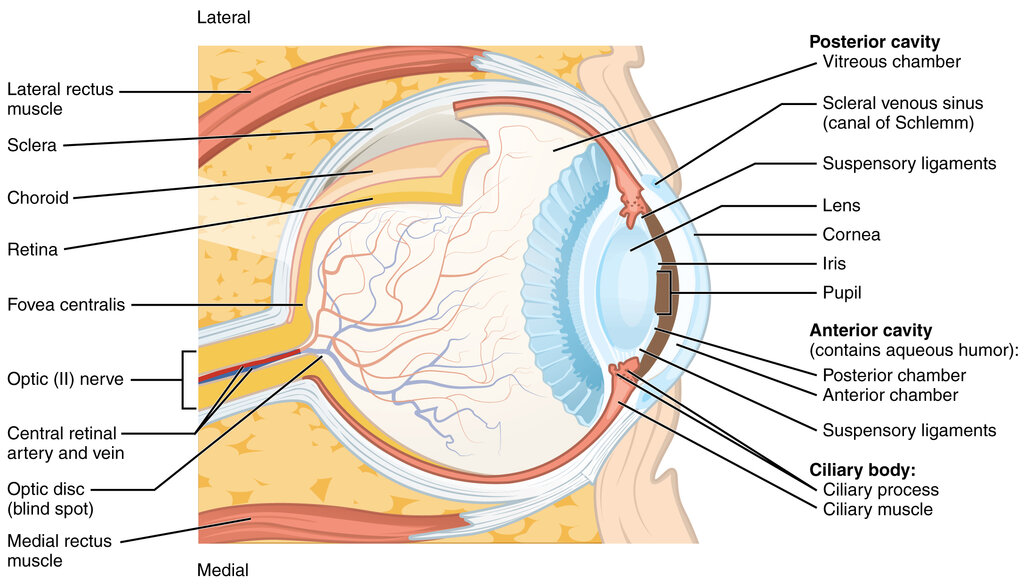
The retina contains photoreceptor cells, known as rods and cones, which convert light into electrical signals. These signals are then passed through a network of other retinal cells before being sent to the brain via the optic nerve.
Each eye's optic nerve carries signals from the retina to a point in the brain called the optic chiasm. Here, something interesting happens: signals from the right side of your visual field (from both eyes) are routed to the left hemisphere of your brain, and signals from the left side of your visual field go to the right hemisphere. This crossover ensures that each side of the brain receives information from the opposite side of the world.
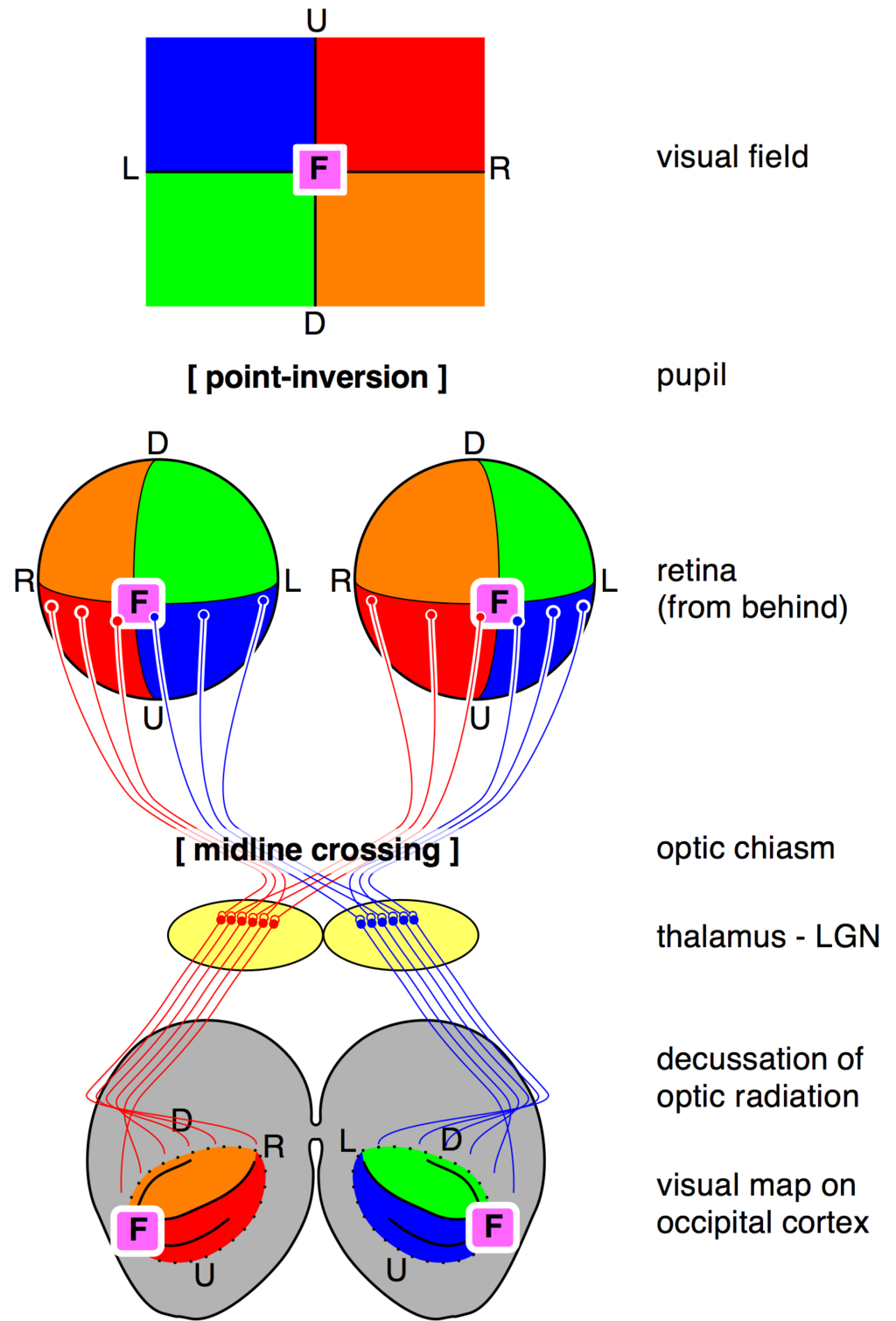
After the optic chiasm, the signals travel to a relay station in the thalamus called the lateral geniculate nucleus (LGN). Finally, the information arrives at its main destination in the occipital lobe: the primary visual cortex, also known as V1.
Making Sense of the Scene
Once visual information reaches V1, the brain's real interpretive work begins. The neurons in V1 don't just see a raw picture. Instead, each neuron is responsible for a tiny portion of the visual field. This specific area that a neuron responds to is its receptive field.
Receptive Field
noun
The specific region of the visual field in which a stimulus will affect the firing of that neuron.
Some neurons in V1 have receptive fields that are activated by simple stimuli, like a line or an edge at a particular orientation. One neuron might fire only when it detects a horizontal line, while its neighbor fires only for a vertical one. From V1, this processed information splits and travels along two major pathways, each with a different job.
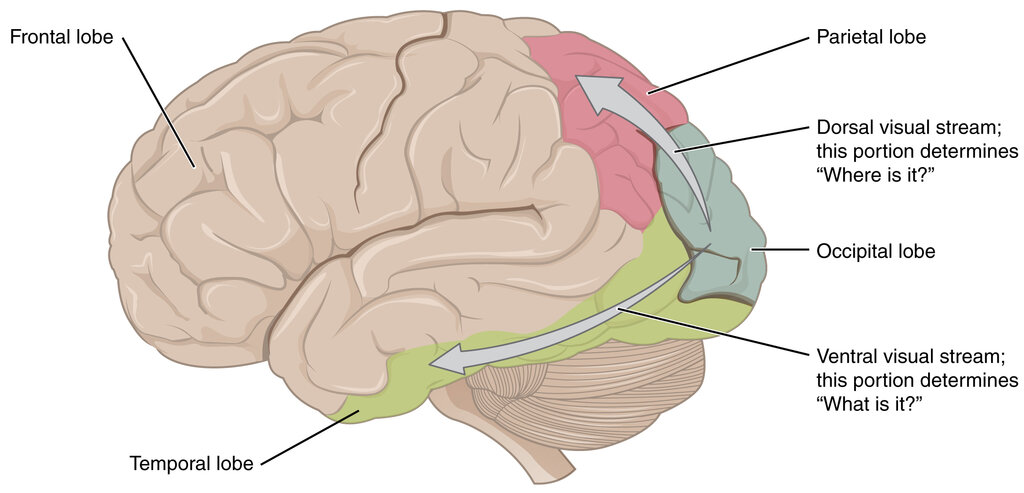
The first is the ventral stream, often called the "what" pathway. It flows from the occipital lobe to the temporal lobe and is crucial for object recognition. It helps you identify what you are looking at—a face, a book, or a tree.
The second is the dorsal stream, or the "where" pathway. This path goes from the occipital lobe to the parietal lobe. It's responsible for processing spatial information, like an object's location, speed, and direction of movement. It helps you understand where the object is and how to interact with it, like reaching out to grab a cup.
Building the Big Picture
Visual processing is hierarchical. The brain builds a complex understanding of the world by starting with simple features and assembling them into more complex representations. It's like building with blocks: you start with individual shapes and then combine them to create intricate structures.
This process starts in V1, where neurons detect basic features like edges, colors, and orientations. This information then travels to higher-level visual areas (like V2, V3, and so on). In these areas, neurons have larger receptive fields and respond to more complex stimuli. For example, a neuron in a later stage might combine the inputs from several V1 neurons to recognize a corner or a curve.
As the information moves further up the hierarchy, especially along the ventral stream, neurons respond to even more complex things, like entire objects or faces. This layered approach allows your visual system to construct a rich, detailed, and meaningful perception of the world from the simple patterns of light hitting your retinas.
Time to review these core concepts.
Now, let's test your understanding of how the brain sees.
What is the correct sequence for visual information traveling from the eye to the primary visual cortex?
The ______ stream, also known as the 'what' pathway, is responsible for object recognition, while the ______ stream, or 'where' pathway, processes spatial information.
This foundational understanding of how our brains process visual information is the first step in exploring the intricate machinery of perception.