Boxing Mastery and Technical Application
Mechanics and Kinetic Links
Power From the Ground Up
A powerful punch doesn't start in your fist. It doesn't even start in your shoulder. Real power begins with your feet on the canvas. Think of your body as a whip. The handle is your feet, and the tip is your fist. To make the tip crack, you don't just flick your wrist; you swing the whole thing, starting from the handle. This sequence of movement is called the kinetic chain—a series of linked body segments working in order to generate maximum force.
Every punch is a full-body movement. Your arms are just the delivery system.
When you throw a cross, for example, the motion initiates with your rear foot pushing off the ground. This drive travels up your leg, causing your hips to rotate explosively. Your torso follows, whipping your shoulder forward. Only at the very end of this chain does your arm extend to deliver the impact. By the time your fist makes contact, it's carrying the momentum generated by your entire body.
The Pivot is Power
The engine of your rotation is the foot pivot. For a cross or a hook, squashing the bug with your rear foot isn't just a cue, it's the mechanism that unlocks your hips. As you pivot on the ball of your foot, your heel turns outward, forcing your hip to rotate forward. This rotation creates torque, the twisting force that gives your punches their knockout potential.
Every punch starts from the ground up.
Without a proper pivot, you're just throwing with your arm. Your punch will be weak and easily timed. The pivot ensures that your body mass is behind the strike. For a lead hook, the same principle applies to your lead foot. The pivot allows your hips to open up, generating torque in the opposite direction and whipping the lead arm around.
Proper weight distribution is also critical. To maximize power, you need to 'sit down' on your punches. This means slightly lowering your center of gravity as you throw, transferring your weight from the back foot to the front foot during a cross, or keeping it centered for a powerful hook. This engages your legs and core more effectively, adding body weight to the punch. It also makes you more stable and less likely to be pushed off balance.
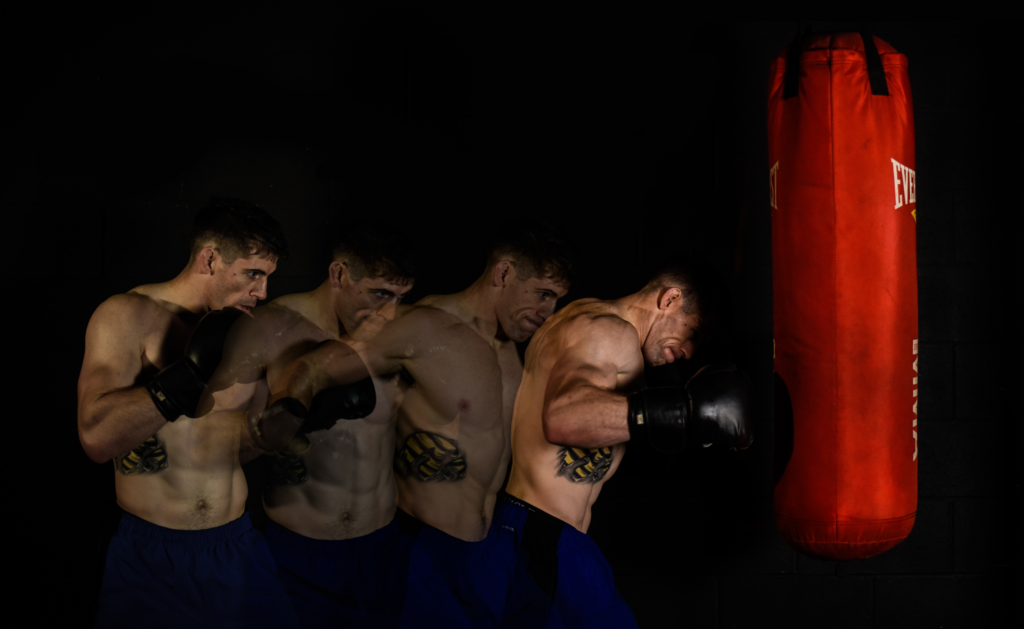
However, there's a trade-off. Committing your weight for a power shot feels great when it lands, but it can leave you vulnerable. If you over-rotate or lean too far forward, you're off-balance and exposed to counters. This is where recovery comes in.
The Snap Back
A punch is not complete when your fist hits the target. It's complete when your hand is back in its defensive guard position. The faster you can recoil, the sooner you're ready to defend or throw another punch. Think of it as a rubber band: it's not just about the stretch, but the snap back.
The punch that knocks you out is often the one you don't see coming, thrown right after your own.
Drill your punches with an equal focus on retraction. This discipline prevents you from over-committing your weight and leaving your chin exposed. A powerful punch that gets you knocked out is a net loss. The goal is to integrate power, speed, and defense into one fluid motion, ensuring every strike you throw doesn't create an opening for your opponent.
Ready to test your understanding of these mechanics? Let's see how these concepts have landed.
According to the concept of the kinetic chain, where does the power for a strong punch primarily originate?
What is the primary mechanical purpose of pivoting the rear foot (the "squash the bug" motion) when throwing a cross?
Mastering the kinetic chain turns a simple punch into a complex, powerful, and safe offensive weapon. It's the difference between being a brawler and a boxer.