Boxing Mastery and Tactical Application
Optimizing the Kinetic Chain
Power from the Ground Up
You already know how to throw a jab, a cross, and a hook. But where does the power really come from? It isn't your arm. A truly powerful punch starts from the floor, harnessing the laws of physics to create a wave of force that ends at your fist.
This sequence of movement is called the kinetic chain. Think of it as a whip. The handle starts the motion, but the tip is what cracks. In boxing, your feet are the handle. They push against the canvas, creating what's known as ground reaction force—the equal and opposite force the ground exerts back on you. This initial energy travels up through your legs, multiplies as your hips and torso rotate, and is finally transferred through your shoulder, arm, and into your opponent.
Without properly linking these segments, you're just arm-punching. An arm punch is fast but weak, and it leaves you exposed. A punch linked through the kinetic chain is powerful, efficient, and safer, because your body remains a solid, balanced structure.
The Cross and Weight Transfer
The cross is the perfect punch to illustrate the kinetic chain. As you initiate the punch, you pivot on the ball of your rear foot, rotating your heel outwards. This isn't just a foot movement; it's the start of a powerful hip and torso rotation. Your body weight, which was distributed evenly or slightly on the back foot, drives forward.
This rotation and forward weight shift is what generates the immense power of the cross. The arm is just the delivery system. The goal is to have your fist make contact at the exact moment your kinetic chain is fully engaged and your weight has committed forward. The rotation of your torso also adds range to your punch, allowing you to hit from further away.
Crucially, you must be able to recover your stance instantly. After the cross lands, your weight shouldn't be stranded forward. Snap your hand back to your guard and reset your feet. A powerful offense is useless if it shatters your defense.
Hooks and Balance
The hook is a devastating punch, but its rotational nature makes it tricky. Throwing a wild hook is a recipe for getting knocked out, as it can easily spin you off-balance. The key is managing your .
For a lead hook, you pivot on your lead foot, generating rotational force from the ground up, just like with the cross. However, instead of shifting your weight forward, you are keeping it centered or even slightly loading it onto the lead leg. Your core must be tight to transfer this rotational energy without letting your upper body fly open.
Think of your spine as an axis. Your body rotates around it. Your lead arm comes around in a tight arc, and your rear hand stays glued to your chin. The power comes from the sharp, sudden rotation of the hips and torso, not from swinging your arm. After the punch, you should be in the exact same solid, balanced stance you started in, ready to defend or throw another punch.
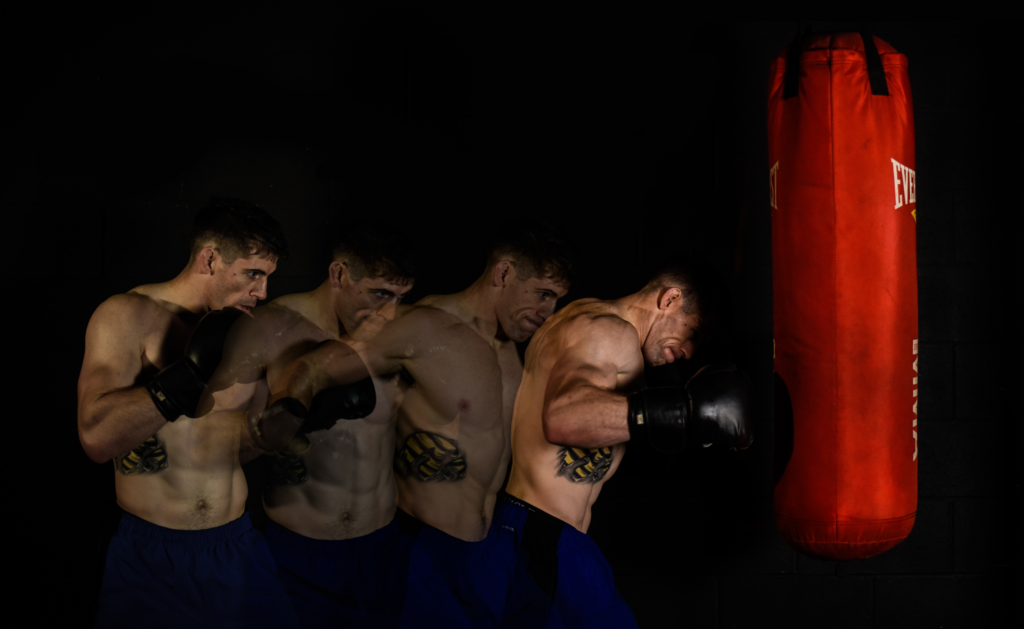
The Versatile Jab
The jab is your most important tool, and its application changes based on how you manage your weight. We can break it down into two main types: the flicking jab and the stiff jab.
The flicking jab is about speed and distraction. It's used to test your opponent's reactions, obscure their vision, and set up more powerful punches. There is very little weight transfer here. It's a quick extension of the arm, a snap of the wrist, and an immediate retraction. The power comes from speed, not body mass.
The stiff jab, or power jab, is different. It's meant to stop an opponent in their tracks. To throw it, you take a small, sharp step forward with your lead foot as you punch. This subtle step drives your body weight into the jab, creating a much more forceful impact. It feels less like a whip and more like a battering ram. Mastering when to use each type is key to controlling the fight.
| Feature | Flicking Jab | Stiff Jab |
|---|---|---|
| Purpose | Range finding, setup, disruption | Stopping opponent, causing damage |
| Weight Shift | Minimal to none | Small step forward |
| Speed | Maximum | High, but slower than flicking |
| Power | Low | High |
| Recovery | Instant | Very fast, but slightly slower |
Understanding these mechanics transforms your punches from simple arm movements into full-body athletic actions. Let's test your knowledge on these concepts.
The sequence of force generation starting from the feet, moving through the legs, hips, and torso, and ending at the fist is known as what?
What is the key mechanical difference between a flicking jab and a stiff (or power) jab?
By focusing on the kinetic chain, you ensure that every punch is not only powerful but also safe, keeping you balanced and ready for whatever comes next.