Boxing Basics Mastery
Boxing Stances
Your Fighting Foundation
Everything in boxing begins with your stance. It's your base of operations for every punch, block, and step you take. A solid stance gives you balance and power, while a weak one leaves you vulnerable. Before you even think about throwing a punch, you need to find your footing.
Your stance is determined by which hand is your dominant one. This splits boxers into two main categories: orthodox and southpaw.
Orthodox
adjective
A stance used by right-handed boxers. The left foot and left hand are forward, with the more powerful right hand held back.
Southpaw
noun
A stance used by left-handed boxers. The right foot and right hand are forward, with the more powerful left hand held back.
Don't overthink it. If you're right-handed, you're likely an orthodox fighter. If you're left-handed, you're probably a southpaw. The goal is to keep your power hand in the rear, ready to deliver stronger punches, while your lead hand jabs and controls distance.
Positioning Your Body
Once you know whether you’re orthodox or southpaw, you can build your stance. Let's break down the key components, assuming an orthodox stance for these examples. If you're a southpaw, just mirror these instructions.
Foot Positioning: Stand with your feet about shoulder-width apart. Your lead foot (left) should point slightly inward, toward your opponent. Your rear foot (right) should be angled out at about 45 degrees, with your heel slightly off the ground. Your feet shouldn't be on the same line; imagine you're standing on either side of a plank of wood.
This staggered position is crucial for balance. It keeps you from being easily knocked over and allows you to move smoothly in any direction.
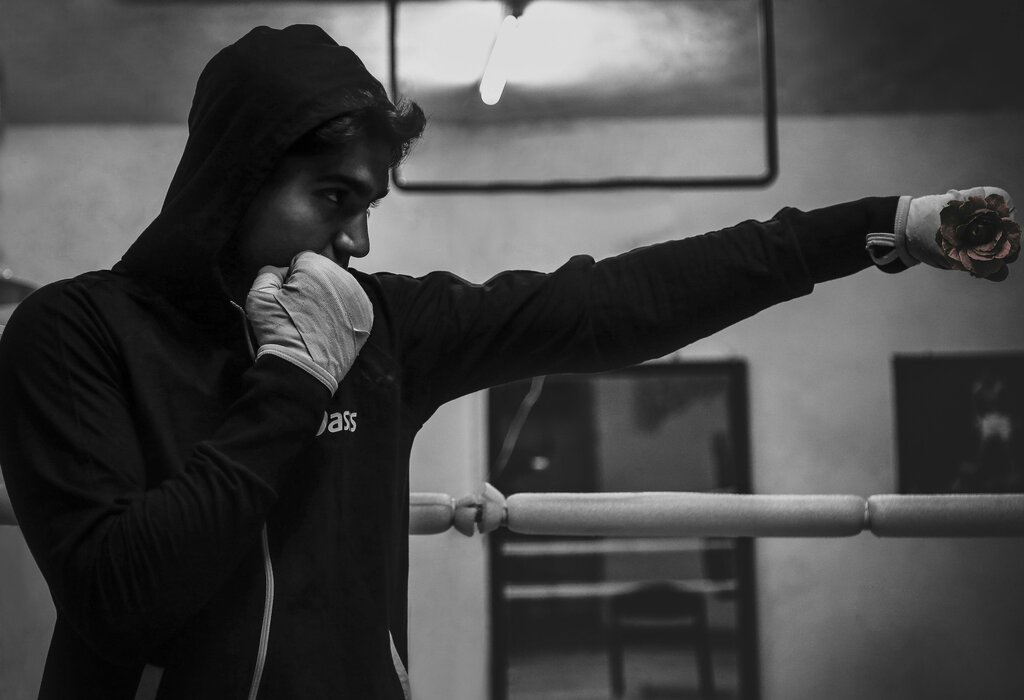
Weight Distribution: Your weight should be distributed almost evenly between your feet, maybe 55% on your back foot and 45% on your front. This keeps you centered and ready to shift your weight to throw a punch or move away from one. Keep your knees slightly bent; never lock them.
Hand Placement: Your hands are your first line of both offense and defense. Bring them up. Your rear hand (right) should rest against your cheek, protecting your chin. Your lead hand (left) should be held slightly forward, at about eye level. Keep your chin tucked down and your elbows in, protecting your body.
A good stance feels both stable and springy. You should be able to hold your ground but also feel light on your feet, ready to react.
Stance Variations
While the basic principles of foot and hand placement remain the same, boxers adjust their height for different situations. These variations are generally known as the upright, semi-crouch, and full crouch stances.
| Stance | Description | Best For | Trade-Off |
|---|---|---|---|
| Upright | Standing tall with minimal knee bend. | Staying mobile, fighting at a distance, maximizing reach. | Less power in punches, easier to push off balance. |
| Semi-Crouch | A balanced stance with a comfortable knee bend. | All-purpose fighting; a blend of power, defense, and mobility. | Not specialized; a master of none. |
| Full Crouch | A low stance with a deep knee bend, leaning forward. | Generating power, making yourself a smaller target. | Slower movement, can be tiring to maintain. |
Most of the time, you'll use the semi-crouch. It’s the most versatile and efficient stance, allowing you to adapt quickly. You might switch to an upright stance to move around the ring faster or use a full crouch when you're looking to land a powerful body shot or slip under your opponent's punches.
Now that you understand the building blocks of a proper boxing stance, it's time to review.
Let's test your knowledge.
What primarily determines if a boxer's stance is orthodox or southpaw?
Why is a boxer's power hand typically kept in the rear position?
Mastering your stance is the first major step. With a solid foundation, you'll be ready to build upon it with movement and punches.