Bored versus Driven Piles
Installation Mechanics
The Mechanics of Installation
Unlike bored piers, which involve excavating soil to create a void, driven piles are about displacement. The goal is to force a pre-manufactured structural element into the ground, compacting the soil around it. This process relies on powerful machinery designed to deliver immense energy in a controlled way. The workhorses of this operation are pile drivers, primarily categorised as impact hammers and vibratory hammers.
The Force of the Hammer
Impact hammers do exactly what their name suggests: they strike the top of the pile with repeated blows, driving it downwards. The core mechanism involves lifting a heavy ram and letting it fall onto an anvil, which transfers the energy into the pile. While the principle is simple, the method of lifting the ram varies, leading to different hammer types.
| Hammer Type | Power Source & Mechanism | Key Characteristics |
|---|---|---|
| Diesel | Internal Combustion | Self-contained; ram is lifted by explosion of atomised diesel fuel. Loud and produces exhaust. |
| Hydraulic | External Hydraulic Power Pack | Precise control over hammer energy and stroke height. Quieter than diesel. |
| Air/Steam | External Compressor/Boiler | Older technology; ram is lifted by compressed air or steam. Less common now due to efficiency. |
Diesel hammers are powerful and self-contained, making them highly mobile on a job site. The cycle starts when the ram is lifted, drawing in fuel and air. When it's released, it falls, compressing the air-fuel mixture until it combusts, driving the pile down and simultaneously forcing the ram back up for the next cycle. Hydraulic hammers offer far more control. An external power unit pumps hydraulic fluid to lift the ram, allowing operators to adjust the force of each blow. This is crucial when dealing with sensitive urban environments or complex soil layers. Air and steam hammers, once the industry standard, function similarly but are less efficient and have been largely superseded by hydraulic systems.
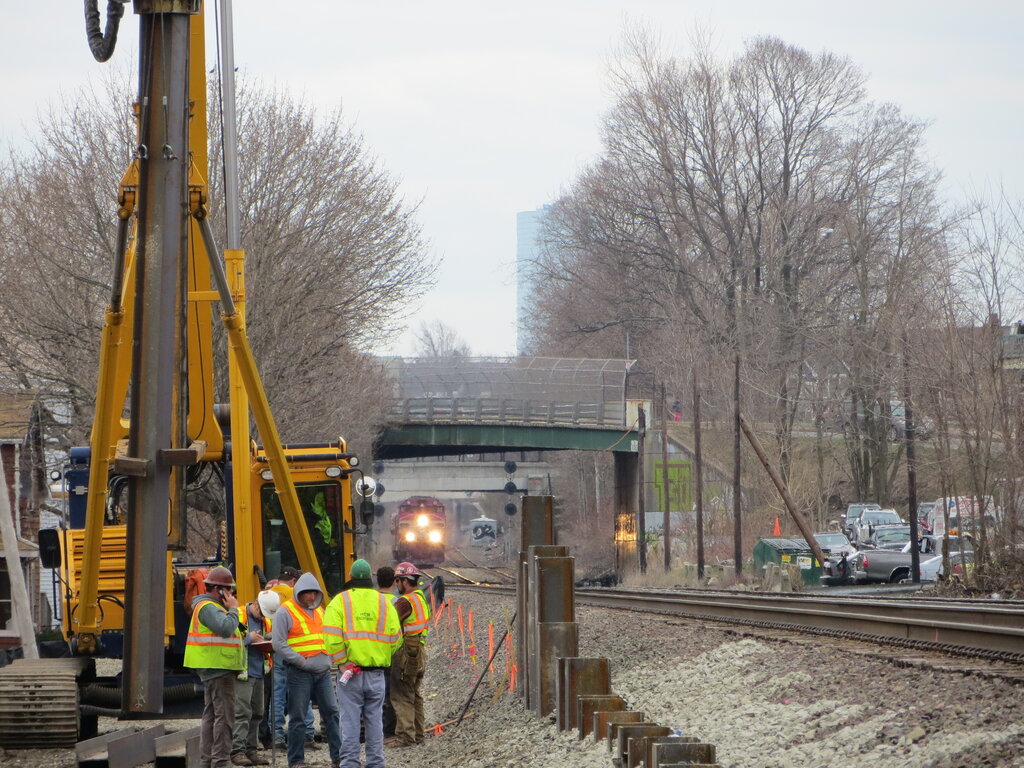
A Different Rhythm
Vibratory hammers take a completely different approach. Instead of forceful impacts, they use high-frequency vibrations to agitate the soil particles adjacent to the pile. This process, known as thixotropy in granular soils like sand and gravel, temporarily reduces skin friction, allowing the pile to sink into the ground primarily under its own weight, plus the weight of the hammer.
This method is highly effective and much faster than impact driving in non-cohesive soils. However, in cohesive soils like dense clay, the vibrations don't create the same liquefying effect. The clay tends to absorb the energy, making vibratory driving inefficient. Often, a project might use a vibratory hammer to drive a pile most of the way and then switch to an impact hammer for the final seating in a denser bearing layer.
From Start to Set
The installation process begins with positioning the pile (whether steel H-pile, precast concrete, or timber) under the hammer. A 'cushion' of softer material, like wood or a synthetic polymer, is often placed between the hammer's anvil and the pile head to prevent damage. The driving then commences.
The operator monitors the pile's penetration per blow. The goal is to reach a specific depth determined by the design drawings or to drive until a state of 'refusal' is achieved. This doesn't mean the pile stops moving entirely, but rather that it takes a very high number of blows—say, 20 blows—to drive it just one inch. This indicates the pile has reached a sufficiently dense stratum and has adequate bearing capacity. This final blow count is often called the 'set criteria'.
The choice of pile material impacts the driving process. Steel H-piles can withstand very high driving stresses. Pre-cast concrete piles are strong in compression but can be brittle, requiring careful energy control to prevent cracking. Timber piles are lighter but can be damaged ('broomed') at the top or tip if overdriven.
But how do we know the hammer's energy translates to the required capacity? Engineers use a method called Wave Equation Analysis of Piles (WEAP). This is a computer modeling technique that simulates the driving process. It treats the hammer, pile, and soil as a series of springs and masses. By inputting data about the hammer, pile properties, and soil conditions, WEAP can predict the pile's static bearing capacity based on the blow count observed during installation. It helps engineers select the right hammer for the job and establish the final set criteria before driving even begins.
From a logistics standpoint, driven pile operations have a different footprint than bored pier construction. While you avoid the need for managing large volumes of excavated soil or bentonite slurry, you require a stable, clear area for the crane and hammer, as well as significant laydown space for storing the long pile sections before they are driven. The choice between driving and boring often comes down to these ground-level logistics as much as the subterranean soil conditions.
What is the primary principle behind installing driven piles?
A contractor is driving piles into a site with loose, granular sand. Which type of hammer would be the most efficient for driving the pile for most of its length?
That covers the essential mechanics of installing driven piles. The process is a blend of raw power and precise engineering analysis, ensuring each pile provides a solid foundation.