Bored Piles and Drilled Shaft Foundations
Boring Techniques
Creating the Void
Unlike driven piles, which force soil out of the way, bored piles are 'replacement' piles. The process starts by creating a void, removing soil from the ground to make space for the concrete and steel reinforcement. This excavation is done using a large, powerful machine called a rotary drilling rig which bores a cylindrical hole, or borehole, to the required depth.
The fundamental choice in this process is how to keep the borehole from collapsing before it can be filled with concrete. The site's soil conditions and groundwater level dictate the strategy. This leads to two primary methods: dry boring and wet boring.
The Dry Method
When working with stable, cohesive soils like stiff clay or silt that can stand on their own without support, engineers can use the dry boring method. It's the simplest and most direct approach. The process is straightforward: a drilling tool, typically a flight auger, bores into the ground, and the excavated soil is brought to the surface.
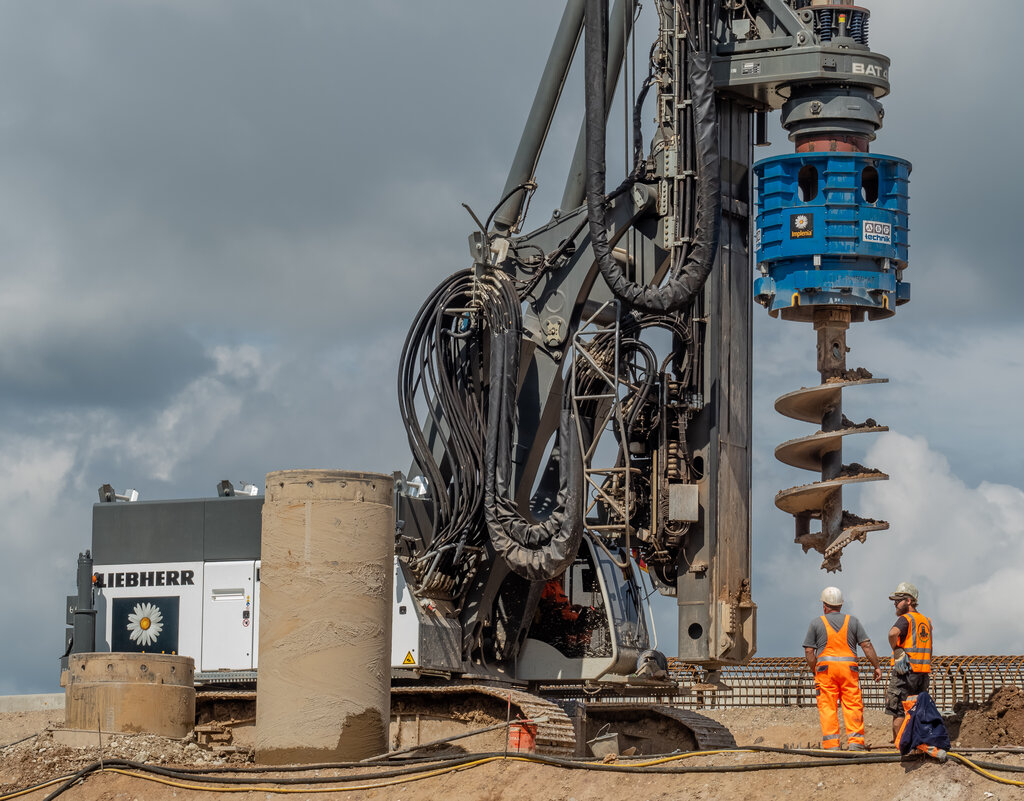
The auger works like a giant corkscrew, cutting into the soil and carrying the cuttings upwards along its spiral flights as it rotates. Once the auger is full, the operator lifts it from the hole, spins it rapidly to fling the soil off to the side, and then lowers it back down to continue digging. This cycle repeats until the borehole reaches its target depth.
For rock or very hard soil, the auger is swapped out for a rock core barrel, which grinds away at the hard material. After the hole is bored, a cleaning bucket may be used to remove any loose debris from the bottom, ensuring a clean base for the pile.
The dry method is preferred for its speed and lower cost, but it's only suitable when the ground is stable enough to prevent the borehole walls from caving in.
The Wet Method
In less cooperative ground, such as loose sand, gravel, or any soil below the water table, the dry method is not an option. The borehole would immediately collapse. Here, the wet boring method is used. This technique involves filling the borehole with a drilling fluid as it's being excavated.
This fluid, often a bentonite slurry or a polymer-based fluid, serves a critical purpose. It exerts hydrostatic pressure on the walls of the borehole, counteracting the pressure from the surrounding soil and groundwater. This pressure effectively holds the hole open, preventing it from collapsing. Think of it as creating a stable, liquid casing.
For wet boring, a drilling bucket is often used instead of an auger. This tool looks like a large cylindrical bucket with cutting teeth and a hinged flap at the bottom. The bucket is lowered into the fluid-filled hole and rotated. The cutting teeth scrape soil from the bottom, which fills the bucket. When the bucket is lifted, the flap closes, trapping the soil and slurry inside. At the surface, the bucket is emptied, and the process repeats.
The drilling fluid is continuously circulated, cleaned, and reused throughout the process. Once the borehole reaches the desired depth and the rebar cage is placed, concrete is pumped into the bottom of the hole through a long pipe called a tremie. As the concrete fills the hole from the bottom up, it displaces the lighter drilling fluid, which is pumped out from the top. This ensures the pile has no voids or contamination.
| Feature | Dry Boring Method | Wet Boring Method |
|---|---|---|
| Soil Type | Cohesive, stable soils (e.g., stiff clay) | Non-cohesive, unstable soils (e.g., sand, gravel) |
| Groundwater | Above the water table | Below the water table |
| Support | None needed; soil is self-supporting | Drilling fluid (e.g., bentonite slurry) |
| Primary Tool | Auger, Rock Core Barrel | Drilling Bucket |
| Complexity | Simpler, faster | More complex, requires fluid management |
Choosing the correct boring technique is one of the first and most critical decisions in bored pile construction. It's a direct response to the story the ground tells us.
What is the fundamental difference between bored piles and driven piles as described in the text?
A geological survey for a construction project reveals stiff, cohesive clay that is well above the water table. Which boring method is most suitable for this situation?
Understanding these methods provides a solid foundation for the next steps in pile construction.