Bored Pile Engineering and Construction
Drilling Methodology Trade-offs
Choosing Your Weapon: Rotary vs. CFA Piling
When you need a deep, strong foundation, bored piles are a common solution. But how you create the hole for that pile is a critical engineering decision. Two dominant methods are Rotary Boring and Continuous Flight Auger (CFA) piling. While both create bored piles, they operate on different principles and are suited for very different ground conditions and project constraints.
Think of Rotary Boring as a process of methodical excavation. A large drilling rig rotates a telescopic pipe called a kelly bar. Attached to the end is a specialised tool, usually an auger for soils or a bucket for loose material. The rig applies immense torque to drive the tool into the ground, filling it with soil. The kelly bar is then withdrawn, the tool is emptied, and the process repeats. This cycle continues until the desired depth is reached. A temporary steel casing or drilling fluid like bentonite slurry is often used to keep the hole from collapsing in unstable ground.
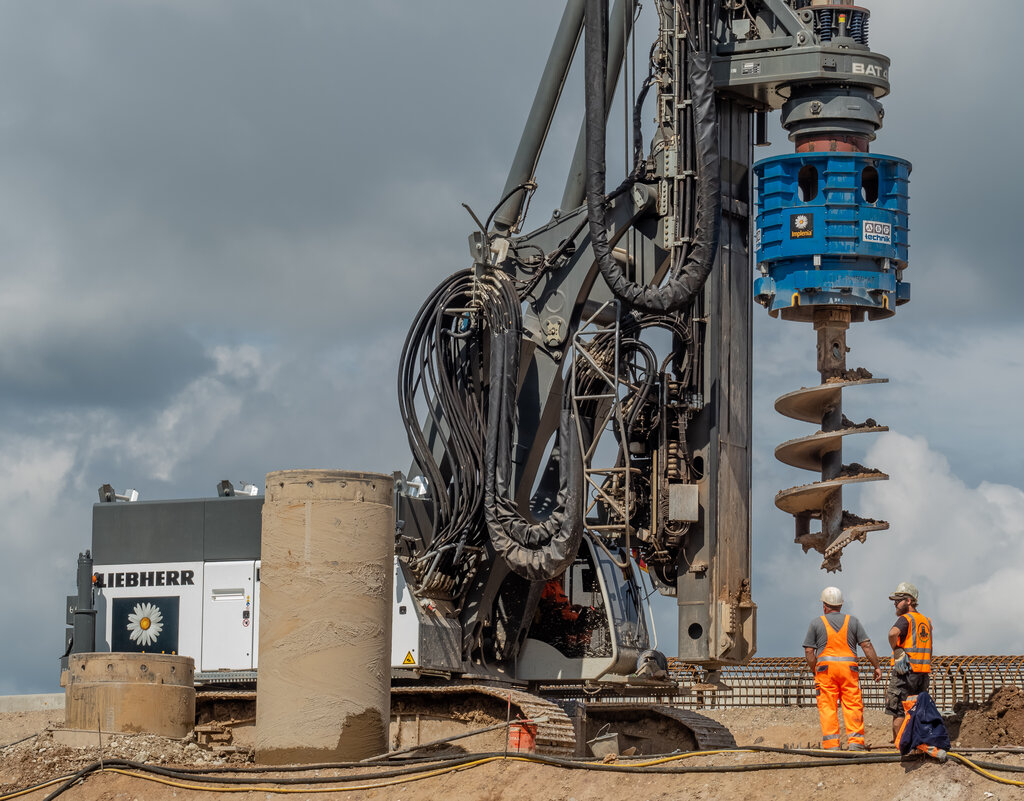
The major advantage of rotary boring is its power and versatility. It can create very large diameter piles—sometimes over 3 metres—and reach significant depths. More importantly, with the right attachments like core barrels, it can drill through hard rock to create a solid foundation base, a process known as . This makes it ideal for supporting immense loads, like those from high-rise buildings or major bridges.
The Continuous Flight Auger Method
The Continuous Flight Auger (CFA) method takes a different approach. Instead of an intermittent drilling cycle, a CFA rig uses a single, long auger with a hollow stem that drills to the full depth in one continuous movement. The auger's flights are packed with soil as it drills down, which provides support to the sides of the borehole and prevents it from collapsing.
Once the target depth is reached, the magic happens. High-pressure concrete is pumped down through the hollow stem of the auger. As the concrete fills the hole from the bottom up, the auger is slowly and carefully withdrawn, carrying the excavated soil with it. A steel reinforcement cage is then immediately pushed into the fresh concrete. The whole process is quick, clean, and highly effective in unstable soils like sand and gravel, where an open hole would collapse instantly.
Making the Call: Key Trade-offs
Choosing between these methods involves weighing several factors. Rotary boring is an excavation process; it physically removes soil from the ground, which then needs to be managed and transported off-site. CFA is largely a soil displacement method. As the auger drills down, it compacts the soil to the sides, and only a portion of the soil is brought to the surface on the flights. This results in less spoil to handle, which can be a significant cost and logistical advantage.
Rotary excels in power and depth, handling rock with ease. CFA excels in speed and stability, especially in soft ground.
Environmental constraints are also a major consideration. Rotary drilling, especially when driving casing with a vibratory hammer, can produce significant noise and ground vibration. This can be disruptive in urban areas or dangerous to nearby sensitive structures. CFA piling, by contrast, is a much quieter, low-vibration method. The continuous drilling and auger support make it a preferred choice for projects in .
| Feature | Rotary Boring | Continuous Flight Auger (CFA) |
|---|---|---|
| Primary Use | Deep foundations, hard ground, rock | Soft to firm ground, unstable soils |
| Diameter | Large (up to 3m+) | Smaller (typically < 1.2m) |
| Depth | Very Deep (> 70m) | Moderate (up to ~35m) |
| Speed | Slower (cyclical process) | Faster (continuous process) |
| Vibration & Noise | High | Low |
| Spoil Handling | High volume of excavated soil | Low volume of displaced soil |
| Ground Support | Requires casing or slurry | Self-supporting via auger |
| Site Footprint | Large rigs, requires more space | Generally smaller rigs |
Ultimately, the choice is a classic engineering trade-off. If you're building a skyscraper on a site with deep bedrock, the power of rotary boring is non-negotiable. If you're constructing a medium-rise building in a sandy, urban lot, the speed, low disturbance, and efficiency of CFA make it the clear winner. The right rig depends entirely on the ground beneath your feet and the constraints of the world around you.