Boolean Algebra and Logic Circuit Design
Introduction to Boolean Algebra
The Math of True and False
At its heart, Boolean algebra is a very simple system of logic. Instead of dealing with numbers like 1, 2, or 3.14, it only deals with two values: true and false. In the world of computers and electronics, we often represent these as 1 for true and 0 for false.
This system was developed by George Boole in the 1800s. He wanted to give algebra to logic itself. It turns out this is the perfect way to describe how computer circuits work. Every decision a computer makes, from adding two numbers to rendering a complex video game, breaks down to these simple true or false operations.
Boolean algebra is the language of digital electronics. It allows us to design and simplify the circuits that power our technology.
The Basic Operations
There are three fundamental operations in Boolean algebra that act as the building blocks for everything else: AND, OR, and NOT.
AND
conjunction
The AND operation is true only if all of its inputs are true. Think of it as a strict condition. For the statement "the light is on AND the door is closed" to be true, both individual parts must be true.
In Boolean expressions, the AND operation is often represented by a dot () or simply by writing the variables next to each other, like multiplication (). Here’s how it works:
| A | B | A AND B |
|---|---|---|
| 0 | 0 | 0 |
| 0 | 1 | 0 |
| 1 | 0 | 0 |
| 1 | 1 | 1 |
OR
conjunction
The OR operation is true if at least one of its inputs is true. It's more flexible. If you're told "you can have cake OR ice cream," you'd be happy if you got either one, or even both.
The OR operation is represented by a plus sign (). Notice how the output is 1 in every case except when both inputs are 0.
| A | B | A OR B |
|---|---|---|
| 0 | 0 | 0 |
| 0 | 1 | 1 |
| 1 | 0 | 1 |
| 1 | 1 | 1 |
NOT
adverb
The NOT operation is the simplest. It just inverts the input. If the input is true, the output is false. If the input is false, the output is true.
NOT is represented by a bar over the variable () or a prime symbol (). It only operates on a single input.
| A | NOT A |
|---|---|
| 0 | 1 |
| 1 | 0 |
Why Boolean Algebra Matters
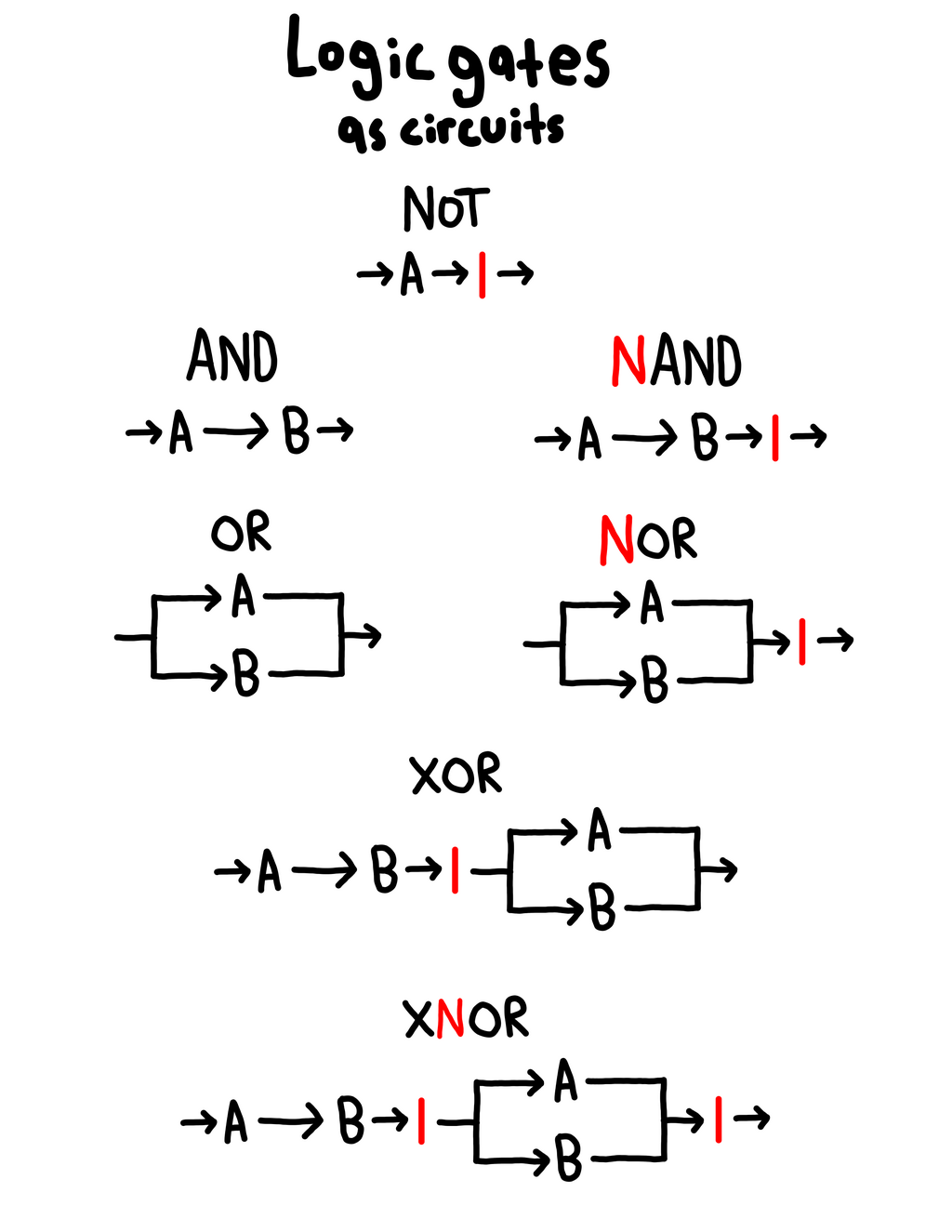
These operations aren't just abstract ideas. They are physically built into computer chips as tiny electronic switches called logic gates. An AND gate is a circuit that implements the AND operation, an OR gate implements the OR operation, and so on.
Millions, or even billions, of these gates are combined to create the complex circuits in your phone or computer. Boolean algebra gives engineers a way to design these circuits on paper first. By using the rules of this algebra, they can simplify complex expressions. A simpler expression means a circuit with fewer logic gates, which makes the chip smaller, faster, and more energy-efficient.
For example, a circuit to control a car's warning light might be expressed as:
Warning = (EngineHot AND NOT OilOK) OR LowFuel
This logical statement can be directly translated into a combination of AND, NOT, and OR gates. This is the fundamental link between logic and modern electronics.
Who is credited with developing the system of logic that forms the basis of modern computer circuits?
The Boolean OR operation () results in 'false' (0) only when...
Boolean algebra provides the essential rules for managing the 1s and 0s that form the foundation of all digital technology.