Bologna through the Ages
Etruscan Felsina and Bononia
A City at the Crossroads
Long before the Romans, the city we now call Bologna was an important Etruscan settlement known as Felsina. The were a sophisticated civilization that flourished in ancient Italy, and they chose their locations carefully. Felsina sat in a perfect strategic position, nestled at the foot of the Apennine mountains where they meet the vast, fertile Po Valley.
This location made it a natural crossroads for trade. Goods and people moving between central Italy and the rest of Europe had to pass through this corridor. Felsina became a bustling hub, controlling the flow of commerce and ideas. Its power came not from a coastal port but from its command of vital inland routes.
The Roman Grid
After a period of occupation by the Gallic tribe, the Romans conquered the area in 191 BCE. They quickly recognized its strategic value and established a Latin colony, renaming the city Bononia. More than just a new name, this marked a complete transformation of the urban landscape. The Romans imposed their signature urban planning: a rigid, geometric grid.
This layout, with its perpendicular main streets—the cardo (north-south) and decumanus (east-west)—formed the skeleton of the new city. This structure wasn't just for aesthetics; it was a highly efficient system for administration, troop movement, and civic life. Amazingly, this ancient Roman grid still defines the core street plan of modern Bologna. The main east-west artery, the decumanus maximus, was a segment of a much larger project that would secure the city's future.
The Artery of the North
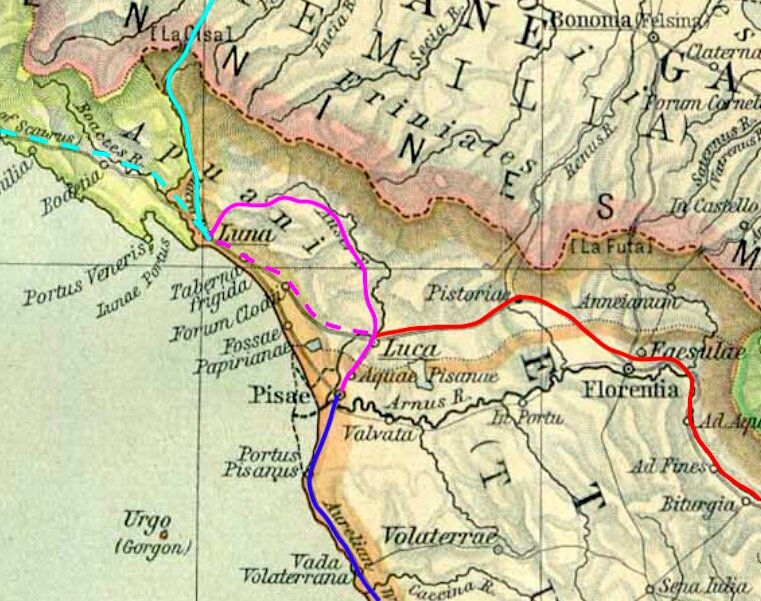
That project was the , a major Roman road constructed in 187 BCE. It stretched from Rimini on the Adriatic coast to Piacenza, effectively connecting the Po Valley to the rest of Roman Italy. Bononia's position directly on this military and commercial highway was a game-changer. It became a vital gateway, channeling resources, soldiers, and trade between Rome and its newly conquered northern territories.
To support the growing city, the Romans also applied their renowned engineering skills to water management. They developed a sophisticated system of canals and aqueducts to supply Bononia with fresh water and manage waste. This early hydraulic engineering laid the groundwork for the complex network of waterways that would become a hallmark of Bologna in the Middle Ages.
Let's review the key terms from this period of Bologna's history.
Now, check your understanding of the city's early development.
What was the original Etruscan name for the city we now know as Bologna?
What was the primary strategic advantage of Felsina's location for the Etruscans?
The strategic foundation laid by the Etruscans and solidified by Roman engineering ensured that Bologna would remain a city of central importance for centuries to come.