Boilers Explained
Boiler Fundamentals
What is a Boiler?
At its heart, a boiler is a simple and powerful device. It's a closed vessel where water is heated. The purpose is to transfer heat from a fuel source, like natural gas or oil, into that water. This process can produce either hot water or steam, depending on the boiler's design and intended use.
The hot water might be used to heat a building, while the steam can be used for a much wider range of applications, from sterilizing equipment in a hospital to spinning massive turbines that generate electricity.
The Key Components
While boilers come in countless shapes and sizes, they all share a few fundamental components that work together to safely and efficiently transfer energy.
Burner
noun
This is where the magic starts. The burner is the device that mixes fuel with air and ignites it, creating a controlled flame that produces heat.
The flame is contained within the combustion chamber, or furnace. This is a robust, fire-proof box designed to withstand intense temperatures. The primary job of this chamber is to contain the heat and direct it toward the water.
The most critical part is the heat exchanger. This is a network of tubes or passages that keeps the combustion gases and the water separate but allows heat to pass from one to the other.
Finally, every boiler has a set of controls. These are the brains of the operation. They monitor pressure and temperature, regulate the fuel and water flow, and ensure the system operates safely. Modern controls are highly automated, maintaining efficiency and shutting the system down if a problem is detected.
How Heat Moves
Boilers rely on the three fundamental principles of heat transfer to move energy from the burning fuel into the water.
- Radiation: The bright flame from the burner radiates thermal energy in all directions, just like the sun radiates light and heat. This energy travels as electromagnetic waves and is absorbed by the inner walls of the combustion chamber and the heat exchanger.
- Convection: This is heat transfer through the movement of fluids. The hot gases produced by combustion swirl around the heat exchanger, transferring their energy to the metal surfaces. Inside the tubes, the water heats up, becomes less dense, and rises, allowing cooler water to take its place. This constant circulation, or convection current, efficiently distributes heat throughout the water.
- Conduction: This is heat transfer through direct contact. Heat from the combustion gases is conducted through the solid metal walls of the heat exchanger to the water on the other side. Think of how the handle of a metal spoon gets hot when you leave it in a cup of tea.
A Simple Cycle
The entire operation follows a continuous loop. It begins when the controls signal a need for heat, activating the burner. The fuel ignites, and the combustion chamber heats up.
Heat is transferred to the water in the heat exchanger, causing its temperature to rise. If it's a hot water boiler, this heated water is then pumped out to radiators or other systems. If it's a steam boiler, the water continues to heat until it boils and turns into high-pressure steam.
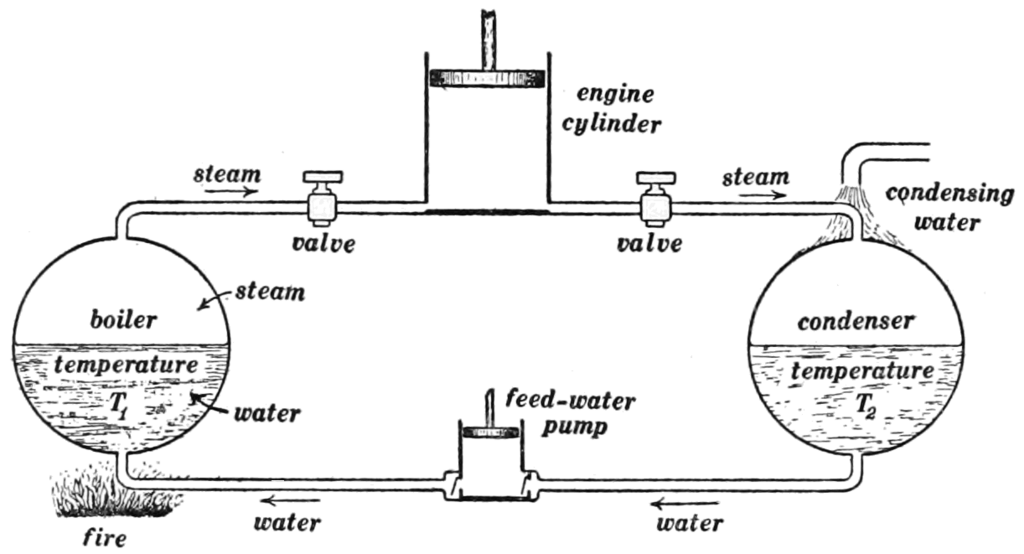
This steam is then piped away to do its job. After it has released its energy (for example, by spinning a turbine), it cools, condenses back into water, and is returned to the boiler to be heated again, completing the cycle.
What is the primary function of a boiler's combustion chamber?
When heat passes from the hot gases through the solid metal walls of a heat exchanger to the water, which mode of heat transfer is occurring?
Understanding these core ideas—the main parts, the methods of heat transfer, and the basic operating cycle—is the key to seeing how all different types of boilers work.