Blue Whale Migration Mysteries
Blue Whale Basics
The Biggest Animal on Earth
The blue whale (Balaenoptera musculus) is the largest animal known to have ever existed, dwarfing even the largest dinosaurs. These marine mammals can grow up to 98 feet long and weigh as much as 200 tons. To put that into perspective, their heart alone is the size of a small car, and their tongue weighs as much as an elephant.
Despite their immense size, blue whales have a long, slender, and streamlined body, which is a mottled blue-gray color. This coloration appears light blue when seen through the water, which is how they got their name. They are graceful swimmers, capable of reaching speeds of over 20 miles per hour when needed.

Seeing their skeleton helps us appreciate their incredible scale. Every bone, from the enormous jaw to the tiny vestiges of hind limbs, tells a story of evolution and adaptation to a life spent entirely in the ocean.
A Krill-Powered Giant
It might seem strange that the largest animal survives by eating one of the smallest. Blue whales are filter feeders, and their diet consists almost exclusively of krill, which are tiny, shrimp-like crustaceans. During the feeding season, an adult blue whale can consume up to 6 tons—or about 40 million—of these tiny creatures every single day.
Instead of teeth, blue whales have baleen plates hanging from their upper jaw.
baleen
noun
A filter-feeding system inside the mouths of baleen whales. These plates are made of keratin, the same protein that makes up human hair and fingernails.
To eat, a blue whale opens its mouth and takes in a colossal gulp of water and krill. Its throat has pleats that expand to hold the massive volume. It then pushes its tongue against the roof of its mouth, forcing the water out through the baleen plates. The krill are trapped inside, ready to be swallowed.
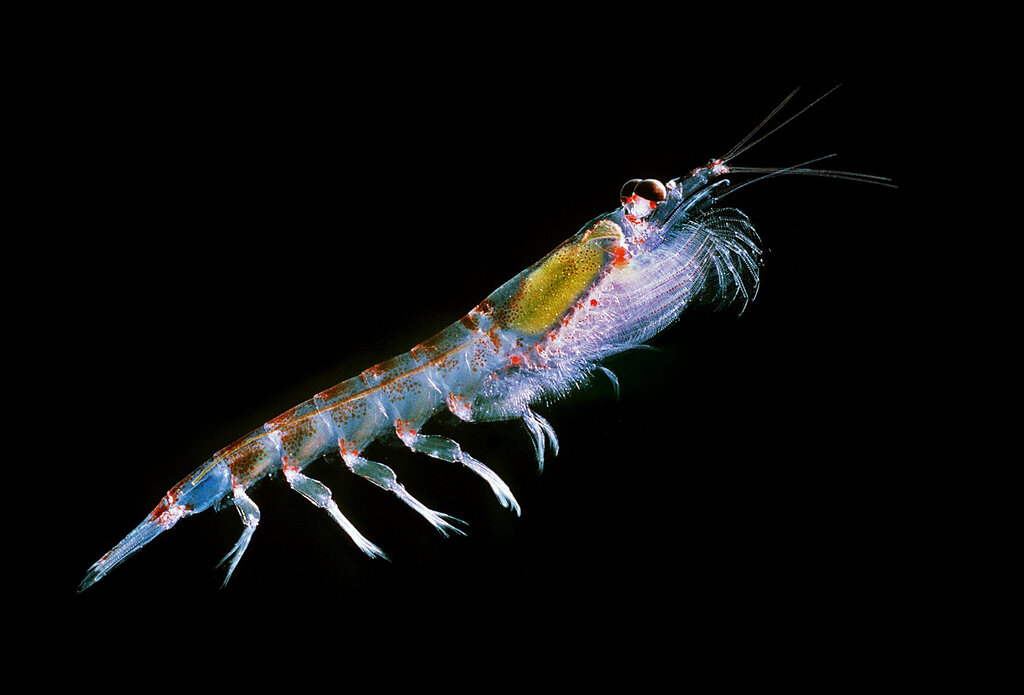
A Lonely Traveler
Unlike some other whale species that travel in large, social groups called pods, blue whales are typically solitary. They usually swim alone or in pairs, though they may gather in larger numbers in areas with abundant food.
Blue whales are found in every ocean around the globe except for the Arctic. Scientists recognize five different subspecies, each with its own distinct range. These subspecies are found in the North Atlantic, North Pacific, and various parts of the Southern Ocean.
While their specific routes can vary, blue whales follow a general yearly cycle. They spend summers feeding in the cold, nutrient-rich waters near the poles. As winter approaches and the sea ice expands, they migrate toward the warmer, equatorial waters. This journey is one of the longest of any animal on Earth.
Ready to test your knowledge?
What is the primary food source for the massive blue whale?
A blue whale's tongue can weigh as much as a full-grown _________.
Understanding these basic facts about the blue whale's life, from its massive size to its simple diet, provides a foundation for exploring the more complex aspects of its behavior, including the incredible migrations they undertake each year.