Blue Ocean Strategy for Education Centers
Introduction to Blue Ocean Strategy
Beyond the Competition
Most businesses operate in a familiar world. They fight for a share of a known market, trying to outperform rivals to grab a bigger piece of the pie. The market is defined, the rules of competition are understood, and the goal is to beat everyone else playing the game.
This crowded marketplace is often called a 'red ocean.' The term is a bit grim, but it's memorable. The idea is that as the space gets more crowded, the competition gets fierce, turning the water red with the blood of rivals fighting over a finite pool of customers.
But what if you could sidestep the fight altogether? What if, instead of battling for a slice of the existing pie, you could bake a completely new one? That’s the core idea behind Blue Ocean Strategy. It's about creating a new, uncontested market space where the competition is irrelevant.
Red Ocean vs. Blue Ocean
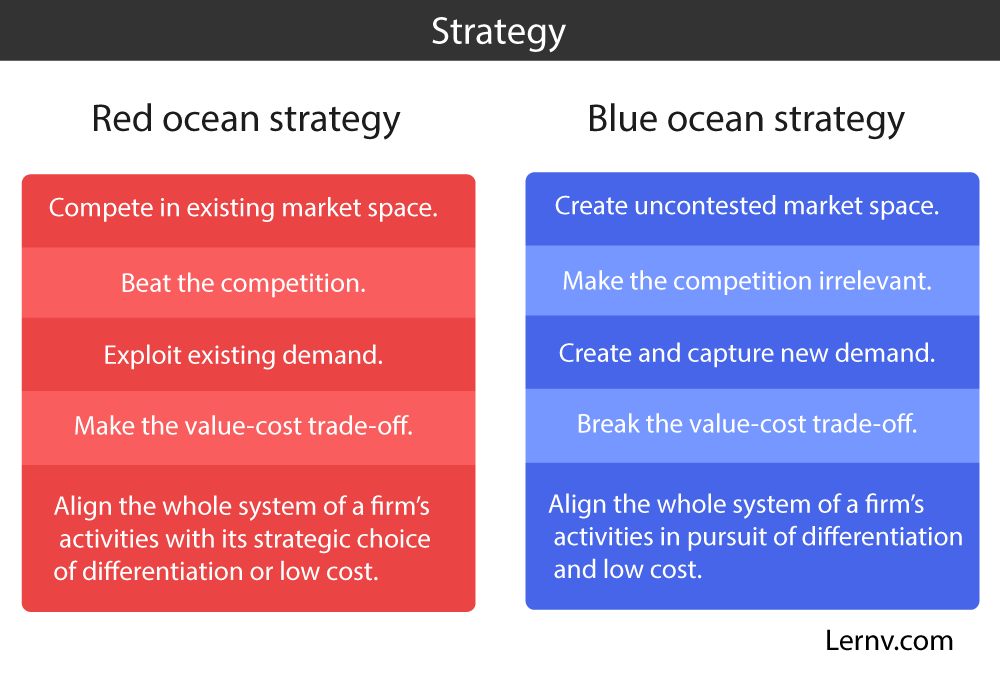
A Red Ocean strategy is about confrontation. It accepts the existing market boundaries and industry structure and focuses on out-executing competitors. You're fighting to be the best in an established field. Think of two major airlines competing on price for the same popular routes.
A Blue Ocean strategy is about creation. It seeks to reconstruct market boundaries and create a new space where there are no direct competitors. The goal isn't to beat the competition, but to make them irrelevant by offering something new and valuable.
| Red Ocean Strategy | Blue Ocean Strategy |
|---|---|
| Compete in existing market space | Create uncontested market space |
| Beat the competition | Make the competition irrelevant |
| Exploit existing demand | Create and capture new demand |
| Make the value-cost trade-off | Break the value-cost trade-off |
| Align the system with differentiation or low cost | Align the system with differentiation and low cost |
The Engine: Value Innovation
The cornerstone of Blue Ocean Strategy is something called value innovation. This isn't just a new feature or a marketing gimmick. It’s the simultaneous pursuit of differentiation and low cost.
Traditionally, businesses believed they had to make a choice: either create a premium product at a high cost or a basic product at a low cost. Value innovation rejects this trade-off. It’s about finding a way to offer a giant leap in value for customers while simultaneously reducing your own costs. You do this by eliminating or reducing features the industry takes for granted and raising or creating features that buyers have never been offered before.
Value innovation is about creating a leap in value for both customers and the company. It makes the competition irrelevant by opening up new and uncontested market space.
Blue Oceans in Action
Let's look at a classic example: Cirque du Soleil. In the 1980s, the circus industry was a red ocean of intense competition. Circuses like Ringling Bros. and Barnum & Bailey competed for a shrinking audience of families with children.
Cirque du Soleil didn't try to build a better circus. Instead, they redefined it. They eliminated costly elements like animal acts, aisle concessions, and star performers. In their place, they introduced elements from theater, ballet, and opera, such as a unifying theme, sophisticated choreography, and original music. This created a new form of entertainment that appealed to adults and corporate clients—people who would never have gone to a traditional circus.
By doing this, Cirque du Soleil achieved both differentiation (a unique, artistic performance) and low cost (by eliminating many of the most expensive parts of a traditional circus). They didn't compete with other circuses; they created their own market and made the competition irrelevant.
Another example is the Nintendo Wii. While Sony's PlayStation and Microsoft's Xbox were in a red ocean battle for hardcore gamers with more powerful graphics and complex controls, Nintendo created a blue ocean. The Wii offered a new kind of value: simple, motion-based gameplay that was fun for everyone, from kids to grandparents. It wasn't as powerful as its rivals, which kept costs down, but it was far more accessible and social. It captured a massive new audience of casual and non-gamers.
The second and more creative approach is the innovative model of entrepreneurial problem solving, which uses techniques that are unknown to the market and that bring advantage to an organization.
These examples show that a Blue Ocean Strategy isn't about being the best in a crowded field. It's about changing the game entirely.