Bloom's Taxonomy Simplified
Introduction to Bloom's Taxonomy
A Framework for Learning
How do we learn? It's a big question, but one way to think about it is by breaking learning down into different types and levels. In 1956, educational psychologist Benjamin Bloom and his team did just that. They created a framework to classify educational goals, known as Bloom's Taxonomy. It's a tool that helps educators and students understand the different stages of learning, from simple memorization to complex creation.
The taxonomy is organized into three main areas, or domains: what we know, what we feel, and what we can do. Thinking about learning in these three categories helps ensure a well-rounded educational experience.
The Three Domains
Bloom identified three distinct domains of learning:
- Cognitive Domain: This is all about knowledge and intellectual skills. It covers how we process information, from recalling basic facts to generating new ideas. It's the “thinking” part of learning.
- Affective Domain: This domain deals with emotions, attitudes, and values. It's about how we feel and what we care about, covering our motivation, appreciation, and enthusiasm for learning. This is the “feeling” part.
- Psychomotor Domain: This domain focuses on physical skills and actions. It involves using our bodies to perform tasks, from simple motor skills like typing to complex ones like playing a musical instrument. This is the “doing” part.
Think of the three domains as a simple breakdown of learning: Head (Cognitive), Heart (Affective), and Hands (Psychomotor).
The Cognitive Domain
Of the three domains, the cognitive one is the most widely used and discussed. It's often visualized as a pyramid, with foundational skills at the bottom and more advanced skills at the top. The idea is that you need to master the lower levels before you can effectively move up to the higher ones.
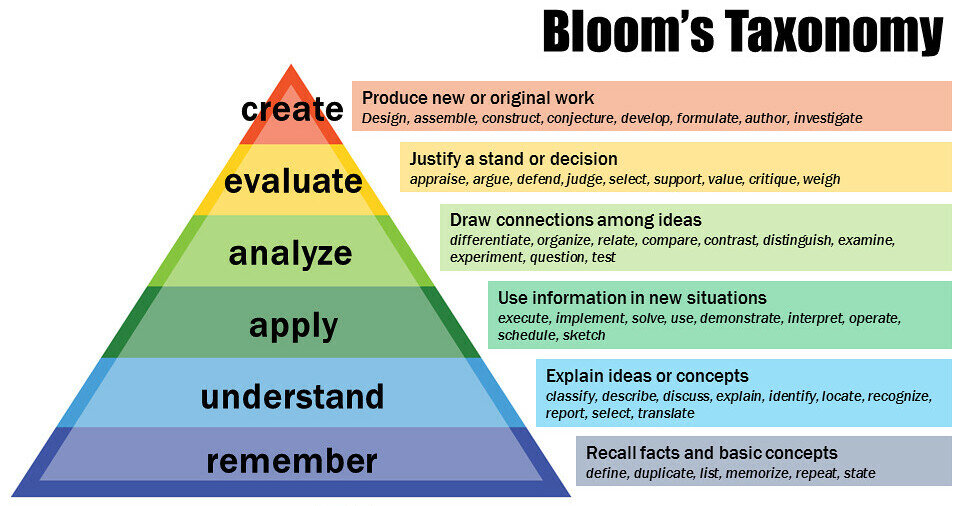
Let's walk through the six levels, starting from the base of the pyramid.
1. Remember This is the foundation of learning. It’s about recalling facts, basic concepts, and answers. Think of memorizing multiplication tables or the names of the planets. It's pure information recall.
2. Understand One step up from remembering is understanding. This means you can explain ideas or concepts in your own words. If you can summarize a book chapter or explain a scientific process, you're operating at the understanding level.
3. Apply Here, you start using the information you've learned in new situations. This could be applying a mathematical formula to solve a new problem or using grammar rules to write a correct sentence.
4. Analyze Analysis involves breaking information down into its component parts to explore relationships. It's about drawing connections and identifying patterns. An example would be comparing and contrasting two different historical events or deconstructing an argument to see how it's built.
5. Evaluate This level requires making judgments and justifying decisions based on criteria and standards. When you critique a piece of art, defend a certain point of view, or decide on the most effective solution to a problem, you are evaluating.
6. Create At the very top of the pyramid is creating. This is where you generate new ideas, products, or ways of viewing things. It involves putting elements together in a new pattern or structure. Writing a short story, designing an experiment, or composing a piece of music are all acts of creation.
The cognitive domain has been the primary focus of most traditional education and is frequently used to structure curriculum competencies, outcomes, assessments, and activities.
Bloom's Taxonomy is more than just an academic theory; it's a practical guide for both teaching and learning. It shows us that true mastery isn't just about knowing facts—it's about being able to use that knowledge in meaningful ways.