Blockchain Transaction Blocks Explained
Introduction to Blockchain
A New Kind of Ledger
Imagine a shared notebook that an entire group of people can write in. Instead of one person holding the notebook, everyone in the group has an identical copy. When someone adds a new entry, it magically appears in everyone else's copy. And once an entry is written, it can't be erased or scribbled out. It's there forever, for everyone to see.
At its most basic level, a blockchain is a digital ledger maintained by a decentralized network of computers.
This is the core idea behind blockchain. It's a digital ledger, or record book, but it's not stored in one place. Instead, it's distributed across many computers in a network. This structure is what makes it a decentralized and distributed system. The main purpose is to create a secure, transparent, and permanent record of transactions without needing a central authority like a bank or government to oversee it.
No Single Point of Failure
Traditional systems, like a bank's database, are centralized. All the data lives on a central server. If that server gets hacked or goes offline, the whole system is in trouble. This creates a single point of failure.
Blockchain avoids this by being decentralized. Because every participant (or "node") on the network has a full copy of the ledger, there's no single point of failure. To take the network down, you'd have to attack thousands of computers at once. To change a record, you'd have to change it on the majority of computers in the network simultaneously, which is practically impossible.
Reaching an Agreement
If no one is in charge, how does the network agree on which transactions are valid and should be added to the ledger? This is solved using a consensus mechanism. It's a set of rules that all participants follow to agree on the state of the ledger.
Two of the most common mechanisms are Proof of Work and Proof of Stake.
Proof of Work (PoW): This is the original consensus mechanism, used by Bitcoin. Participants, called miners, compete to solve a complex mathematical puzzle. The first one to solve it gets to add the next block of transactions to the chain and is rewarded. This process requires a huge amount of computational power, which makes the network very secure but also energy-intensive.
Proof of Stake (PoS): This is a more energy-efficient alternative. Instead of miners competing with computing power, participants, called validators, are chosen to create new blocks based on the number of coins they hold and are willing to "stake" as collateral. If a validator tries to cheat, they lose their staked coins. This incentivizes honest behavior without the massive energy consumption of PoW.
Consensus mechanisms ensure that everyone on the network agrees on a single version of the truth, even without a central authority.
The Digital Fingerprint
The final piece of the security puzzle is cryptographic hashing. A hash function is an algorithm that takes an input of any size and produces a fixed-size string of letters and numbers. This output is called a hash. It's like a unique digital fingerprint for data.
Even a tiny change in the input, like changing a single letter, will produce a completely different hash. This is crucial for blockchain security. Each block in the chain contains the hash of the previous block. This links the blocks together in a secure chain. If someone tried to alter a transaction in an old block, the hash of that block would change. This would cause the hash in the next block to be incorrect, and so on, creating a ripple effect that would instantly signal that tampering has occurred.
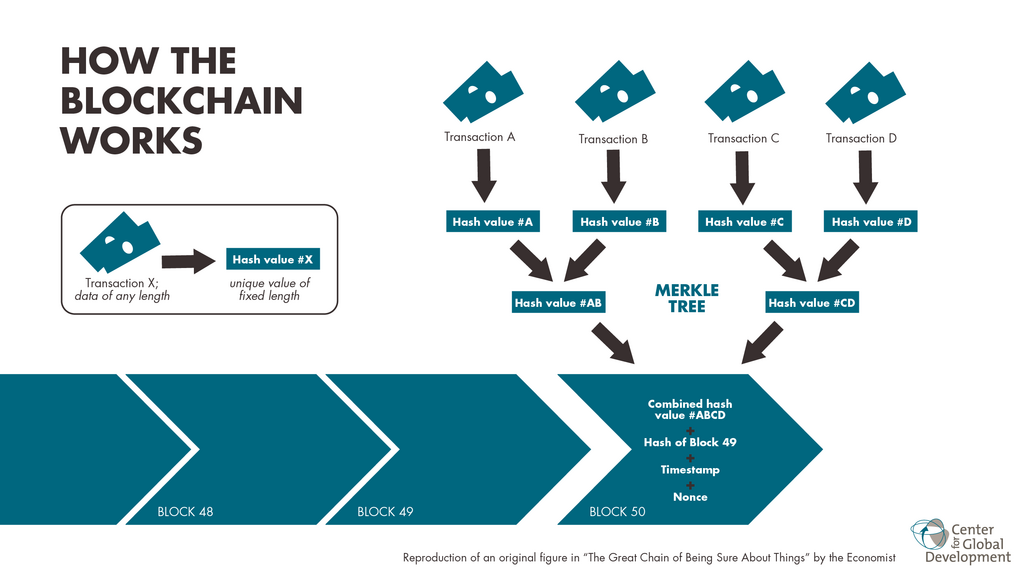
This combination of decentralization, consensus, and cryptographic linking makes the blockchain an incredibly robust and trustworthy system for recording information.
Ready to test your knowledge? Let's see what you've learned about the foundations of blockchain.
What is the primary characteristic of a blockchain that differentiates it from a traditional database, like one used by a bank?
How does cryptographic hashing contribute to the security of a blockchain?
Now you understand the fundamental ideas that make blockchain technology work. It's a distributed ledger, kept in sync by a consensus mechanism and secured by cryptographic hashing.