Blackwork Embroidery Technical Execution
Geometric Pattern Construction
Deconstructing Complex Patterns
Intricate blackwork designs can seem impossibly complex, like a detailed drawing rendered in thread. But look closer, and you'll find a secret: they are almost always built from small, simple, repeatable units. The first step to mastering complex geometric patterns is to train your eye to see not the whole forest, but the individual trees.
Think of it like digital pixels forming an image. A single pixel is meaningless, but thousands arranged in a specific way create a picture. In blackwork, your 'pixel' is a core motif or pattern unit. Your task is to identify this unit and understand how it tessellates—how it fits together with copies of itself—to create the larger design. This analysis is done directly on the grid of your , where each square in the weave acts as a coordinate point.
Path Planning and Scaling
Once you've identified the core unit, the next challenge is stitching it efficiently. This is called path planning. The goal in traditional blackwork is to create the pattern with a continuous line of thread, often making the piece reversible or at least very neat on the back. You're essentially solving a puzzle: how can you trace every line in the unit exactly once, ending where you started or at the edge of the next unit?
This often involves using a double running stitch, also known as the Holbein stitch. You first create the pattern with spaced-out running stitches, then work back along your path, filling in the gaps to create a solid line.
Scaling a pattern without losing its integrity is a matter of simple math. If your core unit is 8x8 threads, you can't just decide to make it 10x10. That would distort the angles and proportions. Instead, you scale by adding more units. To double the size of an area, you would create a 2x2 block of your repeatable unit, making the new, larger element 16x16 threads. All scaling must happen at the level of the unit, not by changing the thread count within the unit itself. This maintains the pattern's geometric structure.
Working with Sub-Grids
As patterns become more complex, you may find that a repeatable unit is itself composed of smaller, symmetrical parts. Thinking in terms of can simplify the counting process. For example, a 16x16 thread unit might be broken down into four 8x8 quadrants. You only need to memorize the path for one quadrant. Once stitched, you can mentally rotate or reflect that path to complete the other three quadrants without having to count out the entire 16x16 grid from scratch for each section.
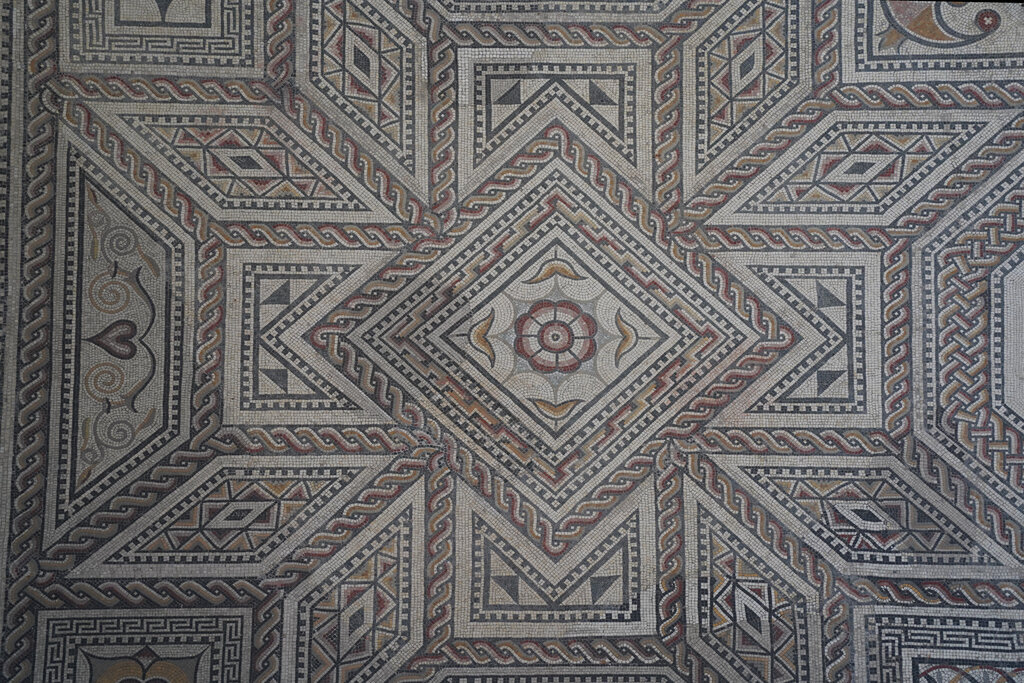
This modular approach is the key to tackling large fill areas. By breaking a huge, intimidating space into a manageable series of identical units, and breaking each unit into even smaller sub-grids, you transform a monumental task into a simple, meditative repetition. Your focus shifts from the entire piece to just the next few stitches needed to complete a quadrant, then a unit, then a row.
What is the foundational principle for executing complex geometric blackwork designs?
The double running stitch, or Holbein stitch, is used in blackwork primarily to...
This structured, analytical way of seeing patterns is the bridge from simple borders to creating stunning, full-coverage geometric art.