Black Oil Reservoir Engineering Fundamentals
Introduction to Reservoir Engineering
What Makes a Good Reservoir?
Not just any rock buried deep underground can hold oil or natural gas. To become a reservoir, a rock needs two special qualities: it must be able to store fluids, and it must allow those fluids to move. These two properties are called porosity and permeability.
Porosity
noun
The measure of the empty space, or pores, within a rock, expressed as a fraction of the rock's total volume.
Think of porosity as the rock's storage capacity. A rock like sandstone is made of tiny grains, and the spaces between those grains are the pores. It's like a jar filled with marbles; the total space between the marbles is the porosity. The more space, the more oil, gas, or water the rock can hold.
But storage is only half the story. The fluids also need a way to travel from one pore to another so they can flow toward a well.
Permeability
noun
A measure of a rock's ability to transmit fluids through its interconnected pores.
Permeability is all about connection. If the pores in a rock are isolated from each other, fluids get trapped. But if the pores are well-connected, they form tiny pathways that allow the oil and gas to move. A rock can have high porosity but low permeability. For example, pumice stone is full of holes but they aren't connected, so water doesn't flow through it easily.
An ideal reservoir rock has both high porosity to store large volumes of hydrocarbons and high permeability to allow them to be produced efficiently.
Rocks Under Pressure
Reservoirs exist thousands of feet underground, where they are under immense pressure from the weight of the overlying rock. This pressure affects not just the fluids, but the rock itself.
Reservoir rocks aren't perfectly rigid. They have a property called compressibility, which means their volume can change slightly when the pressure changes.
Compressibility
noun
The fractional change in volume of a substance per unit change in pressure.
When oil and gas are pumped out of a reservoir, the pressure inside drops. In response, the pore spaces in the rock can shrink a tiny bit, squeezing out more of the trapped fluids. This effect, known as pore volume compressibility, acts like a natural spring that helps push hydrocarbons toward the well.
The fluids themselves are also compressible. While liquids like oil and water compress only slightly, natural gas is highly compressible. As pressure decreases during production, the gas dissolved in the oil expands, which also helps to drive oil out of the rock.
The Fluids Inside
A reservoir typically contains a mix of three fluids: natural gas, crude oil, and saltwater. Because they have different densities, they naturally separate into layers over millions of years. Gas, being the lightest, rises to the top, forming a "gas cap." Oil sits in the middle, and the dense saltwater settles at the bottom.
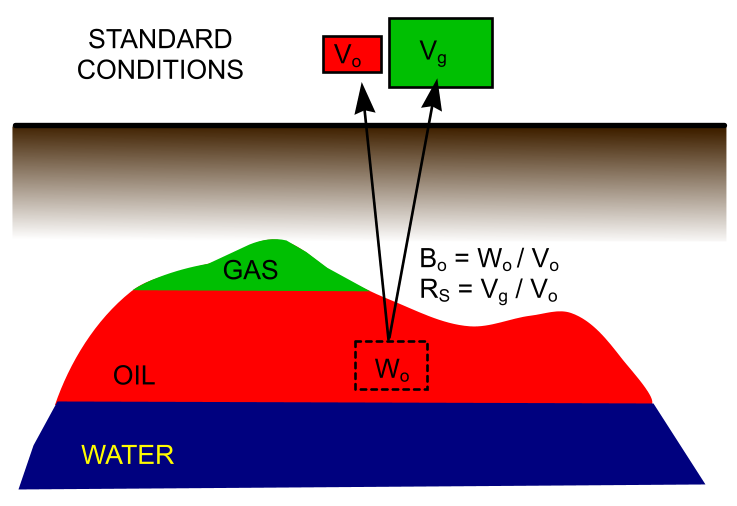
Another key fluid property is viscosity, which is a measure of a fluid's resistance to flow. High-viscosity oil is thick and sticky like molasses, making it difficult to pump out of the ground. Low-viscosity oil flows easily, like water. Temperature plays a big role; oil becomes less viscous as the reservoir gets hotter.
The state of the hydrocarbons—whether they exist as a liquid or a gas—depends entirely on the reservoir's temperature and pressure. This relationship is called phase behavior. A crucial concept here is the bubble point: the specific pressure at which gas begins to separate from the oil, forming bubbles. If the reservoir pressure drops below the bubble point, gas comes out of solution, which can either help or hinder production depending on how it's managed.
Surface Forces
At the microscopic level inside the rock's pores, the interactions between the rock and the fluids are governed by two more important concepts: wettability and capillary pressure.
Wettability describes which fluid—oil or water—prefers to stick to the rock surface. If a rock is water-wet, a thin film of water coats the grains, and oil occupies the center of the pores. If it's oil-wet, the oil sticks to the rock instead. Most reservoirs are naturally water-wet, which is good for oil recovery because the water helps push the oil out of the tight pore spaces.
This preference creates a force called capillary pressure. It's the same force that causes water to climb up a narrow straw or a paper towel to soak up a spill. In a reservoir, capillary pressure is the pressure difference between two fluids (like oil and water) in a tiny pore space. It acts as a barrier that can trap oil, making it harder to recover.
Understanding these microscopic forces is critical for predicting how fluids will flow and how much oil and gas can ultimately be produced from a reservoir.
Which property of a reservoir rock refers to its fluid storage capacity?
A rock can have high porosity but low permeability, making it a poor reservoir.