Black Holes Explained
Introduction to Black Holes
The Ultimate Trapdoor
A black hole is a region of spacetime where gravity is so intense that nothing can escape its pull, not even light. Think about throwing a ball into the air. It goes up, slows down, and comes back. If you throw it faster, it goes higher. If you could throw it at about 11.2 kilometers per second (that's over 25,000 miles per hour), it would never come back. It would escape Earth's gravity entirely. This is Earth's escape velocity.
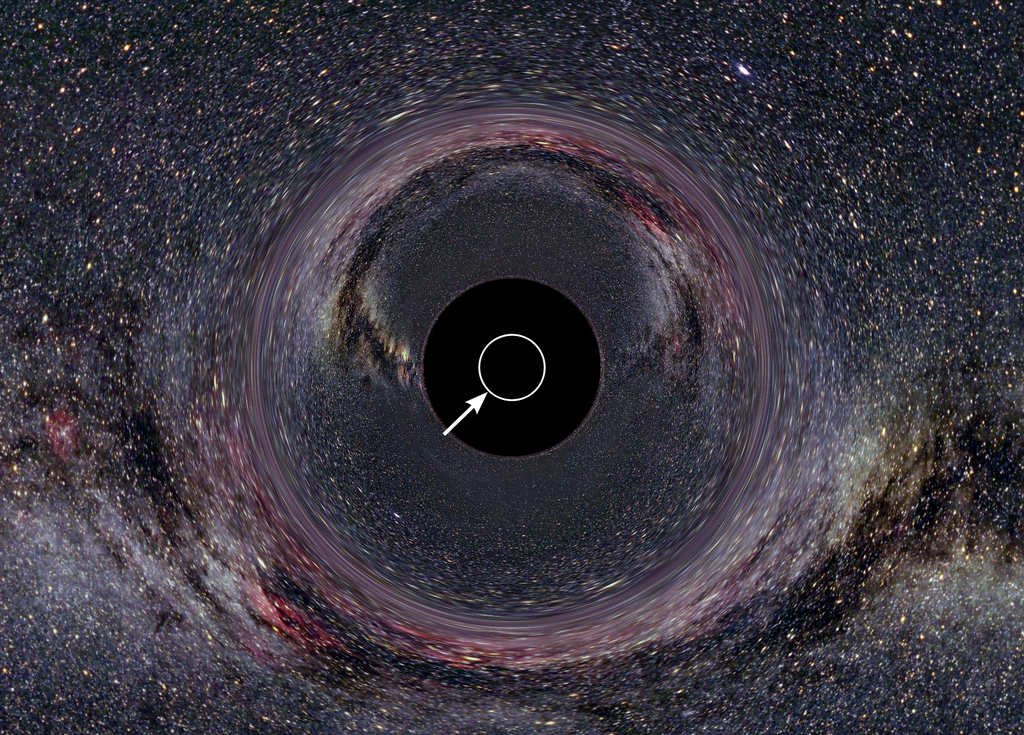
Now, imagine an object so massive and dense that its escape velocity is greater than the speed of light, the fastest thing in the universe. Since nothing can travel faster than light, nothing can get out. It's a one-way trip. Light that falls in is trapped forever, which is why we call these objects black holes. They don't emit or reflect any light of their own, making them appear as voids in space.
singularity
noun
A point at the center of a black hole where the density and gravitational pull are thought to be infinite, and where the known laws of physics break down.
The boundary marking the point of no return is called the event horizon. If you cross the event horizon, you can never get back out. It's not a physical surface you could touch, but rather an invisible border defined by gravity. It's the point where the escape velocity equals the speed of light.
An Idea Before Its Time
The idea of an object with gravity strong enough to trap light is surprisingly old. In 1783, a scientist named John Michell reasoned that if an object were dense enough, its escape velocity could exceed the speed of light, making it invisible. He called these hypothetical objects "dark stars."
A few years later, the French mathematician Pierre-Simon Laplace proposed a similar idea. Both were thinking in terms of Isaac Newton's laws of gravity. But the modern concept of a black hole truly began with Albert Einstein's theory of general relativity in 1915.
Einstein described gravity not as a force, but as a curvature of spacetime caused by mass and energy. Just a few months after he published his theory, a German physicist named Karl Schwarzschild found the first exact solution to Einstein's equations. His math described what we now call a black hole: a point of infinite density, a singularity, surrounded by an event horizon. For decades, many scientists, including Einstein, found the idea too strange to be real. It wasn't until the 1960s that black holes were taken seriously as objects that could actually exist in our universe.
The Three Properties
Despite their complexity, black holes are remarkably simple objects from the outside. Once something falls into a black hole, almost all of its properties are lost forever. According to a principle called the "no-hair theorem," a stable black hole can be completely described by just three properties.
| Property | Description |
|---|---|
| Mass | This is the primary property. It determines the size of the event horizon. More mass means a stronger gravitational pull and a larger black hole. |
| Spin (Angular Momentum) | Most black holes are expected to spin because the stars they formed from were spinning. A spinning black hole drags spacetime around with it, an effect called frame-dragging. |
| Electric Charge | A black hole can have a net positive or negative electric charge. However, in reality, it's expected that most black holes are nearly neutral because they would quickly attract opposite charges to cancel out any charge they have. |
That's it. Any other information about the matter that formed the black hole, like what elements it was made of, is gone. This simplicity makes black holes perfect laboratories for studying the laws of gravity in their most extreme form.
What is the fundamental reason why nothing, not even light, can escape from a black hole?
The boundary around a black hole known as the 'event horizon' is best described as...