Black Holes Explained
Introduction to Black Holes
The Ultimate Gravity Well
Imagine throwing a ball into the air. It goes up, slows down, and falls back to Earth. If you could throw it fast enough—about 7 miles per second—it would escape Earth's gravity and fly into space. This speed is called escape velocity.
A black hole is an object where the escape velocity is greater than the speed of light. Since nothing in the universe can travel faster than light, nothing that crosses a black hole's boundary can ever get out again. It's a one-way trip.
A black hole is a place in space where gravity pulls so much that even light can not get out.
They aren't cosmic vacuum cleaners sucking everything up. You could orbit a black hole from a safe distance just like you orbit the Sun. It's only when you get too close that its extreme gravity becomes inescapable.
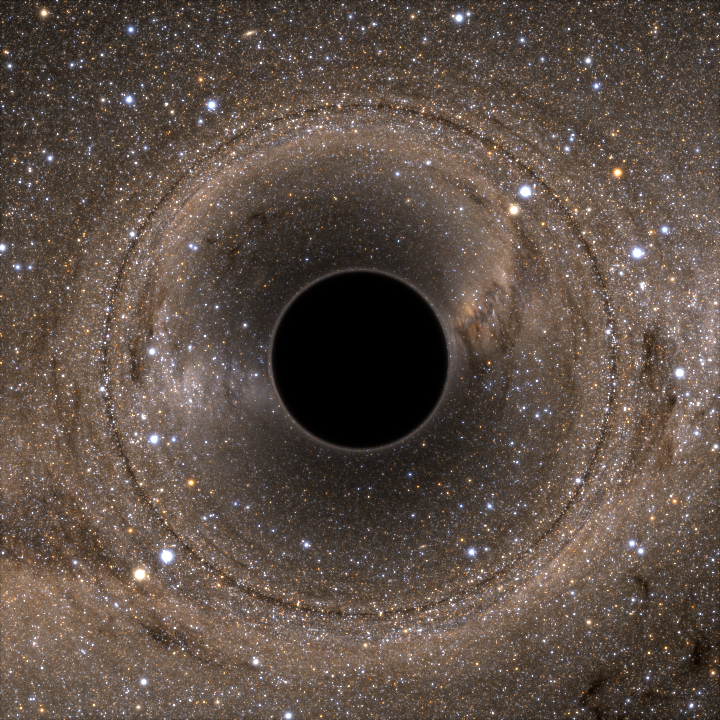
An Idea Before Its Time
The concept of an object so massive that light couldn't escape is surprisingly old. In the late 1700s, scientists John Michell and Pierre-Simon Laplace independently reasoned that such a "dark star" could exist, based on Newton's laws of gravity.
But the modern idea of black holes comes from Albert Einstein's theory of general relativity, published in 1915. His theory described gravity not as a force, but as a curvature of spacetime caused by mass and energy. Just a few months later, a German physicist named Karl Schwarzschild found the first exact solution to Einstein's equations. His math described the spacetime around a single, non-rotating sphere of mass and, buried within the numbers, it predicted a region from which nothing could escape.
For decades, this prediction was considered a mathematical oddity, not a real physical possibility. Many physicists, including Einstein himself, were skeptical that such objects could actually form in the universe.
It wasn't until the 1960s that the idea gained traction, thanks to advances in theoretical and observational astronomy. Physicist John Wheeler finally coined the memorable term "black hole" in 1967, and it stuck.
Anatomy of a Monster
Black holes are defined by two key parts: the event horizon and the singularity.
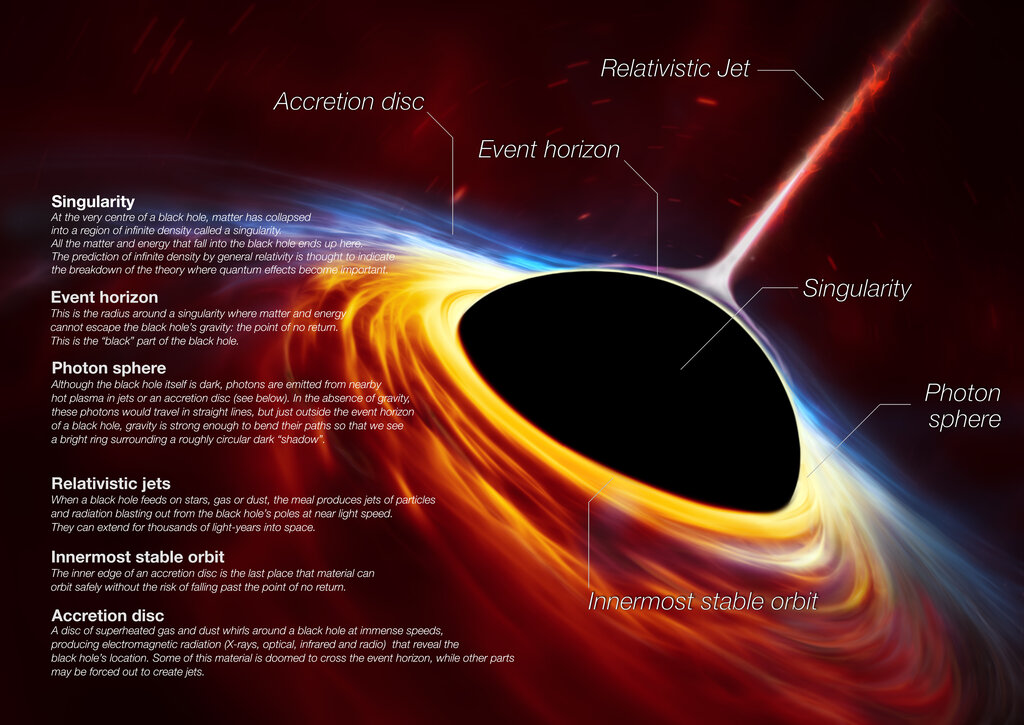
The event horizon is the black hole's boundary. It's not a physical surface you could touch, but rather the point of no return. Anything that crosses the event horizon—a star, a planet, or a beam of light—is trapped forever. It's like going over a waterfall in a canoe; once you pass the edge, there's no paddling back.
Event Horizon
noun
The boundary around a black hole beyond which no light or other radiation can escape.
At the very center of the black hole lies the singularity. This is the point where all the matter that has fallen into the black hole is crushed into an infinitely small, infinitely dense point. Our current laws of physics, including general relativity, break down when trying to describe what happens at a singularity. It represents a frontier of modern science.
Singularity
noun
A point at the center of a black hole where matter is crushed to infinite density and the concepts of space and time cease to exist as we know them.
Cosmic Engines
Black holes are more than just cosmic oddities; they are fundamental to the workings of the universe. They serve as extreme laboratories for testing our understanding of gravity and the nature of spacetime itself. When black holes collide, they send out ripples in spacetime called gravitational waves, giving us a completely new way to observe the cosmos.
Furthermore, supermassive black holes, millions or billions of times the mass of our Sun, are found at the center of nearly every large galaxy, including our own Milky Way. These giants play a crucial role in how galaxies form and evolve over billions of years, regulating star formation and shaping the structures we see today.
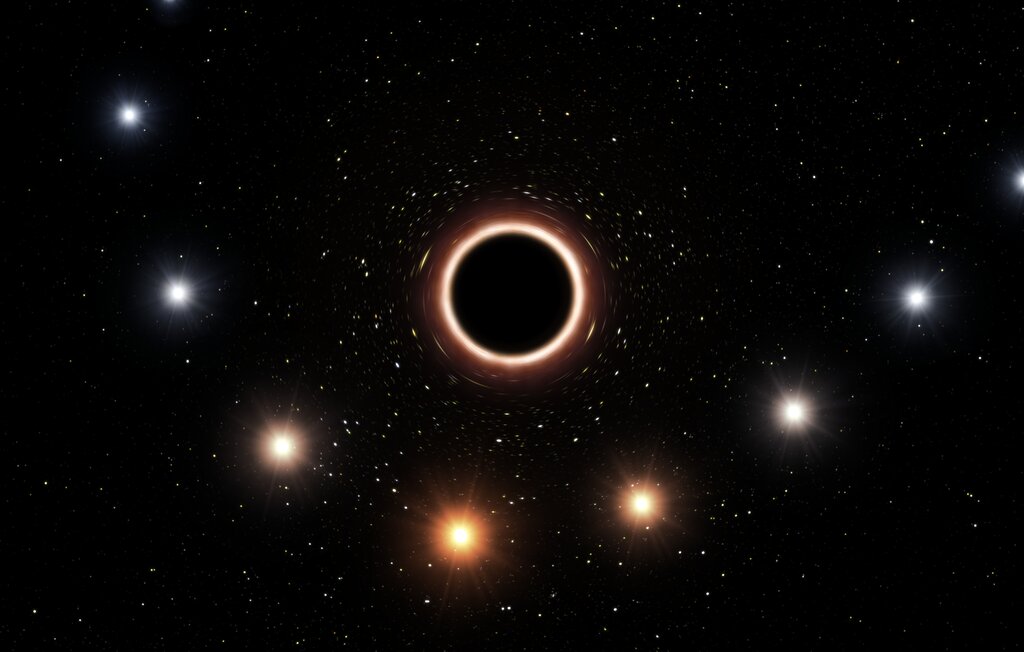
Let's review the core concepts we've covered.
Ready to test your knowledge?
What is the defining characteristic of a black hole?
The 'point of no return' for a black hole, beyond which nothing can escape, is called the...
By studying these enigmatic objects, we learn not just about the endpoints of stars, but about the very fabric of space and time.