Black Holes Explained
Introduction to Black Holes
The Ultimate Trapdoor
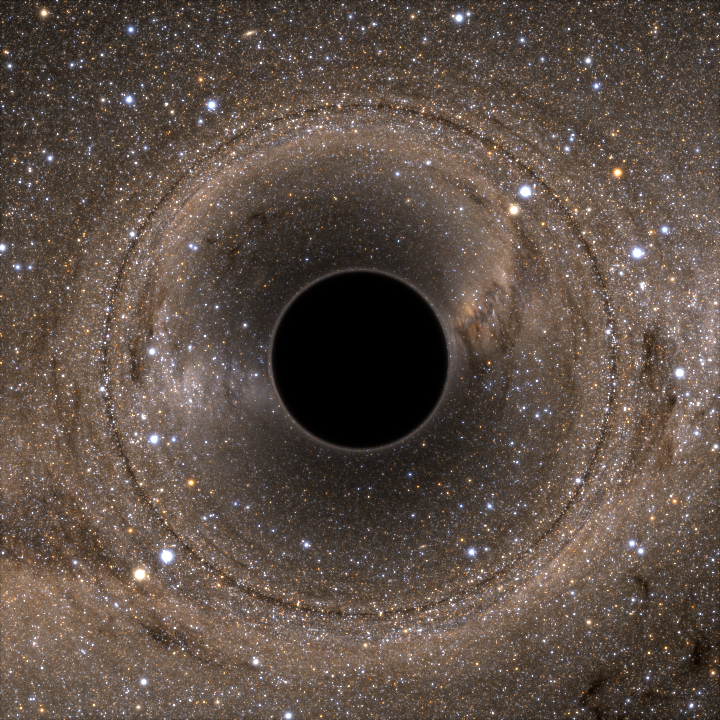
A black hole is a region of space where gravity is so powerful that nothing can escape its pull. Not matter, not radiation, not even light itself. It's the ultimate one-way street in the universe.
To understand this, think about escape velocity, the speed you need to break free from a planet's gravity. For Earth, that's about 25,000 miles per hour. If you could cram all of Earth's mass into a sphere just half an inch wide, its escape velocity would become greater than the speed of light. Since nothing can travel faster than light, nothing could ever leave. That's a black hole.
A black hole is a celestial body or simply a place in space where the gravitational pull is so high that nothing, not even light can escape it.
Because they trap light, black holes are invisible to our eyes and telescopes. We can only detect them indirectly, by observing their effects on nearby stars and gas, or by picking up the gravitational waves they create when they collide.
An Idea Before Its Time
The concept of an object so massive that light couldn't escape is surprisingly old. In 1783, the English natural philosopher John Michell first proposed the existence of what he called “dark stars.” A few years later, the French mathematician Pierre-Simon Laplace had a similar idea. But without a solid theory of gravity, these were just interesting thought experiments.
Everything changed with Albert Einstein's theory of general relativity in 1915. Einstein showed that massive objects don't just pull on things; they warp the very fabric of spacetime. Gravity, he argued, is this curvature. Just a few months after Einstein published his theory, a German physicist named Karl Schwarzschild found the first exact solution to his equations. It described the spacetime around a single, non-rotating spherical mass, and it contained a strange prediction: if enough mass were packed into a small enough space, it would create a region from which escape was impossible.
For decades, this idea was treated as a mathematical curiosity. It wasn't until the 1960s that scientists began to take it seriously, and the physicist John Wheeler finally coined the memorable term “black hole.”
Anatomy of a Black Hole
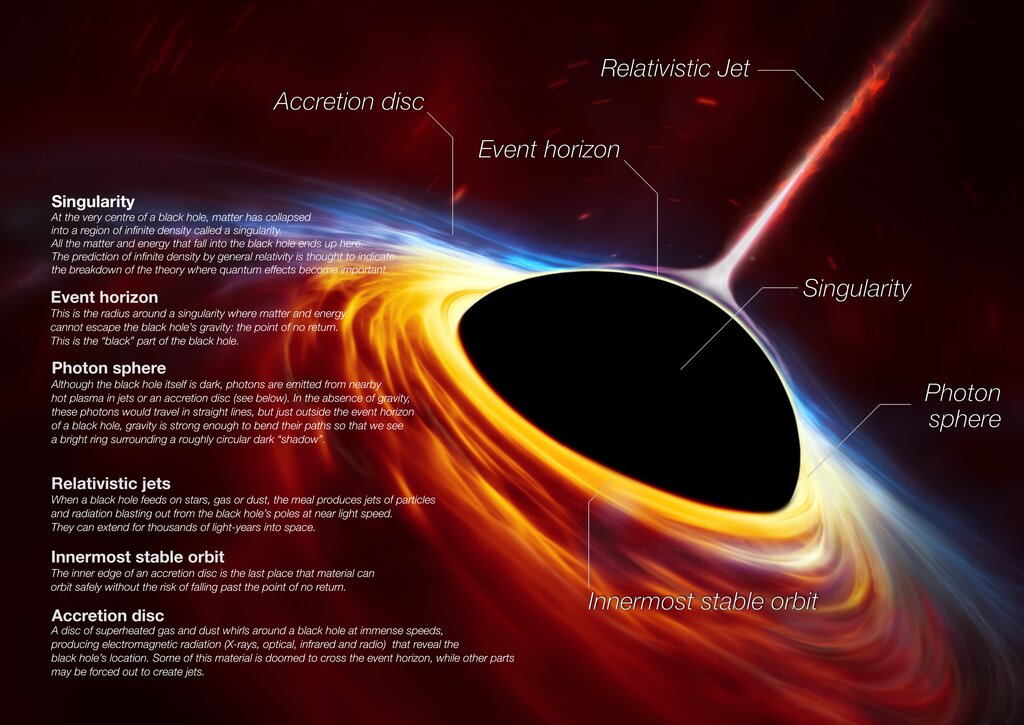
Black holes are defined by two key features: a singularity at the center and an event horizon surrounding it.
The singularity is a one-dimensional point where the laws of physics as we know them break down. It's where the mass of the black hole is concentrated into a region of infinite density.
Surrounding this point is the event horizon. This isn't a physical surface you could touch; it's the boundary marking the point of no return. Once anything crosses the event horizon, it is forever trapped by the black hole's gravity. It’s the edge from which the escape velocity equals the speed of light.
event horizon
noun
The boundary around a black hole beyond which events cannot affect an outside observer. It is the point where the gravitational pull becomes so great as to make escape impossible.
Why They Matter
Black holes are more than just cosmic oddities. They are fundamental to our understanding of the universe. Supermassive black holes, millions or even billions of times the mass of our sun, are believed to reside at the center of most large galaxies, including our own Milky Way. Their immense gravity plays a crucial role in how galaxies form and evolve.
They also serve as extreme laboratories for testing the limits of physics. The conditions inside a black hole push both general relativity and quantum mechanics to their breaking points, hinting that a more fundamental theory of “quantum gravity” is needed to fully describe what happens there. By studying them, we learn about gravity, spacetime, and the ultimate fate of matter.
Time to check what you've learned.
What is the defining characteristic of a black hole?
The boundary around a black hole marking the 'point of no return' is called the ______.
From historical ideas to their modern significance, black holes represent one of the most fascinating subjects in astrophysics, challenging our understanding of the cosmos.