Black Hole Physics and Mechanics
Stellar Collapse
The Tipping Point of Gravity
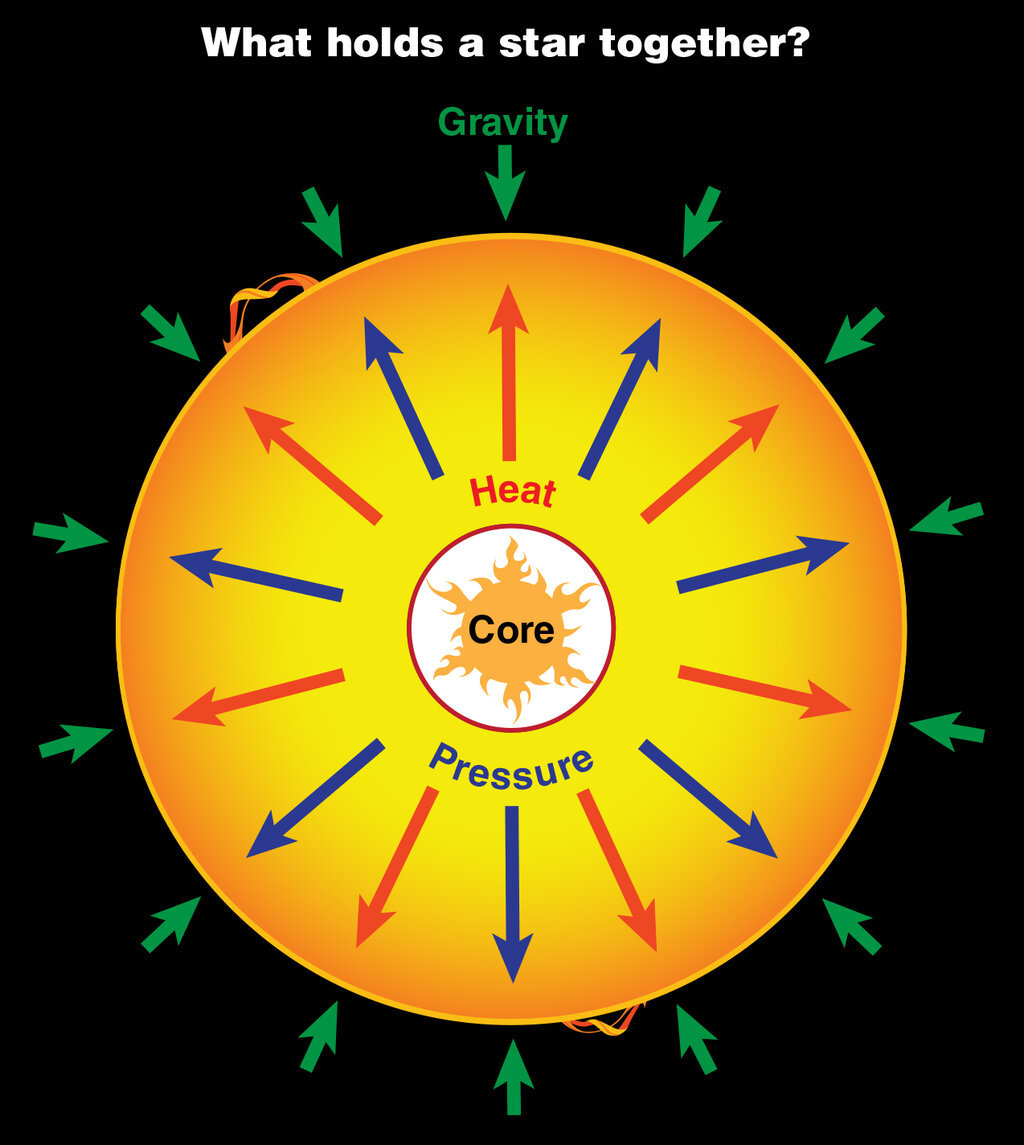
The life of a massive star is a constant battle. Outward pressure from nuclear fusion in its core pushes against the relentless inward crush of its own gravity. For millions of years, these forces are in balance. But when the star exhausts its fuel, fusion stops. Gravity gains the upper hand, and the star's core begins to collapse catastrophically.
For stars up to about 8 times the mass of our Sun, the collapse is halted by electron degeneracy pressure, creating a stable white dwarf. The maximum mass a white dwarf can have before this pressure fails is known as the (about 1.4 solar masses). But what happens in stars far more massive than that, where the collapsing core itself exceeds this limit?
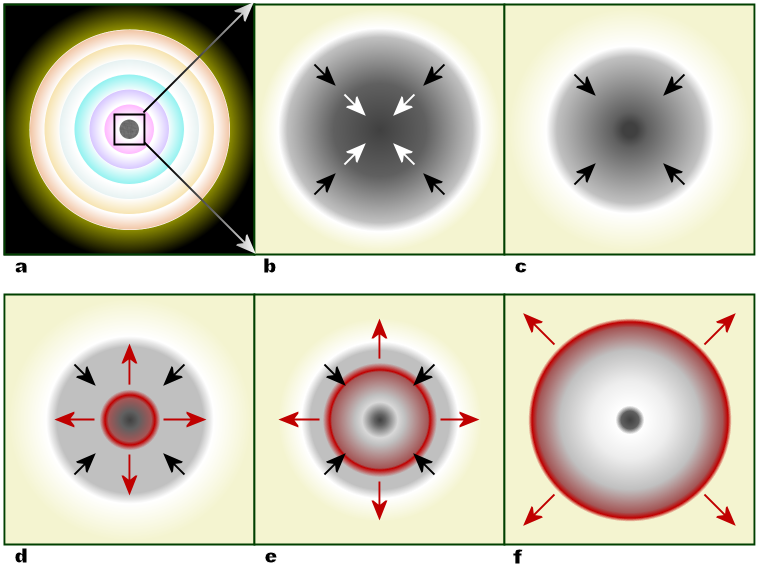
In truly massive stars, those over 8-10 times the Sun's mass, the core collapse is so violent it triggers a explosion. As the core implodes, protons and electrons are squeezed together to form neutrons and neutrinos. The core becomes an incredibly dense ball of neutrons, and the outward-rebounding shockwave from this sudden halt blows the star's outer layers into space.
Beyond the Neutron Star
The collapsed remnant at the heart of the supernova is now a proto-neutron star. It's supported against further collapse by a quantum mechanical force called —a powerful repulsive force that prevents neutrons from being squeezed into the same space. This pressure creates a stable neutron star, a city-sized object with the mass of a sun.
However, this defense has its limits. If the initial star was massive enough, the remnant core will be too heavy for even neutron degeneracy pressure to support. This critical threshold is known as the Tolman-Oppenheimer-Volkoff (TOV) limit. While the exact value is still being refined by physicists, it's estimated to be between 2 and 3 solar masses.
When the core's mass exceeds the s, gravity wins definitively. The core collapses indefinitely, crushing matter out of existence and warping spacetime so severely that nothing, not even light, can escape. A stellar-mass black hole is born. The boundary of this point of no return is the Schwarzschild radius, an imaginary sphere around the singularity.
The Mass Gaps
Observations of compact objects in the universe have revealed curious voids. There appears to be a 'lower mass gap' between the heaviest known neutron stars (around 2.5 solar masses) and the lightest known black holes (around 5 solar masses). It's unclear why nature seems to avoid creating objects in this range. Is there a sudden jump from neutron star to black hole, or are these objects just incredibly hard to detect?
Similarly, an 'upper mass gap' exists between roughly 50 and 130 solar masses. Current models of stellar evolution suggest that stars in this mass range undergo a process called a pair-instability supernova, which blows the star completely apart, leaving no remnant behind—no neutron star, no black hole. Black holes above this gap must therefore form through different means, such as the direct collapse of even more massive stars or through the merger of smaller black holes.
From a star's final moments to the edge of a black hole, the laws of physics are pushed to their absolute limits. The collapse of a star is not just an ending, but the birth of one of the universe's most extreme and mysterious objects.